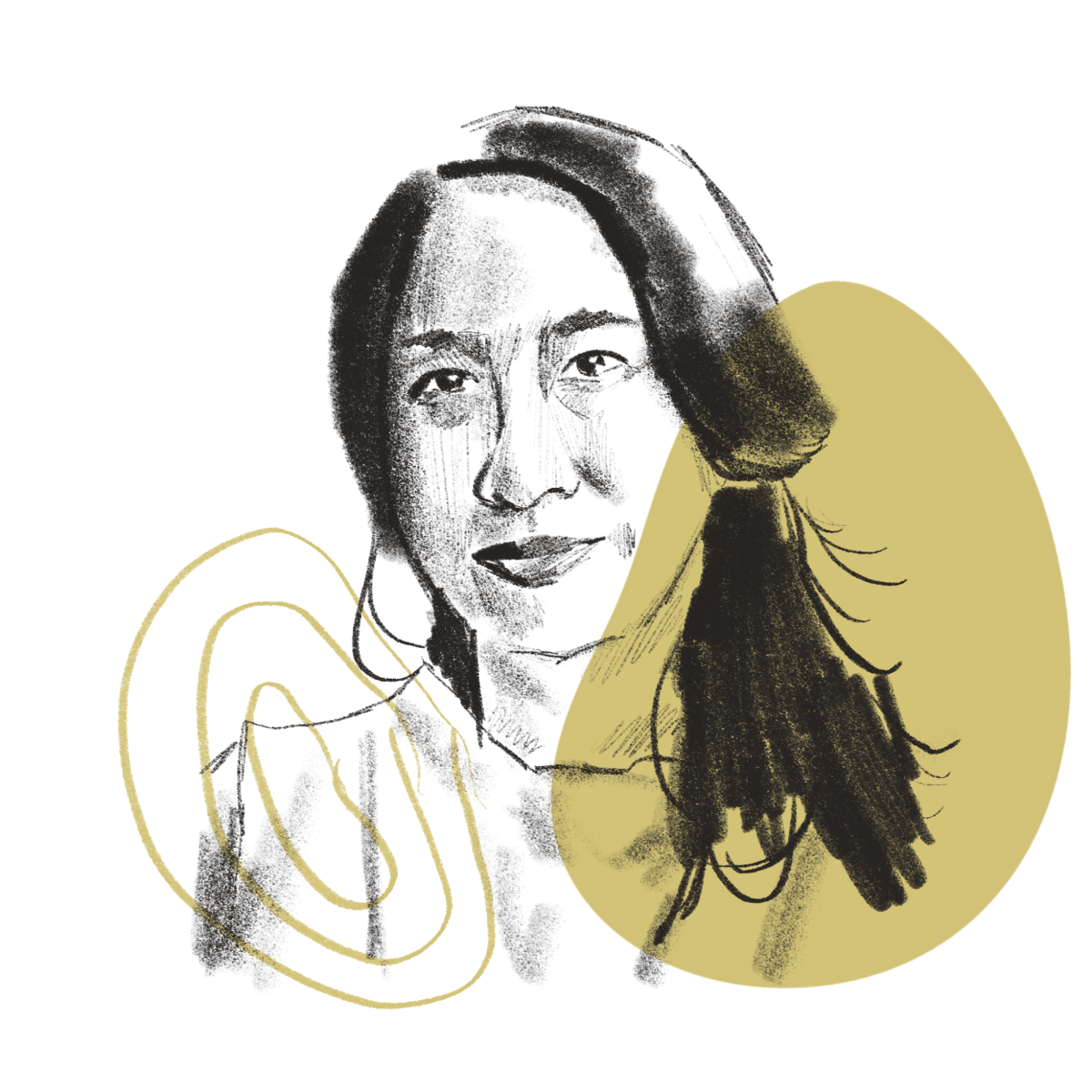
On Oct. 14, 2026, author and journalist Dr. Ava Chin addressed the student body for the Mark J. Bebie ’70 Memorial Lecture. Dr. Chin, a fifth generation Chinese American, is the author of Mott Street: A Chinese American Family’s Story of Exclusion and Homecoming, a memoir about her family history in New York and the repercussions of the Chinese Exclusion Act. Tatler sat down with Dr. Chin for a conversation about immigration, family, and the story behind her writing.
This interview has been edited for clarity and length.
Deniz I. ’28 (DI): You’ve said before that you were motivated to write Mott Street because of not having known your father well as a child. Was there a moment that led you at last to decide to write Mott Street?
Ava Chin (AC): Yeah, so I have always wanted to write this story. I always wanted to be a writer, but when I was really young, I was surrounded by stories, family secrets, mysteries that could not be answered when I was a child, but I always wanted to know. I grew up estranged from my father. I didn’t know who he was; I just heard all these rumors about him and his family, but I didn’t really know what the truth was, and I couldn’t know what the truth was until I became an adult. … And when somebody that important is unknowable to you, they can grow in epic proportions, because you can project so many things of “What was he like? What would it be like when we met each other? Would we like each other? Would he recognize me, or would he be rejecting all over again?” I had a lot of fears around it, and also I kind of felt like, “Well, he’s the adult – shouldn’t he be the one to do the reaching out?” So for a long time, it was hard; also, the family who raised me, I knew they would be upset when I met him. And so I didn’t want to rock the boat, because that’s the only family that I knew.
But at a certain period in time, there were a series of events that happened that brought me in touch with my half-sisters — his daughters from his first marriage, my mother was the second — that then led to my meeting them, and then … him, for the first time. [I]t was during that first meeting that I realized — and you’ll hear me tell the story about what happened when we finally met — and that opened the door to a much larger story that included not just my father and myself, and not just our two families, as they lived as upstairs-downstairs neighbors in the same tenement apartment building, in the same community, and it made me realize that both sides of my family were representative of other Chinese American families that had to negotiate with much larger forces. Those larger forces were the weight and the scrutiny of the U.S.’s first federal immigration restrictions, which were against Chinese — legal Chinese immigration to the United States. There were all these other mysteries too, like, “Why did the mail come to my grandparents’ house, the grandparents who raised me, and why did the mail come to my grandfather under a different name? And was he illegal? I hated that term, I still do; how can a person be illegal? Was he living here under a false identity? How did these things happen when my grandfather’s grandfather worked on the nation’s first transcontinental railroad in the 1860s and, you know, built the apparatus that helped make the country great? How could this happen? Then the other thing was that I’m [a] fifth-generation [immigrant], and my family has been in the country since the 1860s. How was it that I didn’t meet more Chinese Americans like myself on the East Coast? There are more people like me on the West Coast, but very few people like my family on the East Coast. And why were people — other people who are not Asian — always asking me where am I from, as if I wasn’t really an American, and then I realized that all of these things were interrelated. And so the book is about how I uncover this larger legacy of exclusion that my family members and other Chinese Americans had to navigate. And it tells a larger story, I think, about, I would say, the Asian American condition as well.
… I had always had in the back of my head that this was a story I needed to tell, but I had to battle a lot of fears. Some of my biggest fears were “oh, there are people who don’t want to talk to me, and who am I to just come up and talk to them and ask them questions and dig around and write this story? Like, who am I?” I had too many insecurities about who I was in relation to the story.
… There were a series of seemingly random events that conspired, that all happened in the same year, that made me realize this is something. The first thing was a writer from The Forward newspaper, which is a Yiddish newspaper, an old Jewish newspaper from the Lower East Side of New York City — a writer from The Forward reached out to me about the work that one of my ancestors, an uncle, had done in the Chinese community working to raise money to help Jewish pogrom victims in 1903. … That went counter to the things I thought I understood about that period. I thought that Chinese people were suffering and laboring in the United States in the early part of the 20th century, and they couldn’t help themselves, much less other people, but here was an instance where my family members were in a good enough financial position to help other people, and people [who were] non-Asians. … And then there was an exhibit at the New York Historical Society — it’s now called the New York Historical — and that exhibit was called Chinese American: Exclusion/Inclusion. And in that exhibit, there were documents that were connected to my family. That same group of that uncle and his crew of friends, they actually tried to fight for our civil rights. During the exclusion period, Chinese people were not naturalized; there was no path for citizenship, and each 10 years, the government just made it more restrictive, so they were like, “you have to carry documents with you, identification papers, and anybody could stop you and ask you for those identification.” Not just the police, any citizen of the U.S. could stop you and say, “Where are your papers? Show me your papers,” and if you didn’t have your papers, they could deport you. And Chinese people were the only people who had to carry this identification, and so when that happened, my family members banded together with other people. They found allies in the children of famous abolitionists in Boston. They worked with Irish clergy in Brooklyn, Black pastors in Harlem who spoke out against these laws. They tried to gather signatures and present it before Congress to argue how this law should be amended. They ultimately did not win, or they won a little, and then things just continued. But I didn’t realize that their protests and the way they organized had even happened. So this is — these were stories that kind of ran counter to the ways in which we understand Asians in America. And so when those two things happened, … I was like, “there’s a much larger story here, and I have to do this.” It was a period in time in which that older generation, my father’s generation and his uncles, were passing away. So I realized that I needed to interview them before I couldn’t get the story anymore. And that’s when I made it my mission to collect these stories. I collected documents, I went to China on a Fulbright and did research there despite my lack of literacy and language skills. I just did it; I just faced my fears.
… If you’re going to ask me a question of what advice I could give to young student writers, it would be to start asking those questions of family members and friends of family members … now, because there will come a time where you’re not going to be able to get the information. And I’m enormously thankful … enormously grateful for the young Ava Chin that I was who would ask all those pesky questions of the adults, and who would interview my family members with a tape recorder.
DI: You’re also a professor of topics that include Biography and Memoir at the City University of New York. What advice do you give to your students, and does that relate to your own work?
AC: So I teach in Biography and Memoir, and … we have a master’s program in International Migration Studies, so I’ll be teaching, immigration narratives to those master’s students. [W]ith my master’s students, many of them have ideas for books they want to write, but a lot of times they have a book idea that they really want to write that they’re not telling anybody about, and it’s the story that scares them the most. … So I would say, keep an open mind and know that you can change your mind. Sometimes the story you think you’re going to tell, once you start doing the research, once you start interviewing people, once you start spending a lot of time thinking about it and talking to other people about it, … sometimes is a different story than what you thought it was going to be. You have to be flexible. And also, nobody’s perfect, and I think it’s in making the mistakes and also — I do this a lot in my writing — I write about myself, I use myself as your narrator, and I write about the things, how I thought about something, whether it was right or wrong, and I let myself be vulnerable on the page so that there is kind of an arc, so that the rest of the book is about what I’m learning, how through the experience of talking to people and interviewing them, I actually learn different things and I change my mind, and that that’s okay, and that’s actually part of learning. I think one of the most difficult things about life right now, aside from crazy political things that are going on all around us, but just on a day-to-day basis, because everything’s recorded, … nothing ever goes away on the internet. Do people use Snapchat anymore?
DI: I think so.
AC: Well, it doesn’t really disappear. It’s going somewhere. And so I think that sometimes it can paralyze you because you feel like you need to be really ‘on point’ all the time, or you have a persona that’s created when you’re younger, and then what happens when you outgrow that, or you try something new? … People have their ideas about you that are really based on the younger version of yourself, and that’s where things can become problematic. So I think that one of the things [that] I struggled with was just this idea that to get everything right, I had to be perfect. And in fact, no, you do the best you can!
DI: On the topic of family pressures, which resonated with me as a child of immigrants myself, I found it remarkable that your story is one of a fifth-generation Chinese American. What have you learned in your research about how culture and family tradition are preserved after immigration, and what did you find about your family in this process?
AC: What did I come to understand about my family through the process of working on this book about the idea of culture as it continues within families from generation to generation? [I]t’s a good question. It’s almost very difficult to answer, but I’ll say — because sometimes it’s like, there are expectations. People have expectations about, like, “What is it like in your family during Thanksgiving?” You know, it’s like, “We eat turkey like everybody else.” But also, we like to turn the turkey bones into congee, into juk, into rice soup, and that actually is way better than the Thanksgiving meal. … But being fifth-generation, there can be a way that, I think, you can almost never be sure if some of the things, some of the inherited cultural practices, are from a sense of “Chineseyness,” if it’s actually very Chinese, or if it’s just your family’s interpretation of said ritual. I will say that one of the more interesting things I noticed is that there’s a way that Chinatown is like a microcosm and a time capsule — New York’s Chinatown, and probably Chinatowns across the country, and the Chinese diaspora around the world — where people speak dialects and languages that are imperiled in mainland China itself, but people still speak these dialects and languages. Unfortunately for me, the sad part is that … my mother never really spoke Chinese, and then because my mother spoke Chinese, I didn’t speak Chinese. But then I picked up some of the language when I got older; I’m not very good at all. [T]hat loss of language is something that I’m always lamenting because as a writer, it’s all about language and vocabulary. It’s within language that culture perpetuates. We have a lack of Chinese language skills in my generation now, but the thing that we do have is the ways in which the influence of the Chinese grandmothers and great-grandmothers who came before me — it’s all in the food and the ways that food is prepared. Sometimes, doing the research was difficult because I wanted to get the women’s stories, and it’s very hard. [S]ometimes, things are oral stories that aren’t written down. But what I realized is people would remember, like, “oh, Great-Aunt Elva used to bake Christmas cakes and ship them from Brooklyn to Hong Kong, you know, and the family in Hong Kong would get these cakes.” People remembered certain things about them, and it was those details, I think, where a lot of the culture is passed down. So even if you’ve lost the family language, there’s other ways that family speaks languages.
DI: I’ve seen that your book, which also discusses the Chinese Exclusion Act and its monumental historic impact, was timely during the epidemic of anti-Asian hate crimes. And now, though, during the second Trump administration’s efforts —
AC: It’s even more timely due to the kind of retrograde view of immigrants that some people in power have. So yes, it was — as I was working on the book, I had this idea from long before Trump was elected president even the first time. So I start working on the book, in earnest, and I make it my sole focus, and the book just kept getting more and more relevant as the years went by with the first Trump presidency, Covid pandemic, the way that … Trump was awful and really mishandled Covid. … But we know that when it comes to epidemics — you know, AIDS epidemic, other epidemics — the impulse is to, like, “Where’s the country of origin? Who’s that person zero that started it?” But health officials know that it’s really not about casting blame. It’s about “how are we going to come together and get rid of this, and how are we going to fight this?” But because Trump handled it the way it did, it also created scapegoating and anti-Asian violence. And that was something that was really disheartening for me to see. I actually, with a friend, created this self-defense group where we taught other people how to do self-defence: elders, women, queer folks. We created this organization called Sisters in Self-Defense, and we were all artists, too, so it was kind of like an arts collective in a way. But we all still see each other regularly.
DI: What parallels do you see between the moment of the Chinese Exclusion Act in history and our present moment of the Trump administration with their own, as you said, retrograde views?
AC: I feel like the Trump playbook when it comes to immigration is really echoing what has come before us. And I think that politicians like Trump know that immigration is a hot-button issue that people have knee-jerk reactions to, and that it can stoke nativism, populism against groups of people that populists see as outsiders. And this was a very dangerous thing that happened in the 19th century against Chinese, and I feel that it’s up to people like me to call it out, and also to call it out so that other nationalities who are being targeted are protected or not at risk.
DI: Is there something else that you would like members of the Lakeside community to be left with on the subject?
AC: [D]uring Covid, when I was working on the book, one of the things I really drew solace from was knowing that my family members had lived through this period of great anti-immigrant, anti-Chinese sentiment, but that there were still things that they could do both coming together, building coalitions with other people outside of the Chinese community. They had white allies who knew that what was happening was wrong. And so I draw great solace knowing that when people come together, and when people sort of talk about their grievances and really start to see life from a different point of view. And that includes reading books that are banned and not banning books. … But also, learning through literature and learning through history how people lived their lives under great duress, that offers me a path forward. I hope that students can find solace in those things as well, and each other. The other thing I would say is that nothing stays the same. Everything’s always changing, so even if it feels like it’s never going to get better, it will. We all just have to roll up our sleeves and work on it. And the adults really have to get their act together!