The National Science Bowl is a prestigious nationwide competition held by the U.S. Department of Energy for teams of middle and high school students. Groups of four competitors, plus an alternate for each team, use quiz bowl-style buzzers to answer toss-up questions from six different scientific fields. After answering a toss-up correctly, a team receives 4 points and a bonus question worth 20 points. Science Bowl tests participants’ reflexes with prescient and quick buzzes, and their scientific acumen with formidable questions. In recent years, Lakeside has been a new yet rapidly rising presence in the Science Bowl sphere, from making national quarterfinals in 2024 to reaching fourth place in 2025.
This year, returning competitors Vishnu M. ’26, Emma L. ’27, and William W. ’27 were joined by new teammates Sara L. ’28 and James Y. ’29. Tatler sat down with the intrepid students and their coaches, chemistry teacher Jon Russell and math and computer science teacher Michele Lombardi.
The road to the national competition began one frigid February weekend at the Pacific Northwest Regional Science Bowl, held at Columbia Basin College in Pasco, Washington. Going into regionals, the teammates faced high expectations of their own and from the Science Bowl community. Because of Lakeside’s victory at the MIT Science Bowl invitational in November — when Emma outbuzzed an International Biology Olympiad competitor —
team captain Vishnu recalls that “there was a lot of pressure to sort of keep performing at our level.” Despite their worries, the Lakeside team rose to the pressure at regionals. Even with two hair-raising wins by the last question in the double-elimination and final rounds, Lakeside remained undefeated and scored victories over up-and-coming teams to qualify for the National Science Bowl.
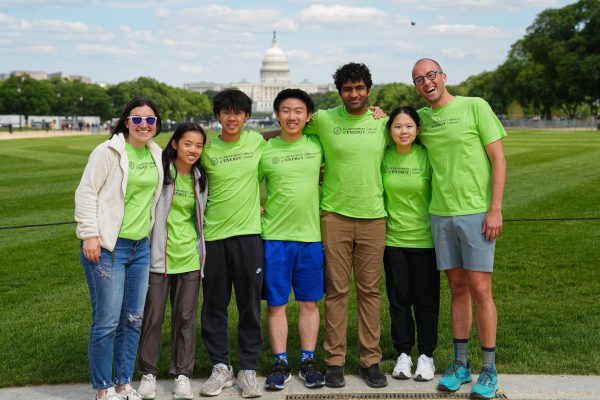
Lakeside’s trip to the National Science Bowl in Washington, D.C., which Ms. Lombardi characterized as “a jam-packed weekend,” began on Thursday with a flight to Dulles International Airport that arrived “barely in time for dinner.”
After that came “Science Day” on Friday morning, when researchers from the Department of Energy’s National Laboratories presented their work to Science Bowl participants. Dr. Russell enjoyed hearing from Jackie Chen of the Sandia National Laboratory about her research into fluid dynamics in combustion, which could provide a bridge to sustainable fuels in the future. Similarly to the past few years, a theme in these presentations was the advancements AI has made in various fields of study. Dr. Russell recalls, “One of the most powerful takeaways was seeing a little bit past the sometimes-illusory nature of LLMs … to what advances in data science and machine learning [are] enabling in hard tech.”
Friday evening comprised the Division Team Challenges, more application-centered activities that test teamwork and serve as tiebreakers for the subsequent round-robin portion. Vishnu drew an egg to determine which of the eight divisions the team would be sorted into. Then, within their division of eight teams, Lakeside took on the roughly hour-long challenges. This year’s Division Team Challenges were themed around food science, with vague problems ranging from measuring the carbon dioxide output of yeast to calculating how fast apples would brown. As Emma explains, “No matter what your background is, you find something that you can help contribute, and you just generally have fun as a team.”
Saturday was a day of leisure for the Science Bowlers, who visited locations such as the Smithsonian Museum of Natural History and the National Air and Space Museum; played games of frisbee on the National Mall; and got some well-needed sleep.
On Sunday, the team met in the National Conference Center near Washington, D.C., for their competition day, including round-robin and double elimination matches. The maze-like layout of the windowless building led to comparisons by James to The Backrooms, and by Ms. Lombardi to Severance. In the round-robin series, beginning at 8:30 a.m., Lakeside won all of their matches against the seven other teams in their division except for one, a narrow loss to West Windsor-Plainsboro High School North from New Jersey. Vishnu said, “That was a little bit demotivating, especially considering that the year before we hadn’t really lost in round-robin … I think that really reminded us how much weight this competition carried.”
The top four teams of each division during round-robin were then seeded into double elimination brackets. Upon entering their nine rounds of double elimination, Lakeside was already anticipating a difficult game in their second round against Mission San José High School from Fremont, California. After losing to that team — who would go on to become this year’s national champions — William explains that the team “had to kind of reset” before the next round: “We definitely had the sensation that every single possible path that we’d have in DE that day would definitely be pushing us, individually and as a team, to pretty much our limits.” Indeed, that next close game was against the North Carolina School of Science and Mathematics, who Lakeside defeated earlier in round-robin, and ended in a tie on the very last question. The possibility of nearly being eliminated that early in the competition was intimidating. Yet, “some way or another,” Vishnu explained, the team advanced to a tiebreaker, consisting of one toss-up from each of the five subjects, which they “won pretty easily.”
The rounds continued late into the night, and Emma recalls that at dinner, “there were teams there that were saying, ‘Lakeside is — they’re having a horrible day, they’re washed, they’re struggling a lot against these easy teams.’ … There’s a lot of talk that’ll happen.” As a new team member and the only freshman on any of the competing teams, James said that he did not feel much pressure, but added, “whenever I compete, I compete with the weight of [that] it’s Vishnu’s last year, so I kind of compete for him.” He spent his dinner refueling with ice cream and gauging his mental capacity with the arithmetic game Zetamac.
The five rounds after dinner depended less upon quick buzzing and more upon deep scientific knowledge, something at which Lakeside excels. They began facing well-known teams such as North Hollywood, the same one that eliminated them from the national bracket last year. They had become somewhat like rivals to Lakeside over time, so playing them and emerging on top was the ultimate test of knowledge and teamwork. The next round was against Montgomery Blair High School from Maryland, another Science Bowl mainstay and last year’s champions; Lakeside scored a climactic victory over them by 4 points in the last question. The final team Lakeside faced in the one-loss bracket was Davidson Academy from Reno, Nevada. By that point, the question packet was extremely difficult, and motivation was hard to find amid the late-night burnout. “Even though the result of that match wasn’t necessarily what we hoped for, I think at the end of the day — speaking for myself and, I hope, everyone — we were all so proud of the work we’d put into it.”
With that, on Monday morning, the team was bused out to the Lisner Auditorium at George Washington University to watch the final round, between Davidson and Mission San José. Being in third place, Lakeside had the opportunity this year to accept the physical Science Bowl trophy and shake hands with Secretary of Energy Chris Wright, who was also a keynote speaker for the event. Afterwards, all that remained for the victorious Lakesiders was Dr. Russell’s trademark games at the airport gate and a schoolwork-filled flight home.
Both of the team’s coaches speak proudly of the students’ character and virtues. Dr. Russell comments, “There’s a tendency to get so excited to learn science that sometimes you leave your body behind, and you forget that you’re a person. These kids have not forgotten to be people.” Ms. Lombardi adds that although “Vishnu really started this team,” the students “have all really grown and stepped up” through the camaraderie that led them to this year’s great showing.
Dr. Russell said it well: “The bowl is a bowl. The community is forever.”