Is Lakeside, a private high school that is consistently ranked as one of the best in Washington, truly accessible to all students? In April 2026, Julius Ayo wrote an editorial addressing this question in The Seattle Today, covering topics such as mounting tuition costs, financial aid, and the effects of increased private school enrollment on public schools. This month, Tatler interviewed Lakeside administrators to respond to his comments.
Tuition
The article opens with Ayo stating that “Private school tuition in the greater Seattle area is climbing steadily towards $50,000 a year, and the city’s most prestigious independent institutions are becoming increasingly difficult to access for anyone outside the top tier of the income ladder.” Lakeside, specifically, charges $49,350 for the 2025-2026 school year, and the tuition for the 2026-27 school year will increase to $52,000.
These numbers are controversial amongst students, with 62 out of the 102 students who responded to the Tatler Poll (about 61%) believing that the cost of Lakeside’s tuition is not worth it relative to the services and resources students are provided. This begs the question, why is Lakeside’s tuition the number it is, and what is it used for?
While the final decision on the exact tuition value is given by the Board of Trustees, Chief Financial Officer Birage Tandon gives them a recommendation every year. “Starting in November or December, all the directors of the school submit their budget needs: how many teachers they need, how many trips, what programs they want to support, etc. I gather all [of] that information, assess it, and then sit down with the head of school to decide what we can support. Then I create a preliminary budget for the next school year,” Ms. Tandon said. Several other things are also factored into this recommendation, including enrollment, financial aid needs, faculty salaries and benefits, and a commitment to stay within the ballpark of Lakeside’s peer schools. Lakeside’s total annual operating cost is around $48 million. Of this $48 million, approximately $10 million come from endowment, $3 million come from the annual fund and the ROAR auction, and the rest is covered by tuition subtracted by financial aid. This means that tuition covers around two-thirds of total operating costs.
Besides the sticker price, another source of discourse over private school tuition is its growth, with Lakeside’s tuition increasing by $2,750 from the 2025-2026 to the 2026-2027 school year. Even accounting for inflation, this is still an almost $1,000 increase. Ms. Tandon attributes this to two things: faculty salaries and reducing the number of small payments. “Faculty and staff salaries, medical insurance, taxes, and transportation costs have all increased faster than the general cost of living. One of our priorities is [having] competitive faculty salaries,” Ms. Tandon said. “We’ve also been including smaller fees, like lunch, Numidian, middle school textbooks, etc. in tuition.” She also noted that for the 2021-2022 school year, Lakeside decided not to increase tuition due to the switch to remote learning during the COVID-19 pandemic. However, the tuition of almost all other peer schools (for example, Seattle Academy of Arts and Sciences (SAAS) and University Prep) in the area did increase, so Ms. Tandon describes these past few years of higher-percentage tuition growth as “catching up.”
Financial Aid and Admissions
Executive Director John Burbank of the Seattle-based Economic Opportunity Institute wrote to Seattle Today, “One area which is often left out [of the conversation surrounding private schools] is the percent of Seattle kids sent to private K-12 schools by their parents, and the income and racial segregation which this enables.”
Additionally, while Ayo acknowledges the racial diversity at Lakeside, he writes that “the structural reality is stubborn … Families must first know these schools exist, believe admission is within reach for their child, navigate a selective and resource-intensive application process, and in many cases, still cover substantial costs even after aid is awarded.” In response, Chief Enrollment Officer Tearon Joseph pointed to the racial and socioeconomic diversity at Lakeside, emphasizing that Lakeside is doing everything possible to break down barriers for potential applicants.
To that end, Lakeside has a need-blind admissions process. Every year, Lakeside forms an admissions committee and a financial aid committee made up of employees on campus who take admissions on as a “second job.” There is no overlap in the employees on both committees, other than Mr. Joseph himself who oversees both. “We do admissions and determine if a student is a good match for the school. We do financial aid separately and determine whether the family qualifies. If a student is admitted, we put [the financial aid application and the admitted application] together and give [the offer] to the family,” Mr. Joseph said.
Because these two committees are completely separate, according to Mr. Joseph, Lakeside students are “pretty representative of our applicant pool”: About 35% to 37% of all applicants request financial aid every year, and 30% to 33% of all Lakeside students receive financial aid. It is, however, important to note that Lakeside does not have information about household income for students who didn’t apply for financial aid because it’s “irrelevant to [their] match at this school” and it’s “a private thing that’s difficult for families to divulge,” said Mr. Joseph.
Lakeside provides more than $10 million worth of financial aid every year, and it is fully funded by the endowment and student tuition. Lakeside’s endowment, which is essentially a gift that lasts, is around $300 million as of 2026, and Lakeside spends a total of $10 million of it every year. Within this $300 million endowment is 170 smaller endowments representing different donors. Donors can instruct Lakeside on what to do with those endowed funds; some endowments are unrestricted, but others come with constraints, such as specifically supporting a student who is interested in science, music, or basketball. Because financial aid is a high priority to many donors, about 50% of annual endowment expenditures go to financial aid. The rest is covered by student tuition.
The Application Process
In the article, Ayo described Lakeside’s application process as “selective and resource intensive.” Additionally, he explained that families must know Lakeside exists and “believe admission is within reach for their child” before even applying, highlighting structural issues of accessibility.
Lakeside has several outreach initiatives for prospective students and their families, focusing especially on reaching out to a diverse set of communities of different racial backgrounds and socioeconomic statuses. “Lakeside has long-standing relationships with different schools and programs that specifically target communities that we may not be able to [directly] reach, like Rainier Scholars [a local community-based organization supporting underrepresented students of color on the path to college graduation] and [El Centro] De La Raza [a community resource center for the Latine community in King County],” said Mr. Joseph. Currently, there are 37 Rainier Scholars attending Lakeside, similar to other independent schools in the area, with 39 at University Prep.
He also notes that Lakeside also hosts several events for applicants from specific communities, like Black, Latino, and LGBTQ-identifying families, to get a feel of what it’s like to be a part of the community at Lakeside. With this, there are many opportunities for prospective families to connect with current families who share commonalities. These events are typically held online and are spread throughout October and November of each year.
As for the “resource-intensive” application process that Ayo refers to, Mr. Joseph said: “We recognize that we are creating some of these costs, but we’re doing a lot to lower them for many families.” Lakeside’s application fee is $25, which is significantly lower than every other independent school. For reference, SAAS has an application fee of $70; the Bush School’s application fee is $70; the application fee at Eastside Preparatory School (EPS) is $55; and the Overlake School’s application fee is $50 for domestic students ($200 for international students).
Despite high application fees, other independent schools in Seattle, including SAAS, Bush, and the Northwest School, have adopted test-flexible policies, allowing students and their families to submit state testing—which every public school student takes free of charge—in place of the SSAT (Secondary School Admission Test) or the ISEE (Independent School Entrance Examination), another way of ensuring equitable access. Though Lakeside requires applicants to submit SSAT scores, fee waivers are available for families who qualify to cover the price tag of the test.
Ayo closes the article by talking about the effects that high costs of private schooling in Seattle have on public schools. “When affluent families withdraw from the public system, they take with them not just their children but their political attention, their advocacy, and the social capital that tends to follow concentrated wealth,” he wrote. He notes specifically that although certain neighborhoods, including Rainier Beach, are experiencing gentrification, the public high schools in the area are still majority students of color, not reflecting that demographic shift.
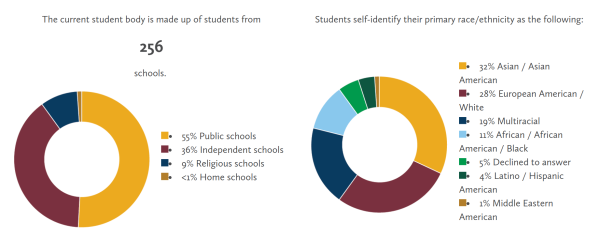
About 55% of all Lakeside students come from public schools. In response, Mr. Joseph said, “We are not drawing from one public school; we’re drawing from lots of schools.” Lakesiders are admitted from all parts of the state, from Bothell to Sammamish to Everett. However, he noted that “when you start adding [EPS] and [SAAS], then I guess we are contributing to that because we’re part of that bigger system.”