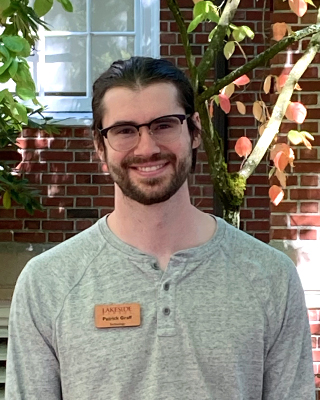
In 2020, Patrick Graff first stepped foot on the Lakeside campus, under unusual circumstances. It was during quarantine, and while the entire school was empty, he still made regular trips to the Grotto. “[It was] often just me alone here at Lakeside, just learning the tech setup,” he recalled.
Lakeside is the fourth private school Patrick has worked for, and over the six years he’s worked here, he has become a pivotal and beloved member of the Lakeside community. As Patrick prepares to leave Lakeside at the end of this year, Tatler interviewed him about his time at Lakeside and his next steps, in addition to hearing from students who’ve been impacted by Patrick.
Working in the Grotto is a difficult job, but one that our school depends on to function properly. It means embracing constant unpredictability. “You have to be really flexible,” Patrick reflected. “You never know what problems are going to happen.”
Most days are filled with repetitive and relatively simple issues including password resets, troubleshooting devices, connecting to the internet, and helping students and faculty with everyday tech needs. But when something major goes wrong, like a network failure, the Grotto is quickly flooded with students and faculty seeking help. On these days, work can quickly pile up and overwhelm the people working there.
Other than troubleshooting, Patrick and everyone working in the Grotto do a lot of work behind the scenes that often goes unnoticed. For example, they stay here working year-round, for five days a week during the summer and school year and for three days a week during spring and winter break. Any time there is an assembly or an after-school event, the people working at the Grotto make sure the technical components involved run smoothly. “It’s our job to take all that stuff, make sure it’s working, put it in place, and then put it back,” Patrick explained.
For Patrick, the most important part of his work isn’t actually the technical side of things, it’s about how he helps other people: “It matters less what services you perform for a person than it does how you make them feel when you’re helping them. That’s what they remember.”
That mindset has shaped the way he approaches his role at Lakeside. Students don’t just see him as tech support, but an experienced and passionate mentor that they can learn and grow with. Because of this, he has become widely respected among Lakeside’s tech enthusiasts.
Filmona M. ’26, who worked at the Grotto last summer, wrote, “I wish I had gotten to know Patrick before last year because in the short time I’ve known him, he’s taught me so much and allowed me to explore new interests that I wouldn’t have been able to anywhere else. Thanks to him, I was able to find out how I enjoyed working with hardware, and it was that experience that played a role in discovering my interest in computer engineering.”
Julia H. ’27, who worked on Andromeda AI,an in-house Lakeside-hosted AI designed to provide equitable access to AI tools for students and faculty, wrote “Patrick was the biggest supporter of Andromeda from the very beginning, and without him, Andromeda might not even have gotten off the ground. I couldn’t have asked for a better summer supervisor, funnier club advisor, and more amazing faculty friend!”
“Students are the reason that I’ve worked in education for so long.” Patrick reflects, “I love nothing more than when we can hand large problems off to a bunch of interested, curious, creative students.”
He finds joy in watching students who are passionate about technology and use it to create something cool. Students have always brought him creative and innovative ideas, something he says he’ll deeply miss. Many of these ideas have actually become real projects, and it’s in those moments that he finds the most inspiration.
Patrick brings up Andromeda AI as a prime example of this: “It is a really massive problem that they were able to solve in a very real way. If it gets supported, it could continue to be a program that provides a great service to the school.”
Throughout these past few years, the Grotto has become a much more student-facing space.
“It’s really cool that we can bring students so deep into our workflow and show them what we do,” Patrick says. He enjoys the student internship initiative, where students are hired to assist with the tech department during the summer.
Now, it is normal to see students experimenting on their next gadget or repairing a laptop in the Grotto.
“It became somewhere for me to experiment and learn,” wrote Filmona. “A big part of that came from Patrick, because he has a way of trusting people and that gives me enough confidence to try doing stuff myself. Whenever something came in, he’d let me take a shot at it — phones, cameras, even an original Xbox — without making me feel like worrying about messing up.”
“I wanted this to feel more like a community.” Patrick says. After this year, though, Patrick won’t be returning to work at another school. Instead, he’s planning to pursue a career in firefighting.
“It’s a big change of pace,” he said. Though this shift feels unexpected, Patrick said he is searching for something he feels is missing in the tech world. In tech, bureaucracy often slows things down. Solving problems isn’t always straightforward and requires layers of communication, delays, and constant coordination. Many projects are paused before they are ever completed. “Even if the problem isn’t dismissed, it can be very unsatisfying for the problem to be solved in a suboptimal way,” Patrick said.
Firefighting, he believes, offers something different. “I’m excited to have more concrete objectives and to work as more of a team,” he said.
“I’m going to miss working with students a lot.” Patrick said. “But I’ve also been doing this for a really long time. It’s time for a change.”