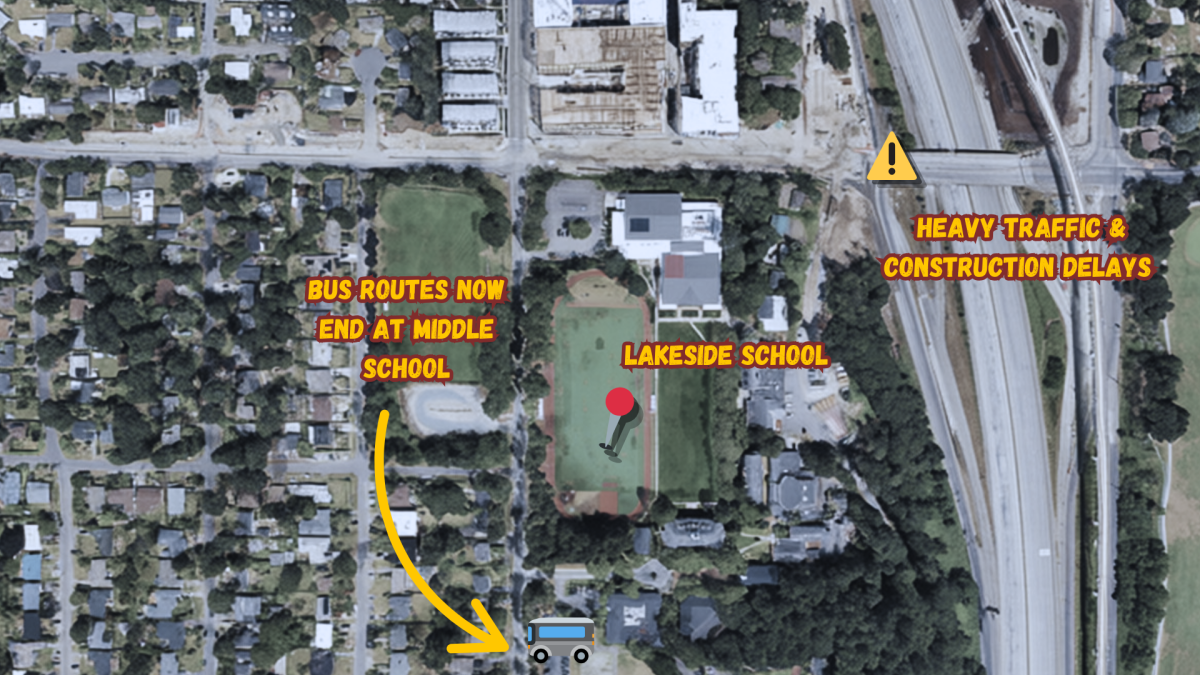
Dozens of students traverse the neighborhood between the Middle School and Upper School each morning, while traffic backs up at the intersection of 145th Street and First Avenue and cars reroute to avoid closed roads. Evidently, construction near campus has drastically changed the morning and afternoon commutes of many Lakeside students.
One of the most notable ways in which construction has changed the average Lakesider’s commute is that Lakeside bus routes have been modified to end at the Middle School. The Lakeside website estimated that 40% of students were enrolled in the bus program, while around 23.8% of Upper School respondents to the Tatler poll expressed taking the buses consistently. This is likely because the buses are used more widely in the middle school, as high schoolers can rely on driving or public transportation to navigate to school.
“We made a decision to leave [the Upper School] closed [to buses] for the remainder of the school year to avoid confusion, because even though they’re technically accessible, First Avenue is going to continue to close a couple of times,” explains Elizabeth Swan, Lakeside’s newly hired transportation specialist, assisting the existing Transportation Manager, Ying Canfield. Ms. Swan adds that not serving the high school with buses for the rest of the school year would mean more reliable communication among families, riders, and Metro bus drivers.
The buses, which are notably public buses instead of traditional yellow school buses, are run as a partnership between Lakeside and King County Metro along with two other independent schools: University Prep and The Evergreen School. Five chartered Metro buses transport students from across Seattle to Uprep and then to Lakeside, serving 370 students. Meanwhile, three other buses — Zum Services 950, 951, and 981 — serve exclusively Lakeside. “The partnership with other schools has been strong,” reflects Ms. Swan. “Lakeside plans the service, and partner schools opt in. It would be difficult for any one school to run this alone, but together it becomes feasible and more effective.”
Another way construction has impacted Lakeside’s bus routes has been the temporary closure of the Clyde Hill/Yarrow Point Freeway Station. As one of the busiest bus stops near Lakeside, it was previously served by buses 986 and 982. However, on March 9, students arriving at the stop to await their buses were suddenly confronted with the sight of its closure for renovation.
“It was very surprising because I usually walk to the bus stop from my house, and I didn’t think it was going to be closed because I didn’t have any prior notice,” Eason D. ’29 explains. “So, I had to walk back home and have my parents drive me.”
Lakeside sent out an email the following Tuesday explaining the closure, although by then many of the impacted students had already discovered the closure on their daily commute.
Occasionally, the buses will also get lost along their route, mostly because the drivers of the buses aren’t always accustomed to the routes Lakeside buses take. “Sometimes, the Lakeside buses get lost or go up to Alderwood when it’s supposed to go south,” says Steven H. ’29, who takes the 988.
However, construction hasn’t always meant delays for Lakeside buses. With the closure of three lanes on I-5 North, the express lanes have been switched from south to north in the mornings. This is particularly advantageous to students riding bus 989, as with the express lanes the bus no longer has to endure the traffic in downtown Seattle. Overall, the Lakeside buses are an effective way to get to school for many Middle Schoolers and underclassmen alike.
The construction surrounding Lakeside has also impacted the roughly 18.1% of students (according to the Tatler poll) who use the light-rail’s 1 Line to get to and from school. First established in 2009, the 1 Line serves everywhere from Lynnwood to Federal Way Downtown, making it an effective way for students living north or south of Seattle to get to school without a car. The closest light-rail station to Lakeside is Shoreline South, which is typically a 12-minute walk from the Upper School. While Lakeside has three buses that stop to pick up and drop off students from the light-rail station, the recent rerouting of buses to the Middle School has meant that Upper School light-rail users still must walk through the neighborhood to campus.
Meanwhile, some of the most notable expansions of the light-rail include the new stop at Pinehurst Station, a short distance from Lakeside Middle School; and the Crosslake Connection, which will provide light-rail connections to Eastside students. According to the Tatler poll, 9.6% of students plan to use this connection frequently.
Despite the school’s high numbers of bus and light-rail riders, an overwhelming majority of Lakeside students travel to school by car (70.4% according to the recent Tatler poll). While numerous construction projects near Lakeside have led many people to change their school routes to avoid closed roads, the recent lane closures on I-5 North have also increased traffic for students who typically pass through downtown Seattle.
Whether commuting to school by train, bus, or car, Lakeside students have seen their daily routines affected by construction around the school, from additional walking to longer times spent sitting in traffic to needing to take alternate routes. The consensus is clear: Students are eager for the construction to wrap up and to have an unaffected morning commute.