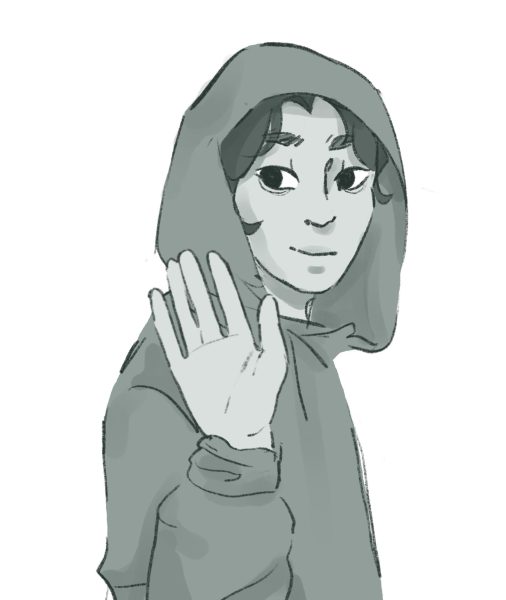
Jasmine B. ’27 sits at her desk, scribbling concept art on a piece of blank paper. After she finishes drawing, she takes the paper and stashes it under her desk, where it joins hundreds of sheets stacked together in a pile. Eventually, that piece of paper will make its way onto her laptop screen, where it will join the myriad of characters, enemies, and environments that make up the world of “ABYSS:METRO”.
“Everything does start on paper, I would say,” Jasmine explains. “Whenever I have an idea for any of my projects, I just add to it… and slowly build it out from there.”
According to Jasmine, the pile of papers under her desk has been growing for quite some time. She began making video games at age eight on Scratch, the popular free programming language and online community. In sixth grade, she moved to popular free game engine Godot Engine, and the complexity of projects ramped up from there. And now, she says, she has taken on her most ambitious venture yet: a multi-project exploration of a fictional universe, which contains a video game, a webcomic, and an interrelated senior showcase, all under the banner of “ABYSS:METRO”.
Jasmine defines the fictional universe that houses “ABYSS:METRO” as more magical realism than fantasy, despite its fantastical elements. The world encompasses a wide range of environments, ranging from the underground abyss, to a magical academy, to space, with the main events of the project taking place in the late 2000s. But in “ABYSS:METRO”, the void is the main attraction. “The abyss is actually a lot of things… it’s sort of this weird space that carries things that are dead and reanimated,” Jasmine explains. “All matter recycles in there. When things die, they’re reborn as something new.”
The video game, which Jasmine describes as her primary focus, follows one of four characters on a journey by train to the City at the End of the World. There, they must slay one of the two gods: the gold beast or the silver beast. Jasmine’s web comic follows a separate set of characters — surface-dwellers of the VOID:STAR Society — as they research the aforementioned train system connecting small pockets of the cityscape in the void.
Some of her inspirations, she says, include Hollow Knight, Slay the Spire, Deltarune, and the entire concept of trains. Deltarune, for example, inspired “the idea that the abyss is powered by people and things on the surface slipping through the cracks.” The train is both a prominent feature in both the game and the world, she adds, as most of the gameplay takes place in either the train itself or the station.
But the process of making progress on developing an entire video game is far more complex than a simple train ride. “There’s just a lot that goes into game development,” Jasmine explains, “that kind of [work] gets underappreciated.” The process of creating a game, she says, is a surprisingly conceptual process, involving significant prescience for future problems. “Everything you code has to be future proof. Piece by piece, component by component.”
According to Jasmine, her personal development process begins with the art, which she mentions is somewhat uncommon among game developers. “I really like to draw the prototypes of the characters and sort out the aesthetic first, and that makes me more excited about the product overall.”
The process of making a comic, she says, is surprisingly similar — “It turns out that [games and comics] actually do follow a lot of the same principles. You need to get all the character designs done, model how they act in motion, and then write about how the characters act.” The webcomic project, she adds, marks the first time she has returned to making comics since she was twelve, where she describes herself as a self-professed “baller… I really liked making comics, and I made a lot of them.”
While she begins with that vast pile of hand-drawn illustrations, she eventually transitions to the pixel art and animation program known as Aseprite. Yet despite having years of experience using the program, she continuously strives for improvement — mentioning, offhandedly, the fact that she retrofitted the program with custom-coded tools to optimize her webcomic, which cleverly combines a pixel art aesthetic and a traditional drawing style.
After long months of planning begins the grueling work of synthesizing a playable game: “I get to programming the base components of the game, the systems that actually make it tick,” she explains. Right now, she says, “I’m not at the point where I make the fun stuff. I’m just doing a lot of backend work. For example, skill trees, the entire map system of the abyss, and then managing how the characters move around the map.”
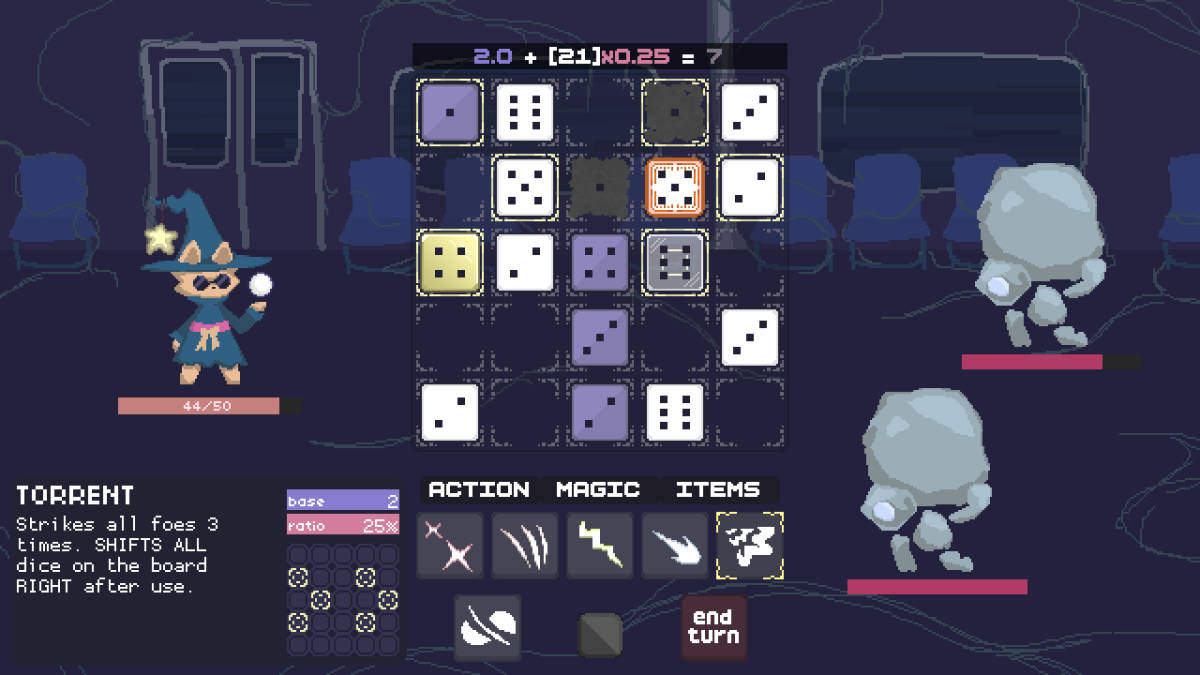
One of her favorite of these systems, she mentions, is “sort of just dice. Literally, dice on a grid.” The mechanic involves interacting with multiple dice rolled randomly onto the grid and executing attacks that score points based on the dice position and type of attack.
She recounts the process of constructing the mechanic as perhaps the greatest challenge she has encountered during the game development process, and the culmination of ten years of game design experience. “It’s gone through so many iterations,” she recalls. “I remember just being so frustrated because the core concept of this grid system was so cool to me, but I couldn’t pull it off in a way that I actually found to be interesting. I knew that I wanted a game that worked with dice and the manipulation of chance, but also had a system to balance the agency of the player and the fun, sporadic nature of dice and randomness.”
The dice grid isn’t the only interesting system featured in “ABYSS:METRO”. Jasmine describes the game as a “roguelike,” which she defines as a game where “the moment you lose, you get sent back to the start.” The roguelike component ties seamlessly into one of the game’s main themes, which is the peculiarity of the abyss itself as a place of both death and rebirth. “In all of my games,” she explains, “humanity is defined by its transience. Everyone’s on a time limit.” She gives an example of a character from a previous game — a “disposable clone on a timer to disintegrate in 6 to 7 hours.”
Yet despite the game’s natural transience, there exists an almost paradoxical sense of eternity. “There is no concept of time in the abyss,” Jasmine says. “There is no concept of time because once you die, you begin as a new thing again.”
In the abyss, nothing truly ends. The dead are reborn, matter is recycled, and characters begin their lives anew. Jasmine’s creative process follows a similarly cyclical logic: characters are recycled, entire worlds metamorphosize through time and place into fundamentally new things, and concepts die and are brought to the surface. Beneath her desk, paper continues to accumulate, each idea ready to be lifted from the interior abyss of the human imagination and born into the brimming, vivid world of “ABYSS:METRO”.