
The Millionaire’s Tax is a proposed tax on Washington households earning over a million dollars per year. The tax would collect 9.9% of earnings above the 1 million mark, and is highly unusual because Washington has long been a state without an income tax: the state constitution disallows it.
One of only nine states without this type of tax, Washington’s money has primarily come from sales tax, property taxes, and government funds. If it isn’t repealed when it comes up on the ballot November 3rd (i.e. the majority of voters vote “No”), it would go into effect January 2028. However, a “Yes” vote on the ballot does more than just repeal the tax – it bars potential future income taxes as well.
When it comes to discussing the millionaire’s tax, David Dunkin, an economics teacher at Lakeside, urges students to approach the controversial topic with a simple question: “Will the tax actually generate the results you want?” He mentions that while the tax has the potential to address the “regressiveness” of Washington’s current system, where the less wealthy pay a greater proportion of their income in taxes and the wealthy pay a smaller proportion, there are also valid concerns: first, the wealthy are also best poised to find ways to evade the tax. And it might inhibit entrepreneurship in the state.
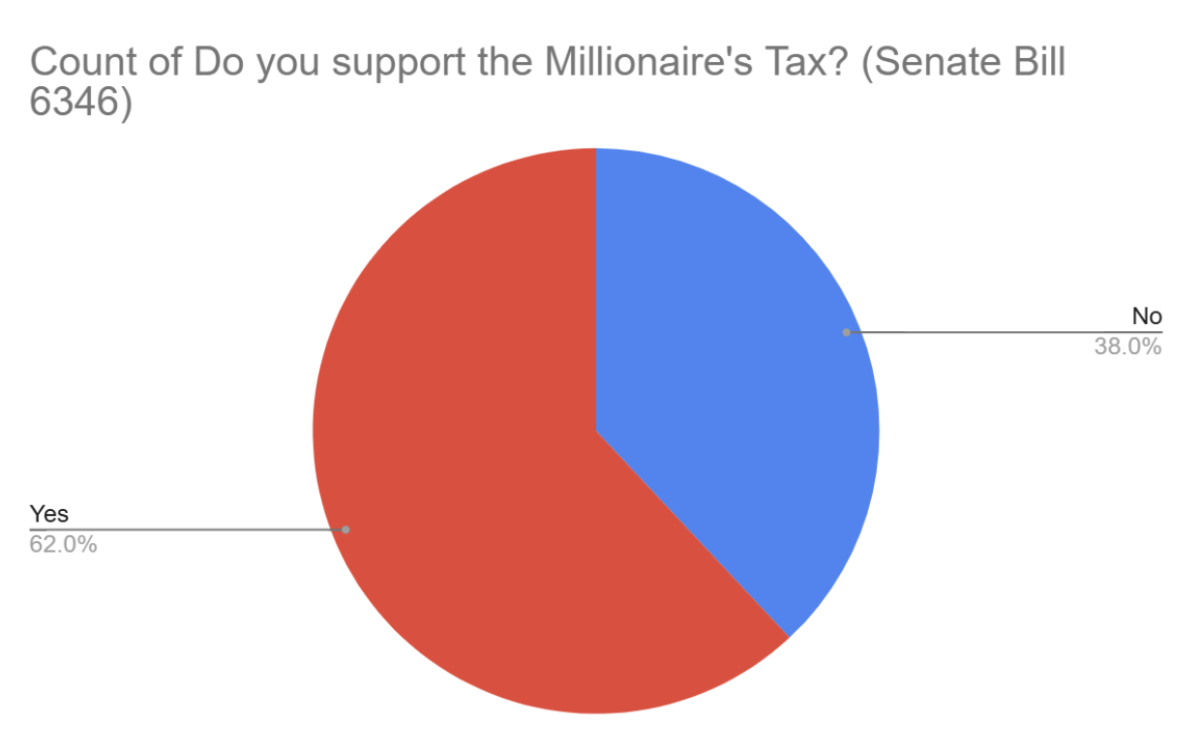
Kaylee T. ‘29, like 36% of Tatler poll respondents, feels that the tax is improper, suggesting that everyone should pay a share proportional to income instead of a wealthier subset being required to do so. “I think rather than adding more [taxes] to millionaires, we should just think of everyone’s range of income, and tailor the tax to everyone’s individual income,” she says. “While [the millionaire’s tax] does help and evens things out … [it seems like it] comes from negative feelings against millionaires.”
Mr. Dunkin also adds that “Any tax will inflict costs on society. [But] those costs may not rest with the person who writes the check to the government.” He references a famous example that occurred in the 1990s, where a highly specific luxury tax on goods such as yachts, furs, and automobiles ended up destroying the boating industry. Boats were one of the few items to actually incur the tax, and many were happy to purchase other items in lieu of them. Thus, rather than affecting the wealthy, it affected the workers who manufactured boats.
Seattle’s tax is much broader than the luxury tax, which offers it some security against falling into the same trap. But as Mr. Dunkin puts it, “we’re not gonna know […] until after the thing hits. You can guess, you can sort of do some theoretical work to estimate … I’m sure they’re thinking those [costs] will be low and manageable.”
64% of Tatler poll respondents do support the tax. Says Sabine H. ‘27, “It’s weird that it’s written into the state constitution that we can’t do that. [It doesn’t seem] that big a deal.” Peggy L. ‘29 reaffirms the statement, calling the tax “reasonable” and mentions that at face value it doesn’t seem particularly problematic.
The initiative will be voted in or out on November 3rd. It is one of the most hotly contested issues this year.