
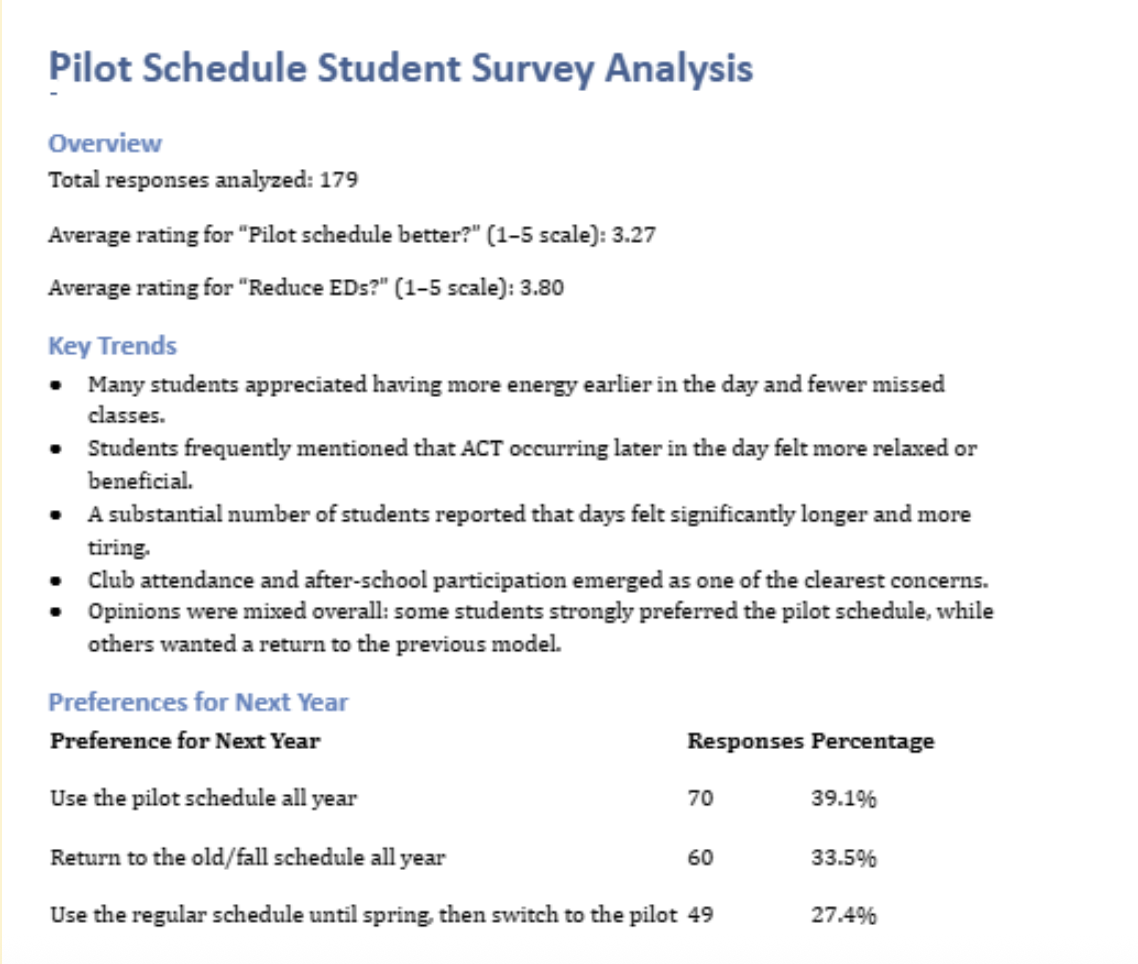
In the 2025-2026 school year, Lakeside tested the Pilot Schedule for a month to understand how switching last period and activity period would affect students’ lives. This change was targeted especially at spring athletes who were disproportionately affected by early dismissals: around 63% of the 146 games in that year’s spring season required an early dismissal, with most falling between 2:00 p.m. and 2:45 p.m. This year, after considering teacher and student opinions, Lakeside has decided to implement the Pilot Schedule in the spring.
According to Upper School Assistant Director Whitney Suttell, while administrators still need to coordinate with the spring sports schedule before picking a specific starting or ending date for the new schedule, an email with more detailed logistical information will be provided to students later in the school year.
Head of School Ryan Boccuzzi made the ultimate decision to re-implement the Pilot Schedule shortly after the 2025-2026 school year ended. Hence, while employees were informed about this at their closing meeting last year, students have not received any official follow-up. When asked why, Whitney answered that there was “no secret to keep from students” and that “we [administrators] don’t usually communicate that much over the summer.” On top of this, because there are “a lot of other things to get up and running as the school year [is] starting, we [administrators] haven’t fully sorted all the details out yet;” hence, no formal communication has occurred.
When asked how this decision was made, Whitney revealed that administrators and faculty who proposed the Pilot Schedule looked at all the feedback given from surveys of both students and employees at the end of the 2025-2026 school year.
The student survey revealed that of the 179 who responded, 39.1% prefer to use the Pilot Schedule all year; 33.5% prefer to return to the regular schedule all year; and 27.4% prefer to use the regular schedule until spring and then switch. The Tatler Poll conducted in May 2026 showed slightly different results: around 53% of 119 respondents indicated that they do not prefer the Pilot Schedule over the regular one. Administrators summarized the most common student survey responses, including having more energy earlier in the day and missing fewer classes, but with the trade-off of having a longer-feeling school day and decreased club attendance, as well as after-school participation taking a hit.
Meanwhile, the employee survey revealed that of the 49 who responded, 51.0% prefer to use the Pilot Schedule all year; 24.5% prefer to return to the regular schedule all year; and 24.5% prefer to use the regular schedule until spring and then switch. Survey responses summarized in administrator notes mentioned instructional continuity (fewer absences, easier assessment planning, and less pressure on athletes), but with the trade-off of weakening the “vibrant community” built from advisory, assembly, and clubs.
While Whitney acknowledged the impact of the Pilot Schedule on activity period, she notes that one reason administrators thought it would be good to roll out the Pilot Schedule in the spring is that it’ll give some time for students to explore and settle into certain activities at the beginning of the school year. “If these habits [of going to certain activities] are already up and established, shifting them to the end of the day may make less of an impact, whereas if [we] just started the school year that way, students would be less likely to go,” she said.
Whitney also added that having the schedule only be in the spring “gives us [administrators] some time this fall and winter to talk with student government representatives, SALT leaders, and others about what things could be helpful [in decreasing the impact of the schedule on activity period].” She connected this with student government’s efforts to support clubs that there’s a demand for, suggesting that both this new schedule and student government’s plans may intersect to benefit engagement with student clubs and organizations.