“I think I’ve always loved storytelling,” Alice M. ’27 recalled, looking back on her long history of interest in the field of writing. “I’ve always loved English class — my favorite parts would be creative writing or poetry units.” But her love for writing only transitioned into fully realized and lengthy stories when she began her freshman year of high school.
Alice said she used to be more of a “fantasy person,” with some of her favorite series including Wings of Fire and Harry Potter, both classic middle grade reads. Yet, as she grew, the draw of the science fiction genre seemed to grow with her. Authors such as Douglas Adams, creator of comedic science fiction novel “The Hitchhiker’s Guide to the Galaxy”, were specifically inspiring, Alice said. “I always thought it was very important to have a unique voice — where you can really hear the narrator’s voice in your head,” she said.
But what really drew Alice to science fiction was the ability to bring human stories to the distance and scale of the future. “My sci-fi concepts become very big — multiple-universe-level scale of worldbuilding,” she explained. In her worldbuilding process, she said, she will imagine huge, potentially catastrophic, and life-changing planetary-scale events and then “just zoom back into a point in the future to explore how everyone’s being affected.”
Part of considering the impact, Alice said, is “the philosophy of it; imagining what the future world will be like.” When talking about the age range of the audience she writes for, she mentioned that she would love it if her book was “engaging enough that, basically, anyone who’s teen and up could read it.” Part of that, she said, is because of the relevance these philosophical questions have to the modern reader. “Stories, no matter how far out they are, no matter what time … will always have something that feels so relevant.”
Still, most of Alice’s work is concentrated in that “zoom.” “I notice that in my stories, even though I worldbuild so much … the story is always about the characters. How the people change the main character, how they change each other, what connections people form,” she said. As she writes, she builds the story around her characters, playing out their interactions like a “movie in [her] head.”
Her perspective is especially refreshing for the genre: the science fiction canon is known for being technical, plot-driven, and concept focused, sometimes shying away from emotional arcs and deep character relationships. But for Alice, the social-emotional aspect is intrinsic to her stories. “I can’t really write any story without making it very interpersonal,” she explained. “I guess that bleeds into my sci-fi, too.”
Alice is currently working on three different stories. “[“Eleven”] started out because I used to be a big Pinterest girly,” Alice said. “So this one was a picture of a Tumblr writing prompt. I actually can’t say the original prompt, because it’s one of the biggest spoilers of the story.” Alice took the prompt, ran with it, and the little Tumblr prompt from Pinterest spiraled into a “full-blown story.” Despite not revealing the original prompt, Alice did share the premise of “Eleven”: ten characters with completely different lives who are kidnapped and must figure out the identity of their captor to escape.
“The other one — it doesn’t really have a name … I kind of just call it ‘the book,’” Alice said. “It’s a utopian-ish post-apocalyptic story, where it’s around the year 13,000 on Earth,” she explained. In the post-apocalyptic world, there are only one or two billion people left on Earth, due to a catastrophic tragedy. But humans have picked up the pieces to “live more intertwined with nature … back to the basics, with almost no technology.” The story centers around one girl who is curious as to odd phenomena headed by the government and sets out to investigate, uncovering deeply hidden revolutionary secrets in the process.
Aside from her two main science fiction stories, Alice has also recently indulged herself in a different genre: romance. The story focuses on a secret society of teens in New York. “I’ve been, like, kind of addicted to [writing] it,” she admitted. “I’ve written seven chapters in the past few days.”
Alice noted that while her romance stories are more loose, her structured projects, especially around worldbuilding, fall more into the science fiction territory. “I have done so much worldbuilding and planning,” she said. “One of my favorite things about writing is inventing the world.” Her extensive level of planning includes an outline of every single chapter and all of the characters, detailed backstories, and a historical timeline.
Her writing itself is equally meticulous. “What makes a world very fleshed out and real is the small details,” she explained. She offered an example from her recent romance story: “In my romance story, there’s a cafe, and it has three menu items. Coffee, tea, and blueberry tea. And no one ever orders the blueberry tea.” The small, quirky details are what bring a story to life, she said — “[the details] seem random, but life is just kind of like that.”
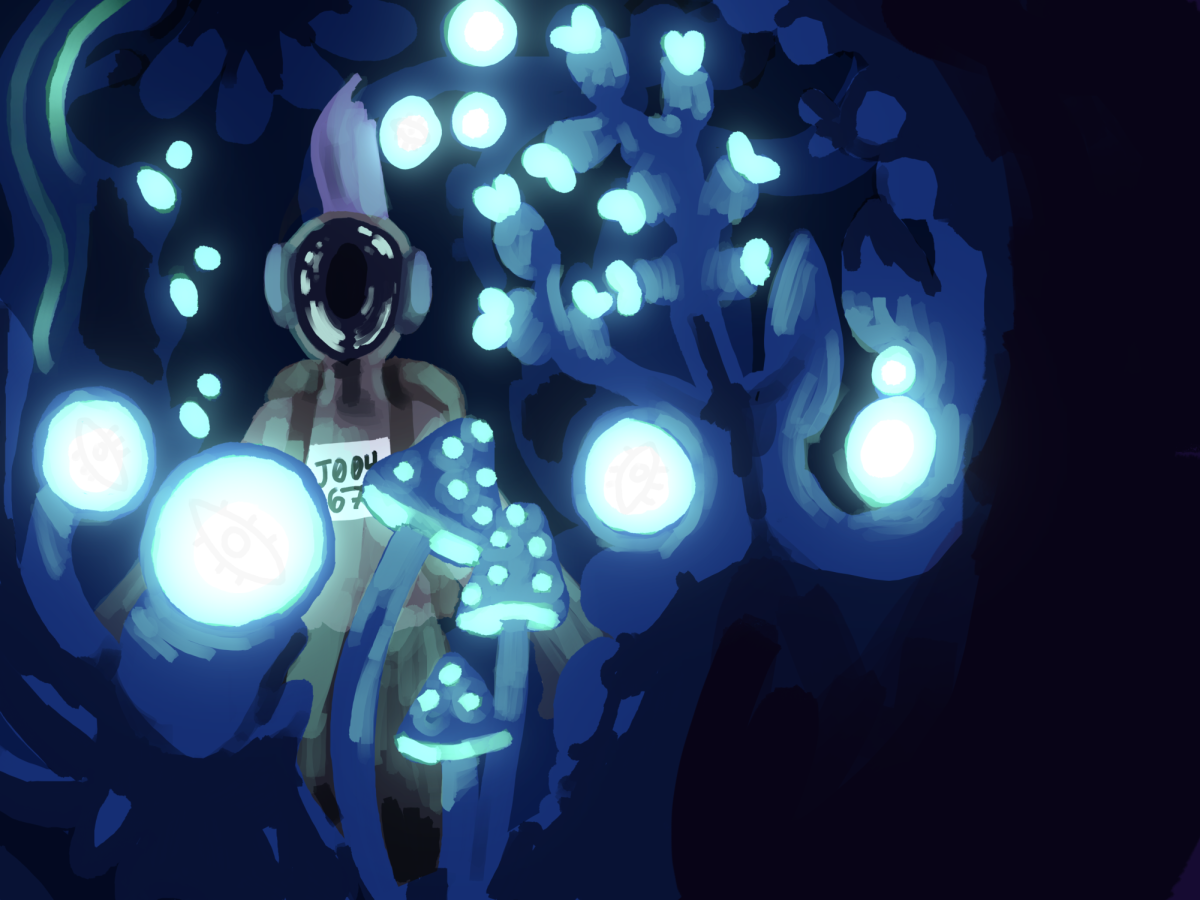
Still, Alice balances structure with a free-flowing extemporization. “Sometimes I’ll pull from games or TV; other times, it’s purely about me making stuff up.” According to Alice, this instinct stems from the genre she grew up with — fantasy. Some of the technology comes close to magic, she said. For example, Alice mentioned, in “Eleven”, there are multiple other worlds that “break natural laws.” One of the worlds is a hollow planet where all of the inhabitants live inside, surrounded by large amounts of vines.
Her writing process is equally as spontaneous. “Unless I have, like, some kind of goal with a deadline, most of [my productivity] is based on my creative energy at the time. I’ll just be struck by inspiration, and then I’ll be inspired to write a lot.” Consistency, she said, is the hardest part of being a writer — but she finds workarounds. “One thing that has really helped me with that is having a chapter outline,” she explained. “So even if I don’t want to write, I can kind of do it mindlessly, just following the structure I’ve already set for myself.”
Despite having to overcome the near-universal difficulties of writer’s block, Alice said, writing is incredibly rewarding. “Usually, my writing is my precious me time, my alone time, where I kind of just get to release my thoughts and kind of untangle the knots in my head.” “I have to intentionally build that time in,” Alice added, describing blocking out her afternoon for writing — even if she hasn’t finished all of her homework. “I usually get all ready for bed, and then I just reserve 30 minutes or an hour to just write and wind down from the day.” Writing, for Alice, is both a “release of energy” and a meditational period of slowing down.
These writing sessions may seem short, but over long periods of months or years, the time adds up. Alice has faith that consistency will pay off: “I have on my bucket list to just — write a book. I think that it’s pretty feasible in my lifetime, in the next few years, maybe.”
Alice is an expert at pondering the details of the human experience through her writing. “In writing, a lot of the time you’re considering every word,” Alice said. “You’re fully crafting these sentences yourself.” She zooms in on the interpersonal aspect of a global conflict, and zooms out into the philosophy of it all. Her stories explore a world rife with intricacies of magical technologies, but also, the blueberry tea in the café that no one ever seems to order.