
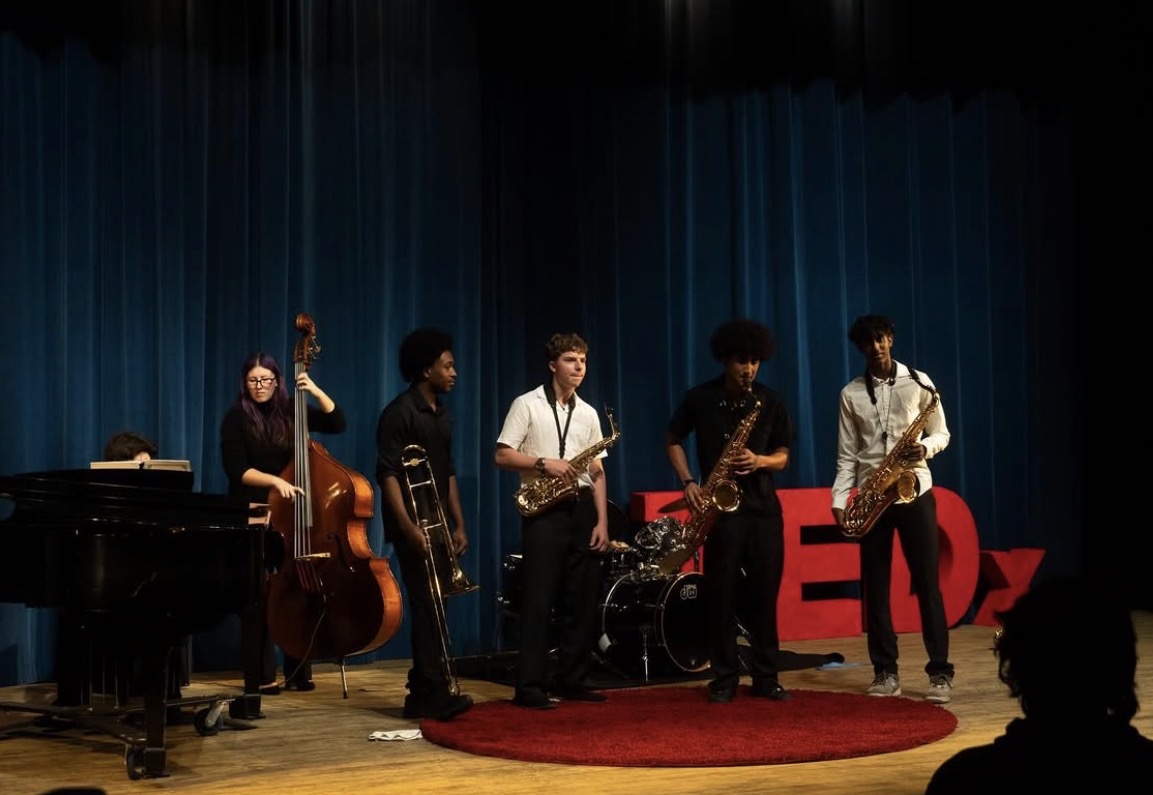
If you’ve ever walked through Red Square early on a Friday morning and heard the sweet sounds of jazz ringing throughout the school, you’re likely already familiar with Lakeside’s Jazz Club, a group of seven students who all share one thing: a common love for jazz. Read further for an exclusive interview with Jazz Club.
This interview has been edited for clarity and concision.
Can you share your name, grade, what instrument you play, and how long you’ve been a part of Jazz Club?
Stella JT. ’28 (SJT): I’m Stella. I’m a junior. I play bass, and this is my second year.
Millan K. ’28 (MK): I’m Millan. I play tenor sax, sometimes alto. I’m in 11th grade, and this is my third year.
Aadi M. ’28 (AM): I’m Aadi, I play tenor saxophone, I’m a junior, and this is my third year.
Hugo F. ’29 (HF): I’m Hugo. I play piano; I’m a sophomore. This is my second year.
Remy L. ’27 (RL): I’m Remy, I’m a senior. I play alto saxophone, and this is my fourth year.
Owen S. ’27 (OS): I’m Owen. I’m a senior. I play trombone, and this is my fourth year.
MK: And then Wilson. Our drummer. He’s a senior. It’s his third year.
How long has Jazz Club existed at Lakeside, and how did it originally start?
MK: When Aadi and I were in our freshman year, there was a Jazz Club.
RL: Jazz Club was mostly seniors and Johan, who was a junior, and me, a sophomore.
MK: I didn’t really want to join that group. So Wilson, Aadi, Owen, Remy, and I formed the JUZZ. Then, during my sophomore year, once the seniors had graduated, we just mixed the two groups into Jazz Club.
How has Jazz Club changed since it originally began?
RL: The Jazz Club before [the juniors] joined was really laid back. We didn’t really meet very often, and every time we met, we would just play some tunes out of a book called “The Real Book.” We had a few gigs. But once Millan and the others joined, they changed this culture to be a lot more intense. He’s making us all transcribe songs by ear, and there’s a lot of hard work there. We have a lot more concerts. There’s a little more tension during the meetings … but pressure makes diamonds.
What originally interested you about jazz, and how long have each of you been doing it?
HF: I started playing jazz in sixth grade when I joined a junior jazz band at my middle school. And then I kind of followed that jazz track all the way through middle school, really enjoyed it, met a lot of great people, and enjoyed just playing music with friends. And when I got here, I was really excited to have a group that cared about music and enjoying time together and celebrating this great culture that is jazz.
MK: I started playing in seventh grade, but when I moved to Seattle, the jazz culture here was way stronger, so in eighth grade, I became more serious about it. And then discovering all the high schools around here that are really good at jazz [has been] a big part of my journey. And there’s this one place called the Jazz Fellowship where I’ve been going, and that’s been helpful to explore more about the jazz community in Seattle.
OS: For me, I have only been playing jazz since around eighth grade, but I’ve always listened to it and been interested in it because growing up, my dad also played a little bit of jazz. So he really introduced me to a lot of famous artists and songs. And then after that, I just liked the freedom of jazz, and I also liked the feeling it evoked within.
MK: Also, to add on to that, jazz is very much a listening culture because Owen’s never really [taken] lessons, but just from being able to listen to records and just practicing by himself, he’s gone pretty far.
What is the schedule like?
SJT: We try to meet every [Tuesday and Thursday during ACT], but everyone has a lot of different commitments and schedules … so when we can.
MK: What we’ve been trying to do as [seniors] have been having more stuff with college [is] focus on one song for longer. We can go more in depth on that rather than learning a bunch of songs in a short amount of time and then not being able to keep up at that pace because of other commitments. So we’re taking a different approach of quality over quantity.
What does a club meeting generally look like?
OS: Like Millan said, we’ve adopted a new practice. Right now, [each meeting] is really focused on playing through the song and then trying to correct any areas like articulation [or] blending. We don’t focus on the solo section as much just because that’s not really something that can be improved live.
MK: Yeah, we try to arrange it in our own unique way.
SJT: Also, sometimes we listen to songs. There’s a lot of listening for intonation and form.
MK: What we used to do was just take one of those books back there and just play a song that we wanted to learn. But what I’ve learned is that you can’t get as much out of just a paper as you can when you’re listening. You hear all the subtle inflections that you can’t hear or understand when you’re just looking at a paper. So it’s very hard to transcribe, but it’s worth it in the long run because it’ll improve all of our playing.
How did you decide to start busking, and what has it been like?
MK: Well, everyone needs money. We were just thinking of ways to make money, and we were like, oh, jazz, money? Busking. Greeklake’s really nice, especially in the evenings. A lot of people with money to spare. [We also wanted] to spread the jazz culture.
SJT: Yeah, it mutually benefits us. We get to make some money and have some fun. Oh, we do go to Chipotle afterwards.
RL: Word of advice for other young buskers: get a Venmo QR code. The tips will be better; then put “support to student musicians” on it.
How do you address issues with communication when they come up?
MK: We sometimes have meetings where we won’t play, and we’ll talk about strategy. On the first day of Jazz Club this year, we wrote out what our vision is and how we want to improve … [And] hanging out outside of rehearsal lets us get closer as a group, and so we are more cohesive when we play.
RL: And I think the longer that we’ve played together, the more we feel like we can give each other open and honest feedback. And we understand how each other plays more. And we know that the feedback isn’t coming from a place of negativity.
How do you think jazz has affected the way you think about performing?
RL: It’s really good for confidence, especially with soloing … Even if we don’t play our best, we don’t really mind.
SJT: … Especially when we play in the mornings, people are just walking past and it’s like, “okay, these people are just gonna hear me play, but that’s fine.” And you know, afterwards, people always come up to you, and they’re like, “that was so beautiful.” … when there are even more people, and there’s a bigger crowd … it doesn’t really matter if you make a mistake; it just matters how you present yourself.
MK: I’d say that playing in smaller groups is more nerve-wracking, but there’s the same goal of making good music. It’s like you’re a part of something else, and it’s not just about how you play, but how you fit in and how you mix together with the other instruments to make good music.
What are some examples of gigs you’ve done in the past?
MK: A lot of busking. We played at the ROAR auction; we played at a choir concert. We play a lot in the mornings. We’re going to be bringing that back soon.
RL: We had one really good gig … before Circus two years ago … That was actually like one of our best gigs.
SJT: We also played at a holiday [event] last winter in a community center.
RL: I also remembered one gig that we did that was huge was our TEDX gig.
OS: Yeah, that one was my favorite.
How do you usually get gigs?
MK: Sometimes Mr. Patterson gets us gigs. What we’re thinking about in the future is to start shooting our shot [writing emails to] a bunch of restaurant-type places where we can get gigs. There’s a good chance that we would get emails back and that’d be really big progress for us, to get big paid gigs like that.
SJT: Yeah, maybe like a farmer’s market or two. We’d have to do some research. It’s one of those scenes with a lot of foot traffic and good vibes.
RL: We’ve gotten some gigs from Mr. Bocuzzi. Obviously not paid but just for school, where he’s reached out to us. Things like the New Students First Day of School, Party on the Quad.
What’s the best thing about Jazz Club?
MK: I’d say just hanging out. Sometimes, we argue …, but when we’re cohesive and we bond as a group, it’s really fun.
RL: I would say small gigs at school, where we get to play for people in our community.
SJT: I’d say the appreciation that other people give to us. After gigs, people will come up to us and say “Wow, you’re so cool.” And me, especially, they’re like, “Wow, it is so cool that you’re up there with these guys.” … Just like the fact that people really enjoy it makes me want to do it more … It’s like when you create an art project or win a game. That feeling of doing something and creating something good.
AM: I think it’s the people. That’s the best part. I just love these guys and girl.
OS: I love the passion that people have. Like Aadi was saying, I love the people, but then I also love the passion that people have for making music, and I love how consistent everyone is in that passion. And how committed people are.
HF: I really love when we’re all playing together, and it just is a genuine experience that we all can truly enjoy.
RL: We do a really good job of all reacting if someone’s soloing and they do something really good.
MK: When we first started playing, we would have really robotic performances. We would just stand there … [but we learned that] you have to look excited in order for the crowd to engage. So cheering on your teammates when they’re playing [is important].
What’s the hardest part about playing jazz in a group?
SJT: Because there’s always a lot going on and there are so many people, it’s kind of hard to work together to make it sound good … sometimes it’s hard to find focus and figure out how to make it work for everybody because we’re all doing different things all the time. [And] I guess accepting constructive criticism and offering it in a kind, helpful, and well-meaning way.
MK: The hardest part of performing is, since everyone has such isolated parts, you have to focus really hard on playing the right thing, but at the same time, listen to everyone around you and make sure you’re playing with them.
What is it like to improvise and how much practice does that take? How do you choose when to improvise?
MK: It’s not just a bunch of random notes. It’s taking inspiration from artists and records you hear, trying to take bits and pieces of solos and different pieces of vocabulary that other artists have already put out in the world for you to use, and trying to integrate those pieces into your play. That’s the hardest thing, but the most important thing for me.
RL: There are levels to it. At the most basic level, anyone can really solo, and the first step is really having the confidence to put yourself out there. You know, have a few notes, have a few licks in your back pocket that you can do. So that’s important to start out. But once you really want to progress, you do have to start listening to a lot of music, transcribing, and practicing.
What are your hopes for the future of Jazz Club?
MK: I want to get a huge gig and just play so perfectly. And everyone rips some crazy solos.
SJT: For the future, I’d say just more exposure. Ideally paid gigs, but also in the mornings, making ourselves known as a thing that Lakeside has. Oh, and [follow us] on Instagram: @lakesidejazzclub. When we have upcoming gigs, we post it there.
RL: I think our biggest goal is [also] to bring joy to everybody else, to bring joy to the community. We want to make ourselves known but, at the same time, we want to make Lakeside a better place for everybody.
HF: Some things we are thinking about from a more logistical standpoint is that next year, we won’t have drummers and trombonists, [so] we’re trying to promote Jazz Club … We won’t be able to play any gigs if we don’t have a drummer.
OS: So, in other words, if you’re a drummer, hit us up.