“Whenever I felt unmotivated to do work, I did bio, which is kind of a crazy thing,” says Emma L. ’27. True words spoken from the gold medalist at the most recent International Biology Olympiad (IBO), the world championship for high school biologists.
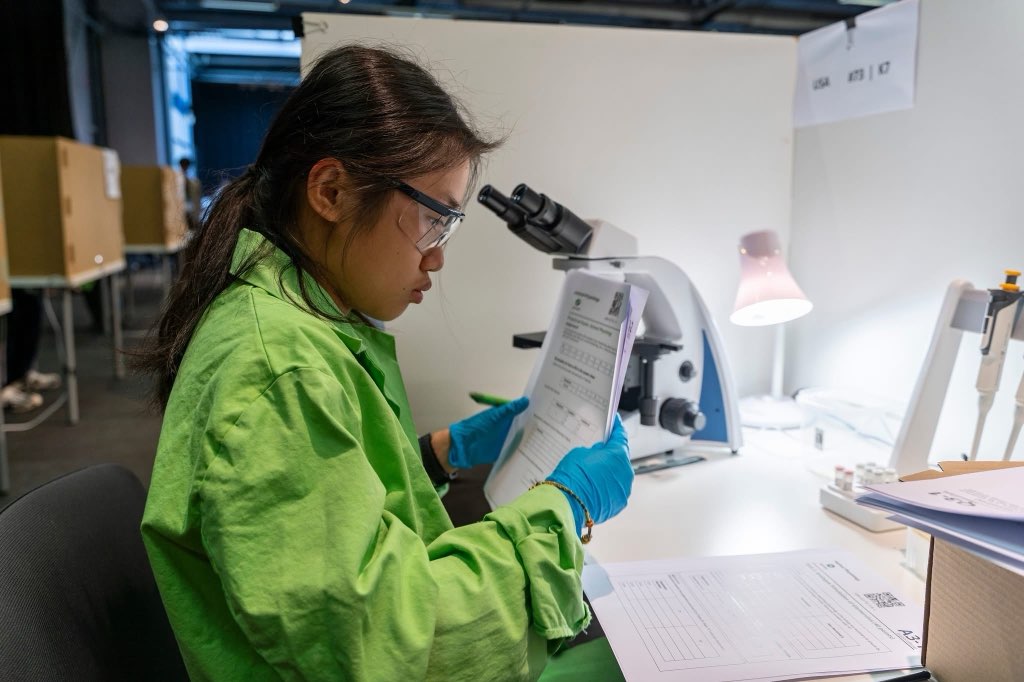
The only girl and highest scorer on the United States team, Emma placed sixth in a competition of over 300 students from over 70 countries. Competitors spent eight or more days in Vilnius, the capital of Lithuania and this year’s location, facing six hours of testing for two days in theoretical multiple-choice questions and lab-based exams.
But to get to where she is now, Emma credits Mr. Donohoe, her Lakeside summer biology teacher, for making biology interesting and encouraging her to participate in class — “I’m not a very big participator,” she remembers, “but he did it in a way that I actually felt good.”
The activity that fanned the flame of passion, though, was Science Bowl, Lakeside’s buzzer-based science competition team. Her freshman year in Science Bowl, she recalls she answered “not a single question.” Nevertheless, since she was recruited by an older student on the first team to be the last minute biology specialist substitute, she felt driven by her teammates’ faith in her to study a lot of biology for her team’s success. At some point along the journey, she says, it “stopped being just … for the team and more for my own enjoyment.”
Her motivation translated into reading. Lots of reading. For context, most qualifiers for the National Finals, the summer camp that selects the members of the USA IBO team, read four to five textbooks. Emma read 15 textbooks total — four hours a day.
“During the school year, I didn’t do any homework at home,” says Emma. “From the moment I got home from crew or wrestling or whatever, it was just bio.” She adds that biology is her hobby — “I don’t really consider it studying,” she explains.
Her reading process? No notes, just read. The next day, she’d try to write down everything she remembered, and then read what she read again. On her desk, she now has a three-inch-tall stack of paper — all her notes. She’d also naturally wake up at 5:30 every morning, and start reading until she couldn’t fall back asleep.
In order to advance to the IBO, students pass through three rounds of testing. First, the entry-level USA Biology Olympiad, an hourlong exam with 50 multiple-choice questions. Then, the top 500 out of 12,000 students who take it advance to the semifinals, a test that Emma describes as “really hard to finish.” This is because despite having twice the time, students must solve 60 multiple-choice questions, four biological scenarios where logical reasoning is necessary to answer true/false statements, and four long free-response questions.
Afterwards, the top 20 students qualify for National Finals, held this year in Cambridge, Massachusetts at Harvard University. The camp was run by four teaching assistants (TA), all alums of the program. A day in Emma’s life during the camp’s week and a half consisted of thirteen and a half hours of daily learning, from 8:30 a.m. to 10:00 p.m. In the morning, students got “handed a college professor” who taught them a daily subject, like ecology. One professor, she recalled, brought the camp to go birdwatching on the Charles River.
Then, in the evening, TAs led study sessions and taught lab skills. The IBO has four 90-minute practical examinations testing lab skills and biological knowledge through activities like dissections. In order to provide adequate dissection training, Emma counts off the animal victim list — fifty grasshoppers, “a ton of huge subway footlong earthworms,” and a “wealth of marine life.”
In the final two days of the camp, the TAs administered the qualifying exam for students, written based on their predictions for the practical exam topics at the IBO. During the exam, Emma remembers feeling nervous going against four previous IBO competitors. Although her practical exam went well — thanks to her strength of staying calm under pressure — she recalls doing “really bad” on the second part of the theory exam.
Nevertheless, after a grueling nine total hours of testing, Emma arrived at the final farewell banquet where results would be announced.
As the results rattled in, starting with bronze winners, hope grew within her. After all, Emma knew she did well, but well enough to win gold? Then, when the silver medal winners were announced and her name wasn’t on there, she knew she’d made the team.
“I was really happy,” Emma remembers. “My mom was there; I think she was hella excited too.”
Afterwards, she and the three other campers selected for the USA IBO team stayed in Cambridge for another ten days, where they relaxed, did a bit of extra practice, and tried local restaurants like Tasty Burger. Then, they flew out to Lithuania with the camp head and another alumni chaperone.
During the IBO, Emma described the hardest challenge as focus. The IBO is split up into two days: two three-hour sections for the theoretical exam, and then four 90-minute practical exams. The theoretical portion allotted plenty of time for the questions, although the difficulty was reading and fully comprehending each problem.The practical portion was more of a time crunch and had the added weight of compounding mistakes — one error in a previous step could lead to mismatched data.
To deal with the pressure, Emma had to stay calm. During one of the four practical exams where students had to perform gel electrophoresis, a process that separates proteins or DNA for genetic research, Emma realized she forgot to insert an enzyme because she got distracted. “I already started running my gel and I was like, ‘oh frick. What am I going to do now?’”
During the awards ceremony, her mistake came back to worry her. “I honestly think getting silver was scary for me not because I personally needed gold, but because I knew that I got to come here representing the US,” Emma explains. “I didn’t want to disappoint my teammates and all the people I’d met.”
In the end, Emma both scored gold and earned the highest composite score on the USA team, as well as the highest raw second round theoretical exam score globally.
The IBO was not only a scientific experience, but also a cultural one. Many days were allotted to exploring Vilnius — for example, through a photo scavenger hunt of famous landmarks.
Each team also got assigned a local guide. Team USA received a Lithuanian rising senior named Agnė, who “was really cool. … We’re American, and she saw at the store they were selling 6-7 corn puffs for 67 euro cents, so she bought them and gave it to us.” Another time, she took them to a museum about the KGB run by a man who “passionately hates everything about Russia.”
During the competition, countries mingled with others often. Since students were free after 6 p.m. when they returned to their hotel, Emma remembers she got close with competitors from other countries living at the same hotel. One student from Moldova, for example, created an entire biology-themed word association card game to share at the competition. In addition, being the only girl on the USA team, Emma shared a room with a competitor from Korea. Countries also gave each other souvenirs, like “a crap ton of Mexican candy,” or Emma’s favorite, a hand fan from Indonesia.
However, being the only girl on the USA team, Emma describes her time as “a bit of an isolating experience, like not intentionally … I don’t do all the same things they do — I don’t play video games like crazy.” However, she also described it as “motivating in a way to be there … I have a unique story.”
Emma’s motivation has been infectious; last November at the MIT Science Bowl Invitational, another girl’s mom came up to her mom and told her “it’s really cool that your daughter [Emma] is up there and it’s all guys buzzing, and she’s outbuzzing the guys.”
Back at Lakeside, Emma feels “pretty alone” in being “super interested in bio.” Only three or four students took the entrance exam, all members of the biology club. Although many students enjoy classes like Molecular and Cellular Biology, she says, not many are interested in pursuing it competitively. “I feel like it’s not for everybody, [but] it’s cool to meet people who it is for.”
“Make biology cool at Lakeside. Don’t make it a three-person club,” she tells the school.