
Description of the summer class and our trip:
This summer, we took a Lakeside summer school class called Literary Explorations: Oregon Shakespeare Festival Experience, which was a three-week immersive course exploring the voices of classic and contemporary playwrights. Throughout the course, we read, performed, and analyzed a selection of plays that were a part of the Oregon Shakespeare Festival programming. Assessments for this course included essay analysis of a scene from a play, a set design, a play review, and a monologue. In the second week of this course, we took a minibus to Ashland, Oregon in order to see the works we read in class come alive on the stage. Below are reviews, written for the course, of two out of the four plays we saw on our trip:
Amber’s play review: You Are Cordially Invited to the Most Human Show You’ll Ever See
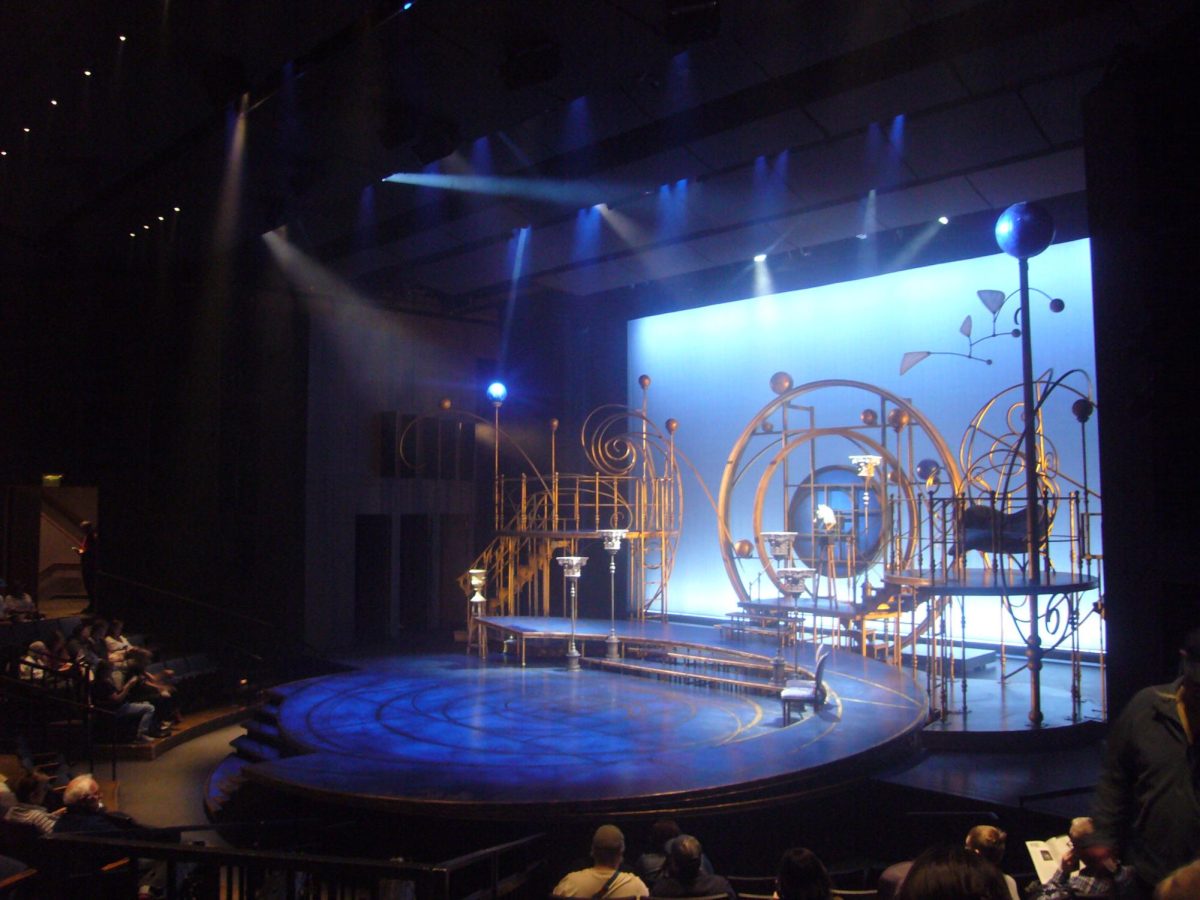
One day after arriving in Ashland, I head into the Thomas Theatre to see the first of the four productions I will see at the Oregon Shakespeare Festival. I am immediately struck by the layout of the intimate theater, the seats of the audience wrapping around what clearly depicts a standard-looking house and driveway. Yet other subtle aspects of the set are not standard in the slightest: star balloons hang from the ceiling, a smoke machine creates an ambient atmosphere, and what seems to be a basketball hoop is created from a glowing wire, attached to the roof of the housefront. The room is dark, and each audience member sits, a few feet from the stage, in anticipation.
You Are Cordially Invited to the End of the World! is a dramatic comedy written by Keiko Green and directed by Zi Alikhan. This story depicts a family dealing with a father’s terminal cancer diagnosis, which the father connects to patterns of climate change, and is narrated by their non-binary child, M. This play blends fantastical elements, such as fever dreams of Greta Thunberg and an extinct animal support group, with realistic family conflict, exploring themes of grief, love, loss, and finding joy amidst chaos — all through a queer lens.
To begin, it immediately struck me that the place where I was sitting within the theater would heavily impact my experience of the production. With the audience fully wrapping around the stage-turned-driveway, I could watch from one perspective while the audience members sitting across from me saw things completely differently. Because of that layout, there is no such thing as “cheating out” for the actors, meaning that they make no intentional effort to face the members of the audience. Instead, Alikhan takes a different approach. In each scene, the actors swap places often, but in a way that felt entirely natural — moving swiftly with the quick-paced nature of the show. In each conversation, we were able to see each character’s facial expressions at different moments. One instance of this was a conversation between the mother Viv Murphy, played by Amy Kim Washke, and support group member Janet, played by Kate Wisniewski. In this uncomfortable interaction, the actresses naturally cross in front of and behind each other, allowing the audience to see both fear from Viv and the desire to connect from Janet. By directing this kind of movement for all the actors on stage, Alikhan lets the audience see the perspective of each character and relate to all the emotions presented. In doing so, the audience begins to find their own moments of loss and love, emphasizing this story as a truly universal one.
This is also shown through the movement of M, the narrator. In their scenes of monologue — which break away from the main plotline — the spotlight appears even before they step into it. M walks all across the stage from spotlight to spotlight, addressing each and every audience member. M speaks vulnerably, recounting experiences of when they first realized their father was human. With these routine moments of connection, the audience is able to further reflect on their own lives, again connecting their own stories to the one playing out in front of them.
In a conversation between M and their aunt Lila, Lila shares how when she lost her mother, the one advice that Viv always gave was to keep saying their mother’s name aloud. In doing so, they could keep her spirit alive and continue remembering her. Near the end of the show, M invited audience members to do the same — to share a name of someone they have lost in order to keep their spirit alive as well. After every person spoke a name simultaneously, the cast launched into an absurd, magical dance party. This moment really brought all the themes together for me. Though this show centered on one story of loss, it was really a story about all of us, for all of us.
This production might not be for everyone, but it cannot be denied that it does exactly as it seeks to do: a true celebration of what it means to be human, uniquely highlighting a story that is new yet eternally familiar. This show is vulnerable and striking, and at times purposely uncomfortable in order to reward you in the end. You, along with the family members in this story, are able to accept the magic of the show — all the bizarre, overwhelming, and hopeful aspects. You are invited to dance, you are invited to cry, and you are invited to just sit there and take it all in because sometimes, that is all you can do. The play moves almost too fast, reminding you that death waits for nobody. And when the lights came up, I only wished that I could have just a bit more time.
Aicha’s play review: A Very Mid Summer Afternoon: Reviewing Oregon Shakespeare Festival’s A Midsummer Night’s Dream (2026)
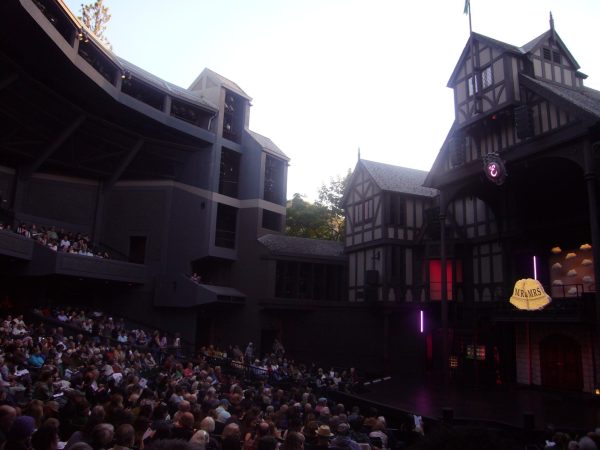
From the very moment you find your seat inside the Angus Bowmer Theatre at the Oregon Shakespeare Festival, it’s clear that this production of A Midsummer Night’s Dream is not interested in subtlety. This is evident from the towering, celestial backdrop, or the slender sphere lights — and of course, when Puck sneaks onstage midway through the curtain speech, ushering in the play by leading the cast through an original song. This alteration to Shakespeare’s centuries-old play is an apt signifier of what to expect from Marcela Lorca’s direction of the show, a feverish, visceral romp involving three distinct plots: four Athenian lovers, a group of tradesmen endeavoring to perform a play at the upcoming royal wedding, and mischief in the Fairy Kingdom. From this opening gesture onwards, the production revels in the comedic extravaganza and physicality that all three worlds offer, often navigated through more original music. While initially this creates an engaging and inventive new Midsummer, it also becomes the production’s central limitation — the production of the show maintains a constant comedic undertone that dulls any other emotion besides humor. The production’s insistence upon playing every moment for laughs weakens the stakes that make the comedy of the play effective.
It’s an understandable pitfall, especially in a play like A Midsummer Night’s Dream. Shakespeare’s writing, devoid of tonal instruction, allows for almost total directorial control over delivery. And when you have a cast as talented in physical comedy as Lorca, it does seem tempting to keep letting them play. We see examples of this from an early scene introducing the Athenian Court and lovers. Theseus, played by Armando McClain and Hipployta’s, played by Jessika Williams delight in a flirty repartee in the few lines they have together, giving the opening scene a buoyancy and lightness.
They’re quickly interrupted by the four lovers, led by Sarah Evelyn Bakari’s Hermia. Bakari’s performance as Hermia is consistently fun, she uses her physicality to reimagine Hermia in a new, coy light — shuffling to Theseus wide-eyed and ready to declare her love, or exchange eyerolls with Lysander, played by Jaysen Wright. Across from her is Helena, superbly played by Rhea Bradley with a delivery that’s equal parts sardonic and wishful. Matched with Bakari’s Hermia, both heroines are given a fresh interpretation that emphasizes physical comedy and verbal wit, and both Lysander and Demetrius (played by Jonathan Stevens) rise to match them, building an ensemble of extremely talented individual performers.
However, it’s here that the problem starts to form. As we venture forward into the play with the momentum of the previous scene, we transition into meeting the Mechanicals. Although
Al Espinosa is a charming Bottom, one can’t help but feel fatigued by another comedic scene, so soon after the first. Some jokes don’t land on a crowd that hasn’t felt any real tension yet, an audience for whom the stakes aren’t nearly high enough, because the production hasn’t paused to contrast moods. While A Midsummer Night’s Dream is undoubtedly a comedy, and while it’s true that Shakespeare allows for almost every single piece of dialogue to be interpreted as to the director’s vision, in choosing to interpret every single scene from a humorous lens, the actual humor of the play is lost. As a result, jokes that would have otherwise landed and stood out amongst a landscape of emotions simply fade into the same comedic background.
Lorca’s production is the strongest when utilizing the same physicality in which she draws humor from as a method of storytelling. Examples of this include Hermia and Hippolyta in the opening scene of the play — Hippolyta patrols the rim of the scene throughout Hermia and Theseus’s discussion, ending up behind Hermia in a silent show of solidarity, even storming out alone when Theseus makes a decision that angers her. This physical mirroring is also repeated in Act II, Scene 1, when Oberon decides to assist Helena in arranging Demetrius’s affection for her, with Oberon ‘invisible’ directly behind her as she launches into declarations of love for Demetrius. These moments demonstrate a competence from both cast and direction that suggests that the production is capable of complexity, of elevating its comedy by committing to the darkness. However, moments like these either don’t appear nearly enough, or the physicalities are blatantly ignored during delivery, leaving the audience all the more frustrated and bored.
The ending of the show is a perfect capsule of its faults. The Mechanicals performance of Pyramus and Thisbe is entertaining, and allows the comedy to surface from the characters instead of the frenzied energy injected into the show. But the show reverts back to its old ways when Puck appears to deliver his closing monologue. This famous not-apology is a classic Shakespearean contemplation on the lines between dream and reality for the audience. But it’s hard to focus on the subtleties of the message when Puck delivers it solely for the laughs. That note of discordance stuck with me even as Puck closed the play with another song, this time inviting the audience to participate. It notably took him a couple of verses to include the crowd— everyone seemed too tired to participate.
Overall, A Midsummer Night’s Dream is a production blessed with talent and vision, but a lackluster execution leaves audiences feeling much more depressed that a comedy ought to. While it may succeed as a spectacle, it’s lacking what all the best executions of Shakespeare’s comedies have — after all, you couldn’t have a midsummer night without darkness.