
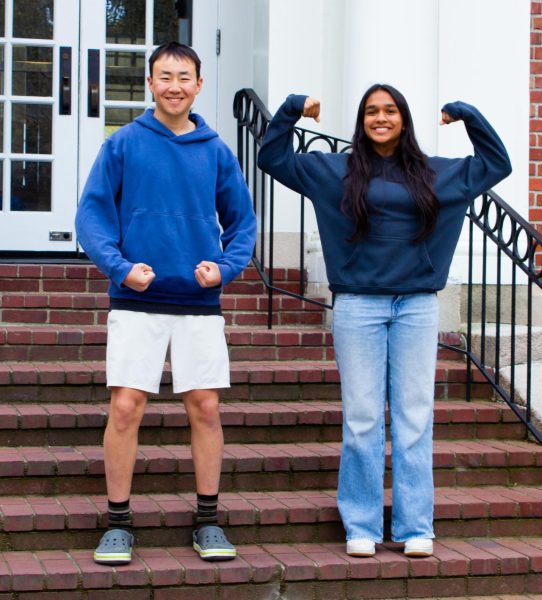
Weeks of preparation and campaigning all led up to the Student Body President elections that took place earlier this March. Finally, Tatler has the privilege of sitting down with President Timothy D. ’27 and Vice President Pia A. ’27 to discuss their vision as they step into the role of leadership for the 2026-2027 school year.
Q: How do you plan to expand on the work you’ve already done on Student Government?
Pia A. ’27 (PA): This was my first year on Student Government, and I feel like I’ve seen Gresham [current Student Body President] and Sonia [current Student Body Vice President] do a lot of work as president and vice president to make it easier for projects to actually become reality. That is my main goal as a rep; [I want to ensure that] it doesn’t feel like a huge barrier [when we are] trying to get something done. I want it to feel like … all those things [we] say in [our] speeches and [ideas] from your grade can actually be implemented within the school.
Timothy D. ’27 (TD): I feel like the two things that come to mind are community and feasibility. I want us to have more of a say when it comes to policy-based changes. For example, the new schedule [and] planning the calendar next year; I want us to be the ones who are involved … in these upper-level decisions instead of having it just be top-down. And on the community end, we already have had dances this year, which were really fun, but [I’d also like to have] more ways to be able to support your friends. I know the poster making station is pretty cool, but I think we also can have [cardboard] posters so you [can] show up to a game and support your friends. Just [doing] the small things that boost our community and [being] more present for students.
Q: How can you ensure that Student Government has a larger impact on Lakeside?
PA: I think it’s mostly just about transparency. From being on Student Government, I do think that there is some validity to the claims that we don’t do a lot, because it is hard to actually make bigger changes. But I do feel like if the student body were aware of what we were doing and how we were doing it, they could, first of all, get more involved, and then second of all … see what we’re doing and feel like they can actually have a say in that as well. So I think it’s more [about] communication, which I think Tim [Timothy D. ’27] has been doing a really good job of this year with the newsletter, as our publicist. So, [releasing] reels and … fun, enjoyable content, but also communicating what we want to be communicated.
TD: And I feel like my newsletter could also be a little bit more frequent, I suppose.
PA: Or, more frequent spirit boosters are one way to stay present.
TD: One of the things I was also thinking of, on the topic of more communication, is to have us talking with students more. Either during assembly, which might not be that preferred, or, I think the table outside the WCC was a great way to do that this year. … Another idea I just had was posting outside on our board what we’re currently talking about in our meetings. For example, we spend a good amount of time talking about lunchroom table messes and lunch duty stuff.
PA: I think it was just general disrespect for our campus. For example, the changes that were made about being quiet within the library. I think that’s true that if people know what we’re currently working on, there can be more input, and you can feel that the whole student body is pushing towards those changes. Whereas if we’re just doing them independently, it can feel closed off — I get that. I’ve [also] been [outside of] Student Government, so I know how that feels as well.
TD: And I definitely think about coming up with more ways to get people involved in good discussions on these kinds of things. I remember I went to the archivist in the schoolhouse one time to look at what [previous] Student Governments did with transparency. And for example, one thing they used to do was publish meeting papers, [including] minutes, that had tons of stuff about what they talked about in meetings.
Are there any projects that you hope to implement or that you are already working on?
TD: I really want a pool table in Vassar, and [portable] speakers [for students] would be really nice. And I said this in my speech, but [in] Moore Hall, [on the] 2nd floor, there’s [a] blue-walled classroom, and I thought, “this looks like such a perfect classroom for us to have a cool lounge space.” We’ll have to see what administration says, but I personally believe that if we show there is enough need from the students, they’ll be more likely to listen.
PA: The biggest thing for me is working towards the administration and teachers being able to communicate with each other about when their due dates are, because [students] have always been talking about this. I’ve talked to a couple teachers about this, but mainly what I’ve heard is that teachers have only had success when the departments have [had] time to talk to each other about when they’re doing these big projects, and currently, there isn’t a structured system for that. I think it can be … just as easy as a calendar. No one has done it yet, so it’s probably going to be complicated, but that is … my main goal. … I’ve [also] talked to people who are more coding-inclined [about] building some sort of system for [deadlines] to be streamlined and for teachers to talk to each other. I feel like that would be a meaningful change.
TD: Also, definitely planning early in the year to ensure we have a good schedule of what’s coming next year. I know that sometimes we tend to forget things that usually happen due to Student Government, so I want to start planning earlier, for example, with HOCO [Homecoming]. Additionally, hopefully even getting to meet over the summer, both as a hangout to get to know new reps better, to make those connections, and to make ourselves a big family. But also, to start planning for HOCO so we can get a theme out earlier and people can start actually dressing for them. And likewise, for spirit boosters, to start planning those so we don’t forget.
How do you think your teamwork will make your presidency successful?
PA: I want to say that Tim is very caring and puts in so much hard work and just truly wants to do good. So that is something I’m gonna learn a lot from him. Tim is going to put in the hard work, and I’m gonna have to match that. So, rising to the occasion, … learning to listen, and learning to be dedicated is what I can gain from Tim.
TD: [Pia] is also such a hard worker. For example, with the umbrellas [around campus]. [Pia is] always so thoughtful and always talking to so many students, so I feel like [she] really drive[s] me to push myself to connect, even if I may not really feel like it in the moment. And also, [she’s] very diplomatic as well. And sometimes I do tend to get a bit chaotic, so I feel like [she’s] our grounding force.
What is one specific goal you have for Lakeside next year?
TD: I want students to love each other more, to be present for each other more, [and] to love our school more. … If I were to say one goal, I want to build a stronger community where people feel like they can feel seen and they can support each other.
PA: I think that for me, something that Rohan, the [student body] president two years ago, said in his convocation speech was … “go to Lakeside and fail one test; your goal for this year is to purposely not study for one test.” That has really stuck with me. I think that we all have this deep sense to achieve greatness, but no one has reached it yet, and we’re all almost fighting for it. … Sometimes [it feels] like a little too much, even though obviously that’s what defines Lakeside in some ways. But I think it can be all-consuming, and I want there to be more opportunities for people to accept failure.
TD: Yeah, greatness isn’t what you do. It’s in the relationships you build. I definitely see lots of potential with the [new] building and all the change that’s happening.
PA: I think that it also can feel like a daunting task for us to want to change school culture, but truly, I feel like if you don’t reach for something bigger, then you’re not going to get anywhere. So, I like that we’re gonna start with these big goals, and then hopefully we’ll be able to inch towards something better, and whoever’s president and vice president [next year], and everyone else on Student Government next year can also help us with that.
TD: There’s someone, I think William Murray [’21]. I don’t remember his tenure, but I remember that he was a good president. Same with Luke Li [’23], just because they were very present for the student body. And I feel like it’s all [about] the small actions. I just want to talk about, when we’re seniors next year, us being [the] big brothers and big sisters of the school. Because I feel like a lot of it definitely comes from people [who] see that small actions can have big results.
And finally, what message do you hope to send out to the student body?
PA: That we aren’t doing this [with] just the two of us. … We want to work with everyone, and we would appreciate all of the feedback and all of the advice and all of the help we can get so it can feel communal.
TD: Let’s Timothy-do this, but let’s do it together!
This interview has been edited for clarity.