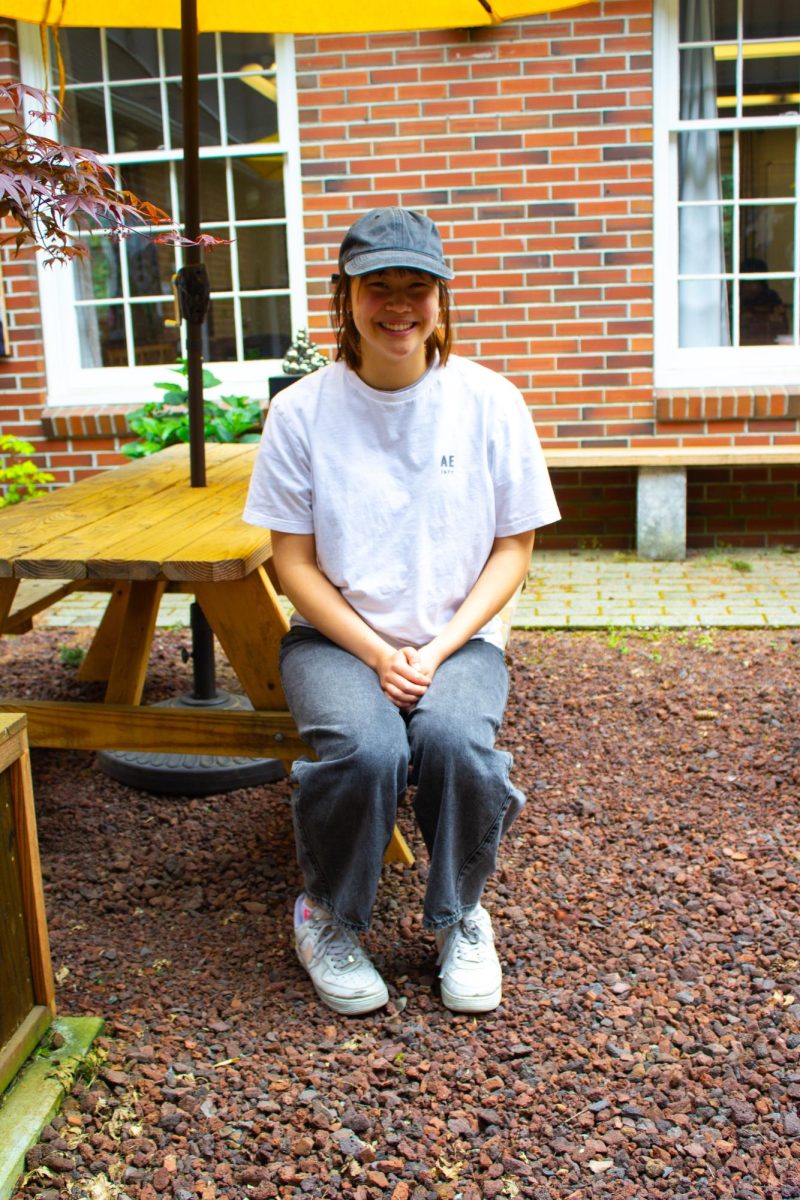
In the midst of a busy A3 lunch period, Nami G. ’28 sips from her bowl of pho, balancing conversation, lunch, and a laptop brimming with ideas. “Oh, yeah, it’s, like, a fantasy novel about a war in a kind of a frozen kingdom,” she says, as she pulls the document up onto her screen. The lunch period is nearing its end, and Nami talks fast, enthused and flowing from idea to idea.
Nami is no stranger to squeezing personal projects between school ones and balancing a loaded plate. “After I’d get home from school, I’d do homework, and then I’d try to write,” she says. “On days off, after I’d finished any homework, I would create this schedule for myself where I would write for the rest of the day.”
And write she has. After completing a full-length novel in 7th grade, followed by two years of editing, she is now looking to publish.
Her novel follows Eskra, who, after the bombing of her home, finds herself fleeing Estravia’s glittering industrial cities to live in a tundra with a mysterious fellow refugee from her hometown. Eight years later, Eskra is recruited to Estravia’s military academy, known for its prestige and famous graduates — but most of all, its brutal training program. All Eskra wants to do is work hard, graduate quickly, and avenge her parents’ deaths. But as rule-breakers wreak havoc across campus and Estravia begins losing the war, Eskra’s plans go awry after she discovers the horrors behind her country’s utopian facade.
The story’s frozen and barren tundra backdrop — an element central to the plot and environment — was something that immediately drew Nami in and kickstarted the writing process, she says. “I’d never written anything in a frozen setting,” she explains. “There was one in a grassland and one kind of in the Pacific Northwest-like area — but nothing as desolate as a tundra.” And of the military school setting, she says, her own experiences of being a student were vital in the portrayal of the characters. “All of the characters are students,” she says. “I’ve tried to write characters who aren’t students or are older, but it’s a lot harder because I haven’t been there myself.”
Despite her being only in the 7th grade at the time of writing her first draft, Nami’s interest started even earlier. In between sips of pho, she tosses out casually, “I’ve been writing books for a while” — a remark understating the prolific nature of her work, as some authors take decades to finish a single book. “I think my interest in writing started in 1st grade,” she says. “Before 1st grade, I couldn’t write down most of my stories, so I would tell them to my parents, and they would scribe them for me. First grade was when I started writing stories down into journals.”
Nami’s genre of choice is fantasy, which she explains she was immediately drawn to. “I really enjoyed fantasy books, and because of that, I’ve always kind of thought that I wanted to be a published author someday.” Over the years, she has experimented with different genres. “I tried writing historical fiction when I was younger,” she clarifies, “but for me, I just like fantasy, because it gives you a lot more creative liberty.”
And her medium of choice is — of course — the novel. “I like other types of writing, like journalism, poetry, and short stories,” she says. “But I feel like I’m kind of long-winded whenever I try to tell something. So, it ends up getting too complicated, or it ends up not being short.” Long-form stories, she says, are the sweet spot.
According to Nami, her current book is “80,000 words, maybe 90,000.” And the first draft, she says, was even longer. “I had this full plan. It was going to be a five-part book,” she says. “And so then I finished writing the first part, and I realized it was 100,000 words and already the length of a book, and I was like, ‘uh-oh, this isn’t going to work out.’”
“So I was like, ‘okay, maybe it’ll be five separate books.’” As she began writing part two, she recalled, she realized that she could “condense the first part down a bunch.” And so, she says, began the arduous and multi-year process of editing.
“I wrote down every single scene in part one to figure out what scenes I needed and what I actually didn’t.” She scrapped part one, rewriting the entire draft from scratch. “Along the way, a bunch of things changed,” Nami says. She changed “the name of the characters, a lot of their personalities.” Ever since then, she says, she followed her plan for what she wanted the plot to look like. “I just leave all the typos and all of the plot holes there. I’ve just been editing ever since.”
“[Editing] was one of the hardest parts,” Nami adds. “It’s been — well, two things. There’s the full editing process. Because I’m not really a good editor — so it’s taken a while to read through and edit. And then also, for some of my characters, I was having trouble figuring out who I wanted them to be. Especially the names — some people have had three names throughout the course of the editing process, or even four for some people.”
Still, the editing process ended up being uniquely rewarding, Nami says. “My favorite part of the process was editing the end and starting to see everything come together.”
As for future plans, Nami says she is already in the process of writing another novel. “I haven’t written in a while, so I think I just need to switch my editing brain off,” she explains. And despite her productivity, she says she often experiences writer’s block. “I started trying to plan the book instead of writing it, and I got writer’s block,” she says.
But she does offer solutions: skip forward in the chronology to write a new section, she suggests, or try to clear your mind by riding a bike. She adds that writer’s block is often more of a symptom than a problem: “For me, when I’m getting writer’s block, it’s a sign that I’m not as interested in the scene. So, I try to introduce an element to the scene that makes it a little bit more interesting.”
Though the novel is new, Nami’s ethos of go-with-the-flow writing and rigorous editing remains the same. Her current methodology to introduce a new, exciting element is “to go in blindfolded” and watch the story unfold in new and interesting ways. “I think I’ll just write,” she says, “and see what ends up happening.”
Reflecting on her experience of being an author, Nami has another piece of advice to offer to prospective authors and creatives. “I think a lot of times, people say, ‘I’d do it if I had more time,’” she says. “But I think at the end of the day, especially if you go to Lakeside, your life’s gonna be really busy. So, I guess, just try to find time. You might need to do a small assignment on the bus, or not stress too much about assignments, just so that you have that extra time to write.”
Between assignments, bus rides, and homework, Nami continues to write, exploring fantasy lands of frozen tundras and grasslands. Her love for writing has, and will continue to be, a “lifelong thing,” she says. “I think, just do it,” she offers as a final piece of advice. And perhaps no one is as adept at embodying this idea as herself: for Nami, imagination doesn’t wait for the right moment. She seeks out stories, eking progress out of small moments, day after day, words and worlds sprawling ceaselessly from her pen.