
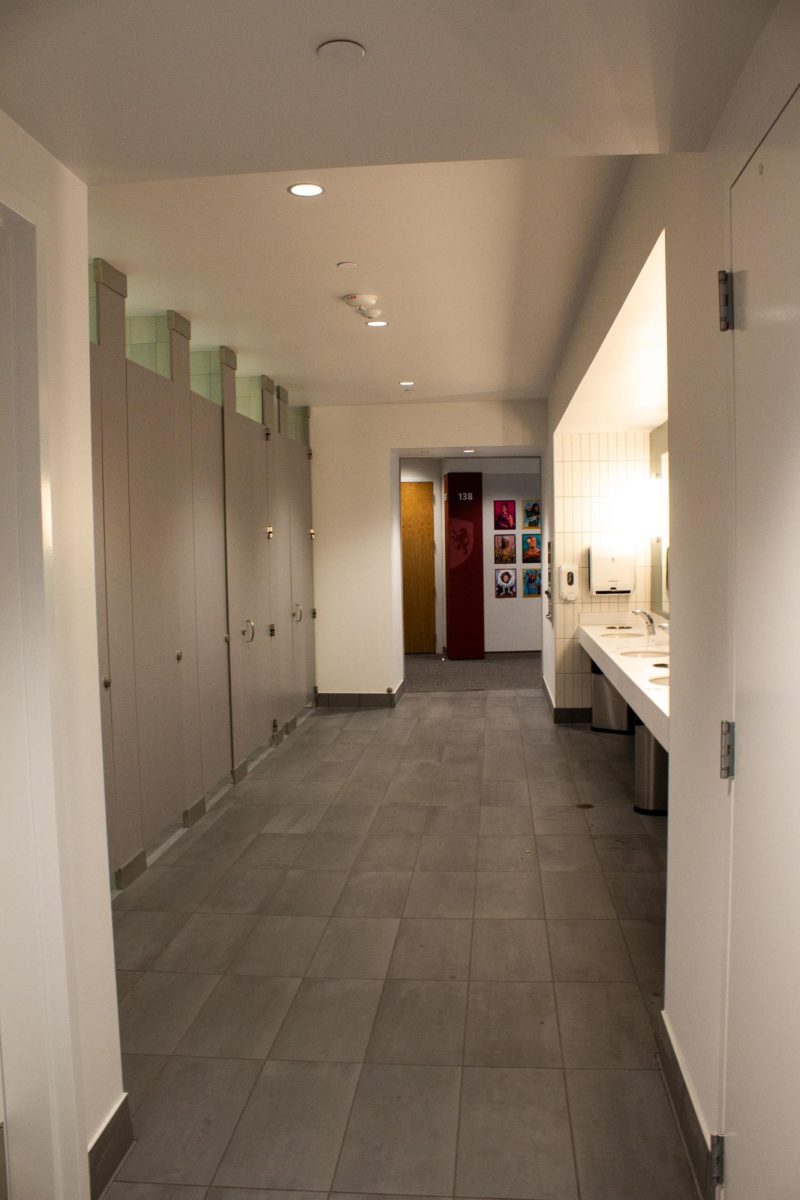
When the T.J. Vassar ’68 Center for Sciences and Humanities first opened and members of the Lakeside community were allowed to tour various parts of the new building, whispers rippled through the student body about one thing in particular: the bathrooms. While the whole building’s design is starkly different from the rest of the buildings on campus, the bathroom structure received the most mixed responses, ranging from delight to confusion and even anger. While the bathrooms aren’t as bad as some people think, I believe it would be extremely beneficial to implement doors around the area.
Lakeside worked with several companies during the building process, including LMN Architects and BNBuilders. Tatler interviewed members from both companies as well as administration to shine light on their reasoning behind certain decisions, and I paired that with my own analysis on how this might affect Lakesider’s life in the new building.
Concern 1: The Location
The most obvious thing about the bathrooms are their locations: The two bathrooms are essentially long hallways at the very heart of each floor. This design is very different from bathrooms in other buildings like Bliss, Moore, or Allen-Gates, where the bathrooms are situated near the side, and the center is occupied by rooms like the main office, the Bliss conference room, classrooms, or teacher workspaces.
Through talking to different people involved in the construction process, I found that there are two reasons behind the location of the bathrooms, the first one being convenience. “Rather than segregating these two restrooms to different parts of the building, [Lakeside] thought it was a good idea to have it in a central location, so when class ends, [especially with science on one side and humanities on the other], [people] can share a common space between the two sides rather than having boys running to one corner and girls running to another corner,” said LMN architect John Lim.
The second is saving resources. “If you build two separate restrooms, then you’re effectively doubling the infrastructure needed to take care of it, like the sewer lines and water lines,” Lim continued.
Even though placing the bathroom in a central location certainly is convenient and saves more space than building two different bathrooms, the problem lies not with the location alone, but how it exacerbates another concern: the openness.
Concern 2: The Ventilation
One of the concerns stemming from the openness and location is the ventilation: With classrooms and workspaces being so close to the bathrooms, wouldn’t it be extremely awkward to hear and smell people doing their business?
Architects were cognizant of this potential problem, and constructed the bathrooms in a way that would hypothetically solve it. “Each stall has its own dedicated exhaust system and there are partitions segregating each of the stalls, so I don’t think [students] have to worry about the smell lingering,” assured Lim. Interim Head of School Ryan Boccuzzi adds that each stall is, by code, treated as if it is its own room, decked with its own ventilation, smoke detector, and sprinkler system.
Although there is a system in place to get rid of lingering smells, whether or not it functions properly is a different conversation. Upon having classes in the Vassar Center, many students noted that the temperature on the thermostat doesn’t match the temperature in the room: In my own experience, while it showed 76 degrees on the thermostat, my classmates and I were cold despite wearing thick jackets and sweatshirts. With the ventilation system being the only measure in place preventing bad smells from lingering, it’s extremely crucial that it is checked regularly, especially with the alarming signs of ventilation malfunction in normal classrooms.
While the issue of bad smells may be semi-covered, the issue of sounds still remains.
“All of the walls [around] are fully insulated: behind the toilets and on the ends to help with the separation of sound. Also, if a teacher wants to close the door, they can, and if during class, someone leaves the classroom, the door automatically closes, which helps with mitigating the noise transfer,” BNBuilders Senior Project Manager Jessica Jenness said in an interview with Tatler. She also added that the assembly of the insulated walls received the best possible acoustical rating, a value measuring how well something absorbs sound.
Despite this, while attending a class near the bathroom, I could hear sounds of the sink running and other bodily noises with a closed classroom door. On top of this, there are many reasons why a teacher would want to leave the classroom door open (i.e., if ventilation malfunctions on a blistering summer day), so it’s unreasonable to request that teachers keep their classroom door closed at all times to block out sounds from a bathroom.
Concern 3: Privacy
Another problem connected to the bathrooms’ openness is privacy. While bathrooms in all other buildings are enclosed with a door, the Vassar Center’s bathrooms are completely open, meaning anyone who passes by can see the entirety of a typically private space.
“It’s not a huge space, and if you added more doors, then, as [people] go in and out of the space, [they] would run into other people, and that becomes a bottleneck,” Mr. Lim explained. It also has to do with security as well, because doors present an opportunity for someone to lurk — not that that’s going to happen, but in a high school setting, I think it’s appropriate that you have good sightlines and be able to see who’s inside.”
Mr. Boccuzzi also acknowledged that students might feel like there’s less privacy in the main space, which includes the vanity of the bathroom sinks and mirrors, but added, “I do think it’s fine with [administration] that students might hang out in those spaces or do other things in those spaces less than they would in other bathrooms.”
There are so many other ways to get from one side of the building to another, with the route passing through the bathroom being one of the least ideal. So, even if there were doors on each side, it’s highly unlikely to create a bottleneck. In terms of privacy of the main space, it prevents dilly-dallying in the bathroom, but at a cost. The main space is naturally connected to each stall, so everyone passing by can see when, where, and how long you’re spending in the stalls. That in itself is extremely uncomfortable, and makes it so people feel conscious about going inside.
While the main space has little to no privacy, Lakeside built the individual stalls in a way that maximizes privacy. One large design difference between previous bathrooms and this new bathroom is that every stall is designed to be completely gapless due to the material of the doors: phenolic. “If you go into Allen-Gates and look at those restrooms which have the metal compartments, the way that the door and like the panel next to it go together, there’s always this little peekaboo gap. Hopefully most people aren’t trying to see what’s going on in there, but you can always kind of walk by and tell if someone’s in there or not, and sometimes, people can feel self-conscious with these little peekaboo gaps,” Jenness explained. “That’s just the result of those types of panels; there’s no way to build metal compartments without that. One of the features of these phenolic fronts is that the way that the door is closed, there’s actually an overlap, so there’s no peekaboo gap.”
Another feature of the bathroom stalls is that all four surroundings are almost floor to ceiling. To be exact, the stall door is almost floor to ceiling, and the other three walls are completely floor to ceiling. “The reason we chose not to [make the stall door floor to ceiling] is because we are a school and we’re responsible for the safety and security of all the students that are here. There might be a situation where we need to know … if there was someone inside,” Mr. Boccuzzi said.
The administration is very careful about ensuring student privacy in the stalls, shown by how two stalls are temporarily out of order and being replaced on the second floor because after installation, small gaps appeared between the stall door and the surrounding wall. While this is greatly appreciated and certainly helps students feel more comfortable in a non-gendered and open environment, more privacy measures implemented throughout the bathroom to reduce visibility of stalls would be much appreciated.
Concern 4: All Gender Neutral
Speaking of a non-gendered environment, another shock to students when the new building was unveiled was that every bathroom was gender neutral, marking the Vassar Center as the first Lakeside building without a gendered option. Why was this decision made? “We did a series of student focus groups. We pulled three or four focus groups together for a total of 15-ish kids. We were talking about, ‘what do you want to see in different spaces?’ and the idea of more gender-neutral spaces came up,” explained Mr. Boccuzzi.
After making the decision to continue with gender-neutral bathrooms, LMN Architects created a plan that aligned with Lakeside’s values, which included safety, privacy, and inclusivity. To do this, architects looked into successful designs of gender-neutral bathrooms in other spaces for inspiration. “We are always trying to compare our design with other schools that are comparable. Bush school has these gender-neutral options, and some other schools like [Seattle Academy of Arts and Sciences (SAAS)] also [do],” Lim said.
When looking through pictures of such schools with gender-neutral bathrooms, Vassar Center’s bathrooms look strikingly similar to those at the SAAS Upper School. Mr. Boccuzzi tells Tatler in the interview that at times, Lakeside administrators were skeptical of the design and reached out to schools like SAAS and the Bush School which had already implemented gender-neutral bathrooms, and received many comments about how successful and unproblematic it was.
A Lakeside student’s experience shouldn’t be any different than that of a student in a comparable space at SAAS or Bush. Going in completely blind and facing the huge leap from gendered to gender-neutral bathrooms are what drove so much anxiety for many students, but hearing that this system is functional in so many other similar spaces is very soothing.
Of course, this doesn’t discount the majority of students in the Tatler Poll, who have expressed anonymously that not having gender separation felt “odd,” “weird,” and “uncomfortable.” To that, Mr. Boccuzzi says, “There are a ton of restrooms on this campus. If you prefer a gender specific restroom, you will not have trouble finding one.”
What Mr. Boccuzzi said raised a question for me: Allen-Gates has gendered options downstairs and gender-neutral options upstairs, so why couldn’t that 50-50 split be applied to the Vassar Center? While Mr. Boccuzzi didn’t remember why this 50-50 split couldn’t be applied, Ms. Jenness has a hypothesis: “Most buildings stack the restrooms, and by ‘stack,’ we mean they occur on top of each other. The reason for that is the piping continues up from one floor to the next, so if you didn’t have the same restroom on the 1st floor and the 2nd floor, it would require some design consideration for how to route plumbing to different places.” And while having different bathrooms on the first and second floor was theoretically possible, there were significant constraints that made this a technical nightmare: extra space needed to route plumbing, higher costs, more access panels for maintenance, etc.
All this being said, Mr. Boccuzzi made it clear in his interview with Tatler that despite backlash, Lakeside would not completely rebuild the bathrooms. While small tweaks can be made, the bathrooms making a switch from gender neutral to gendered is highly unlikely. For members of the community who truly find this uncomfortable, Allen-Gates and the library are just a hop, skip, and a jump away.
Communication
While I personally do not have qualms about gender neutrality, what I do have a problem with is only consulting 15 students to make a decision that affects the entire school. On top of this, the plans to make all bathrooms gender neutral were kept in the dark until a few months ago, and were never brought up in any of the Vassar Center design presentations, preventing students from voicing opinions and potentially advocating for changes. This is especially crucial because bathrooms are supposed to be private spaces where everyone feels safe.
This belongs in the long list of examples of communication disconnections between administrators and students. From the phone ban to the assembly seating chart to grades being taken away for 7th and 8th graders in the Middle School, it’s extremely frustrating that such drastic changes are being sprung upon us left and right without consultation or forewarning.
A Potential Solution
To prevent bad smells, block more sound, and provide more privacy, the obvious answer would be to install a door — even a translucent one so adults can hold students accountable if they’re trying to skip class. When talking to Jenness, she wasn’t able to give me a direct answer for how much a door would cost; however, she cited that it could be a complicated process, as the door frame has a stone trim. She emphasized that this wasn’t to say that it wasn’t possible — only that it would take more thought, resources, and time.
April is a very weird time to open a new building, as it would more sensibly be opened in the beginning of the school year. This decision was made so that these last couple of months of this school year could serve as a pilot, and any concerns can be dealt with before school starts next year. “We are open to feedback. I’m not pretending like we’ve [ever] designed a bathroom in a science and English building before. This is good for us to know,” said Mr. Boccuzzi. Despite this, it’s evident that he’s still cautious of implementing too much change too early, especially since such changes can stir up emotions and cause people to overreact.
Of course, at the time of writing this article, classes have just begun to settle in, so it’s hard to tell how the bathroom situation will pan out. In a month’s time, when classes have settled in, it’s imperative that we as a community look back on how we felt and reevaluate on these issues: Did these concerns simply arise from fear of change, or do they stem from valid concerns?