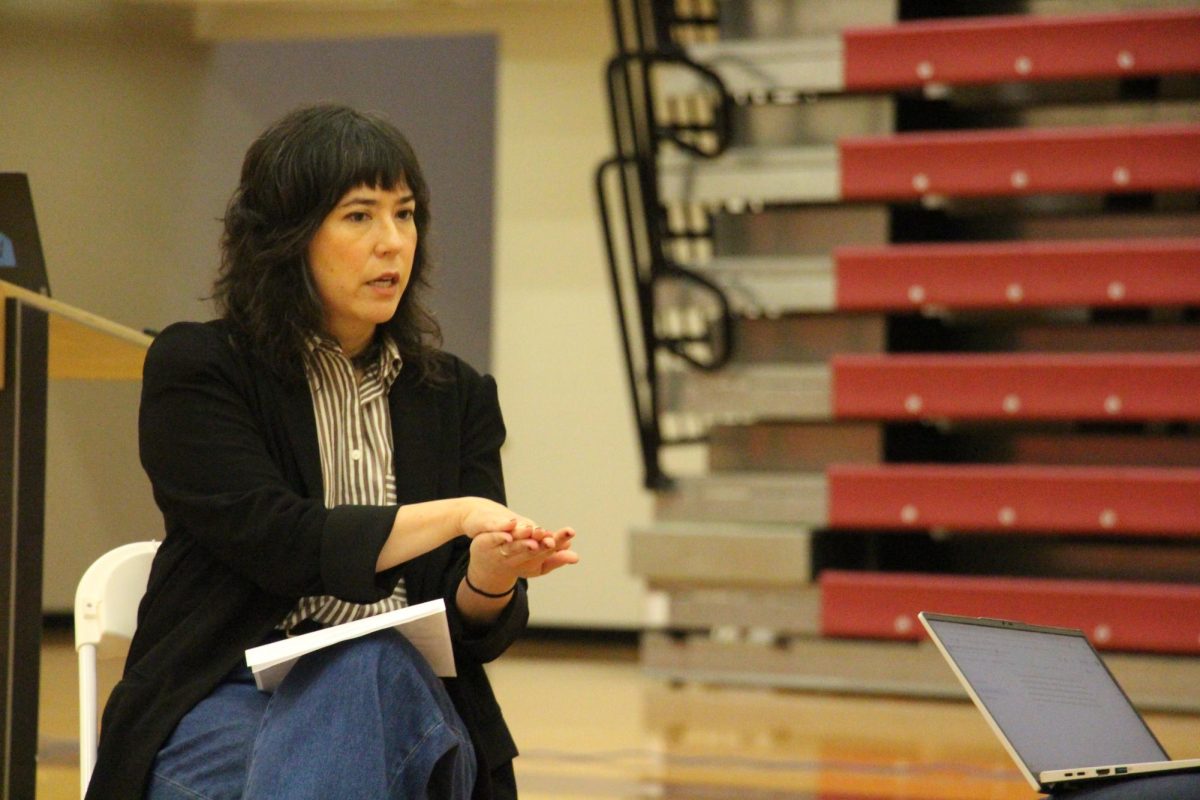
Megan Asaka ’99 is the author of Seattle From the Margins: Exclusion, Erasure, and the Making of a Pacific Coast City, in which she explores Seattle’s origins by weaving through different stories of how Asian Americans, Indigenous people, and other marginalized groups played a crucial role in Seattle’s workforce. She’s also an award-winning scholar, author, and professor of Asian American history, urban history, and public humanities at UC Riverside. In her lecture at the Upper School, she made a case for maintaining birthright citizenship by bringing the Lakeside community through decades of court cases and presenting parallels with African American rights before the Civil War. Also the sister of Assistant Head of School Jamie Asaka, Tatler had the opportunity to speak to Professor Megan Asaka before the lecture to focus on her research on Asian American resistance both throughout history and today.
Natalie G. (NG): In your book and several interviews, you speak on how Asian migrants and Indigenous people were erased from history. Do you have any examples of resistance against this erasure? How does this contradict certain Asian stereotypes today?
That’s such a great question because I think the prevailing stereotype of Asian Americans today — which wasn’t always true — is the model minority myth, and that myth came about in the 50s and 60s for very specific reasons: it was used during the Civil Rights Movement to create a narrative of success and self-reliance of a minority group and to use as a weapon against African Americans during this movement. It was very divide and conquer.
And so for me, highlighting acts of resistance and an agency of Asian Americans in the past is really important, because I think it counters the model minority myth that so many Asian Americans grow up really struggling with. In terms of acts of resistance, there’s a few things that I highlight in my book: I talk about labor resistance, so when Asian and Indigenous workers feel exploited and taken advantage of, they do things like withhold their labor, strike, and demand higher wages. I would also say there’s resistance in terms of marginalized people living their lives how they want to. I think that’s also a form of resistance: rejecting expectations and rejecting certain norms that are placed onto them, and just living their lives autonomously and peacefully on their own terms.
I think there’s also an idea of Asian Americans being passive and conforming, but that’s not at all what I’m seeing in the archives and in history. They were creative; they were wild; they were troublemakers. Those stories are also important to highlight because those are also acts we can understand as resistance to dominant expectations at the time.
NG: Can you share a specific act of resistance that you found super impactful through your research?
I find the most powerful acts of resistance are when different groups of people come together, united for the same cause. I think it’s really powerful when people come together across differences, and not to say that those differences aren’t important, but that doesn’t mean people can’t unify together around particular issues and struggles. For example, Civil rights leaders, along with Asian American leaders, came together and really pushed for immigration reform as part of this broader civil rights movement, and they were incredibly successful.
NG: You are a fourth-generation Japanese-American, so your family has experienced many times of great discrimination against Asian Americans, including anti-Asian sentiment stemming from the Chinese Exclusion Act, the incarceration of Japanese-Americans during World War II, and most recently, Covid-19. Could you share how you and your family showed resistance through these events?
When I was visiting Dr. Pingree’s class on Seattle history, a student asked me what was the most surprising thing that I’ve learned through my research, and I showed a picture of two Japanese lumber workers from the 1920s who were holding rifles. I learned that my great grandfather was the one who smuggled those rifles into their labor camp so they could defend themselves against white mobs.
So that’s one example, but I’d also say that we should think about resistance in more complicated ways. My Japanese-American grandfather fought in World War II, and he fought in segregated unit 442. For a long time, I felt like he was just conforming to this patriotic, model minority narrative of Japanese Americans, but more recently, I’ve thought more about his decision to serve. You could say that that might also be an act of resistance because I assume he was trying to help his family who was incarcerated in Manzanar, a Japanese incarceration camp. I imagine that this was a choice that he made to try to sacrifice — possibly his life — to help free his family and his parents. It was perhaps also a way for him to fight for a United States of America that promised democracy. So I’ve actually changed how I think about resistance a lot, and acknowledge these more quiet acts as a form of resistance as well.
NG: In an article you wrote for the Seattle Times detailing your personal connection with your book, Seattle From the Margins, you write, “It’s my hope that the book can open new understandings of Seattle’s past, and how the past continues to reverberate in the present.” During the Covid-19 pandemic, which was relatively recent, we saw this huge insurgence of AAPI hate. Is this insurgence connected to any of your previous historical research?
Absolutely, unfortunately. We see Asian Americans being a scapegoat. That’s a constant throughout U.S. History: being scapegoated for economic problems, financial problems, and social issues that are beyond our control. There’s a deep-seated xenophobia in this country, and Asian Americans are often targeted with that, including the violence inflicted on anyone who even looked East Asian during Covid-19.
It’s part of a much longer history. In the 1980s, for example, when Japan arose as an economic competitor to the United States in manufacturing of cars and electronics, there was also a surge of violence against Asian Americans. There’s the case of Vincent Chin. He was a Chinese-American who was killed by two white out-of-work auto workers in Detroit who mistook him for a Japanese person, because they claimed he was responsible for their lay-off. Then you can go back to Japanese American incarceration and anti-Chinese violence in the late 19th century.
So, unfortunately, over time we see that Asian Americans — and Latinos in this moment — have been scapegoated for larger issues that they have no control over. This parallel is really important to acknowledge because Covid and the backlash against Asian Americans was not new. So, history is valuable in that it can help us understand the present, to help us then equip us better to respond in the current moment.
NG: You’ve talked about Asian Americans being scapegoats, and at the same time, we have this model minority myth where Asian Americans are the model. Could you explain this confusing juxtaposition?
It’s a complexity, and so this is, again, where history is really important. So what we see before World War II, Asian Americans are the “yellow peril.” They’re the enemies of the United States. They can never be citizens. What we see is that it doesn’t go away, but we see the coexistence of another stereotype, which is model minority.
I see them as two sides of the same coin. You can see them flipping: at one time we’re blamed for Covid and subjected to racial violence, while on the other hand, we’re being held up as the model minority. I think it’s helpful to think of this as two sides of the same coin because the model minority is also a racist stereotype. It manifests differently, but it’s coming from the same root as the Yellow Peril stereotype. It’s just coming out as “praise” instead of physical violence or hostility.
Model minority is tricky because on its surface, it seems like it’s not a bad thing, but I think two things about the model minority: one is that it sets up impossibly high expectations for Asian Americans, especially students and youth, that are impossible to live up to, and that creates a lot of mental health issues. Second, there’s this idea of Asian Americans as being like white people. But Asian Americans are never going to fully be accepted as white people, and I don’t think that’s what Asian Americans should strive for.
I think the power is actually in Asian Americans defining who we are in our own terms, so in my teaching, I try to use history to denaturalize the model minority myth, and to get Asian Americans to think about who we are on our own terms.
NG: You were talking about undocumented Asian Americans in the US. ICE has been a huge talking point in this country, especially since we’ve heard many stories about Latino immigrants and Black immigrants being deported, but I don’t hear very many stories about Asian Americans. So, is ICE affecting Asian Americans? And if so, why is this not as mainstream?
Absolutely, but this has been true since before the Trump administration. The cases that I’ve read about in Southern California involve a lot of Southeast Asians who came as either refugee children or who came with their parents in the 70s and 80s. They’re targeted by ICE and then, they’re either locked up or deported to places like Laos or Cambodia — countries they don’t know.
I actually assigned a reading for my Asian American History class about the case of a refugee who came with his parents when he was a child, was incarcerated as an adult in California, and was among those people who were forced to fight fires. For context, in California, they use incarcerated people to fight wildfires, and then after he had provided that service and served his prison time, he was picked up by ICE and was in detention. In the end, the community did mobilize and managed to stop that deportation.
As for why we don’t know the story of undocumented Asian Americans, and why we don’t know that they’re also being targeted by ICE, I think the model minority is part of the issue. It makes people assume that Asian Americans are not facing things like this.
This interview has been edited for grammar, concision, and clarity.