
Grab your best dancing dancing shoes and get ready to move and groove, because after over 20 years, Lakeside’s dance team has made its comeback. Led by history teacher Sam Weiman, dance joins an extensive list of clubs and sports, with hopes of increasing school spirit and allowing dancers an opportunity to showcase their passion.
At Lakeside, the existence of dance has repeatedly fluctuated. According to the Tatler archives, dance classes were first proposed in 1991. Though the program faced difficulties entailing a lack of student interest (or, for more experienced dancers, a lack of willingness to leave outside studios) and available resources, the class was introduced in the fall of 1994 as a physical education elective titled Jazz and Modern Dance. The class continued until 1998. In 2015, dance emerged once again in Meaning through Movement and Dance, a drama elective designed to give “all students an understanding of human movement, its capacity for expressive storytelling, and skills to control and manipulate objects,” according to the Upper School curriculum guides.
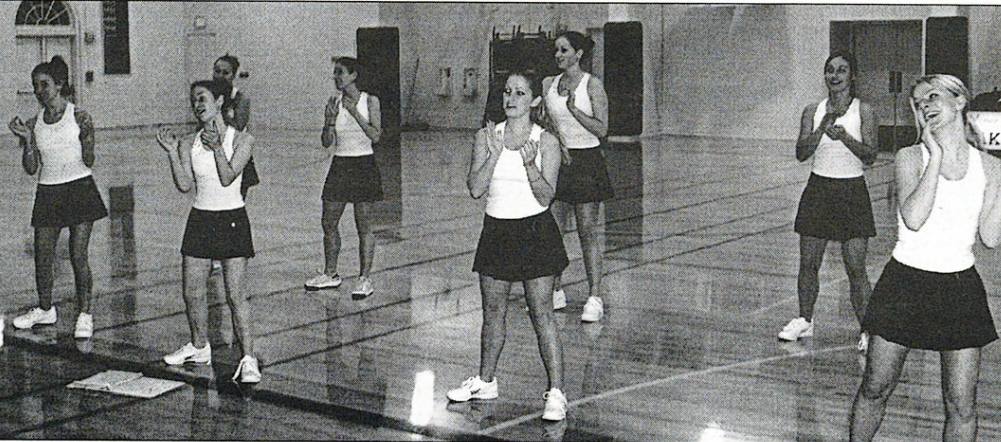
However, dance was not solely found within the classroom. Affinity groups often utilized dance within their meetings, for example, and physical education classes generally included some dancing even before the surfacing of dance-specific electives. Several clubs have also involved dance, specifically Global Dance Club, which is no longer in existence due to the departure of its senior leaders. Possibly the most notable, however, was a student-run dance squad formed in the early 2000s. The team mainly performed at halftime during varsity basketball games. “The Lakeside Dance Team stunned the crowd with an obviously well-rehearsed routine. Their energy and coordination made it a very enjoyable performance … this new club has begun the year with a bang,” a 2003 Tatler article covering the new squad wrote.
Though dance has not always been a prevalent activity or class, Upper School Assistant Director Jeff Bonar believes that the problem has been less a lack of student interest and more a difficulty in getting anything started. “I think sometimes people think that if they don’t see [a club], then it’s not allowed,” Mr. Bonar noted. “We’re just waiting for a little momentum within the student population.”
This momentum, however, seems to have arrived. Sam, who grew up as a competitive dancer and now continues to dance recreationally, recalls first considering the creation of a dance squad during a recent pep rally. “There was so much potential energy in the room,” she remembers. However, without many “classic features of a pep rally,” there was difficulty harnessing this energy. Similarly, after watching several dance performances at the ROARing Hearts auction, Mr. Bonar had recently been considering how to highlight dance within the community. After consideration, Sam approached Mr. Bonar and the administration. With their support, she gauged interest from the greater community and started the team.
While there were over 30 students who first showed interest in joining the squad, there are currently six to eight students who are fully committed, likely because of how busy many Lakesiders are. Despite this, Sam hopes that more students are able to join given the amount of initial interest, emphasizing that student involvement is crucial to the success of a dance program. On a similar note, Amani T. ’26, a choreographer and dancer on the team, encourages all students to join and emphasizes the benefits of taking the risk no matter one’s level of experience. “Everyone can dance … but what’s harder is to trust yourself to do that, and I think dance is a great way to build trust within yourself.”
Within the dance team, student choreographers are currently preparing routines for other members to learn and showcase as a group at an upcoming pep rally. Sam notes that the performance will include a variety of songs combining genres like jazz, pop, Latin, and house music, with the goal of increasing excitement within the student body. The importance of the dance squad is not simply the ability to bring energy and enthusiasm to events, however. “We have so many dancers at the school, and I think they can sometimes not feel as though they can bring that part of themselves to school,” Sam commented. “[I want] them to have a place where they get to showcase their passions and their talents … in the same way that athletes and people in other clubs do.” She also hopes to make events such as pep rallies more inclusive, citing the dance team as a way to celebrate athletics while bringing in the performing arts. Amani anticipates that dance may become a means of bringing people together as well. “I really want it to be a fuel for community building, not just within Lakeside, but outside of Lakeside,” she remarked.
It is also worthwhile to note that, while dance has many mental and physical health benefits, it is often associated with toxic culture, specifically around body image. Sam acknowledges the importance of this topic, especially as a dancer herself. She hopes to combat this through non-revealing costumes, choreography that is accessible to all, and conscious choices of dance style and song. “Micky and Alban have already set up a really positive performance culture at school,” she added, and the dance team will likely be “integrating into that.” Similarly, Amani emphasized that “[dancers] are not meant to look perfect in any way, shape, or form while dancing.” She added that while dance as a whole may be associated with a toxic culture, “it’s not something that’s embedded in my teaching culture and not something that’s embedded in Lakeside’s culture.” Alice M. ’27, another dancer on the team, hopes that as the club gains more foundation and possibly begins to compete, they will more explicitly reinforce that “anyone can do dance and you don’t need to have a certain body to do that, you don’t need to have a certain look to do that. Everyone is welcome.”
The dance squad is currently classified as a club and Mr. Bonar explains that the current goal is to “[keep] it as simple as possible to try to generate interest and see little spots where we can highlight a performance or two.” However, both Mr. Bonar and Sam are open to the idea of expanding the team and even possibly competing against other schools if enough interest arises. “There are a lot of hoops that you have to jump through in regards to that,” Mr. Bonar commented, but “[if] there’s a desire to go to something against other schools, we can have conversations about that to see if that’s realistic for us or not.”
As for now, members of the dance squad are hopeful for the future of the team and excited for the upcoming pep rally. Alice hopes to continue adding more ways to get dance embedded in the community. “I always want more art here to counterbalance all of the tough academics that we have,” she said, adding that “we’re just trying to have the most fun possible and make art for other people to see.” For Amani, “dance is all about having fun, dance is all about expression. … Dance is not meant to be perfect and I hope others can see that and just have fun with the music and the dance.”