
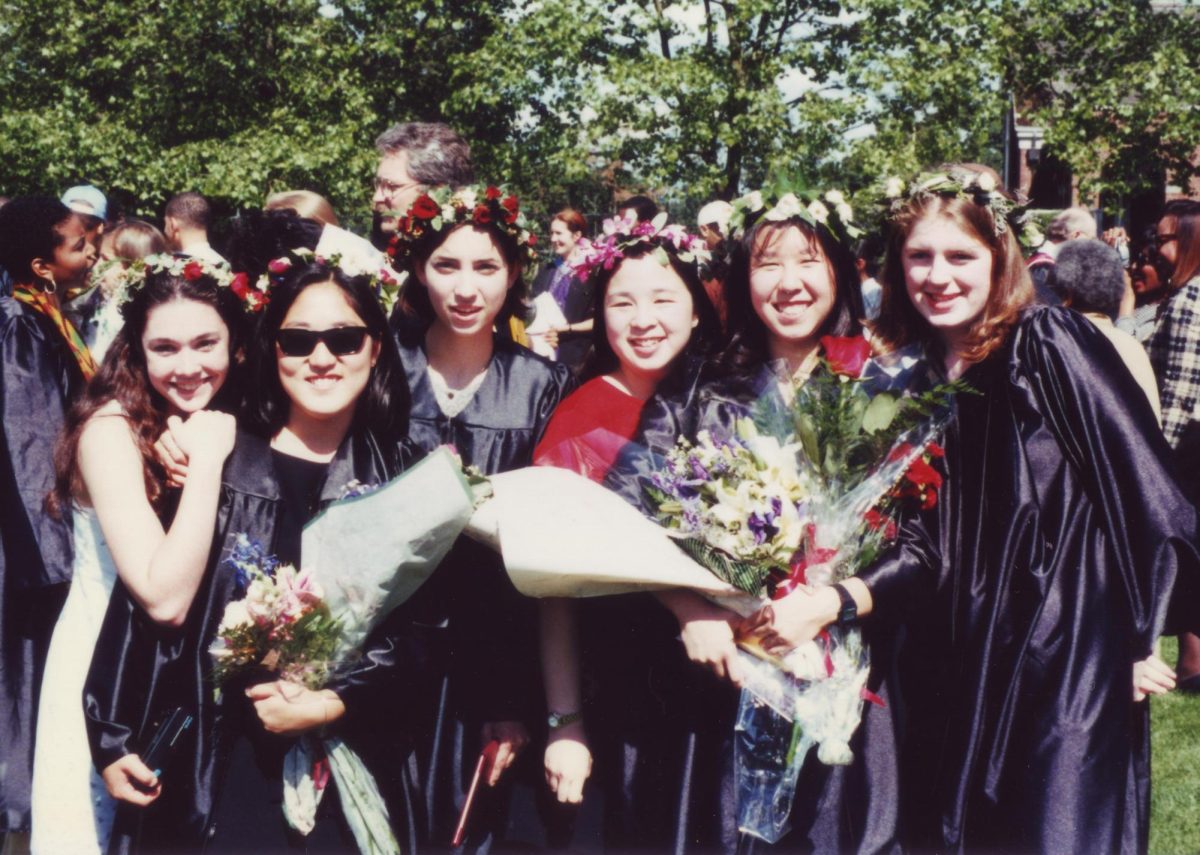
From the first day of classes in 1919 to today’s Tatler special issue, Lakeside has always been in motion. While retaining our core values and priorities, we’ve grown immensely to reach where we are today. Four members of Lakeside’s current alum board — across age, race, gender, and socioeconomic status — shared their unique stories for a look into both the long-term changes and the enduring constants of the school.
Academics
Lakeside’s reputation is built upon its academic rigor and educational excellence. Accordingly, each alum gave glowing reviews of the individualized attention and dedicated faculty. Nate Benjamin ’07 lauds the small class sizes that promoted personalized feedback: “it was probably one of the best one-on-one or small group feedback that I ever got on my writing.” Similarly, Junemee Kim ’97, who had a Lakeside faculty table at her wedding, fondly remembers the support from Tom Rona, her 7th-grade math teacher. After seeing her struggling with math, he offered her extra after-school tutoring sessions. “He went above and beyond to help me, and that unconditional support when you’re in seventh grade is pretty amazing,” Junemee reflects. This constant support from teachers enabled the alums to be well-prepared academically for college. Nevertheless, the rigor of Lakeside and the unspoken norm of being “smart” sometimes created a sense of shame. “When I would struggle with stuff, I didn’t feel safe to be open that I was struggling,” shares Alejandro Luna-Juliano ’08. “A couple of times I’d had [other] students be like, ‘Oh, you really don’t understand this?’”
Diversity, Equity, Inclusion, and Belonging
Arguably, the most visible change to Lakeside in the past 50 years has been in its efforts to increase diversity, equity, inclusion, and belonging. During the time Carla Erickson ’80 Orlando was a student at Lakeside in the late seventies, the school’s homogeneity was evident. “There were so few kids on scholarships and [financial] aid. There were very few kids who were of a [non-white] racial demographic,” she explains. When Junemee attended the school 20 years later, she found more diversity in the racial and socioeconomic demographics of the student body, though certain other identities were not overtly celebrated or highlighted. For instance, “the diversity of the LGBTQIA2+ community existed at the time, but those students did not feel comfortable being visible or being out.” By the early 2000s, while substantial progress had been made on many fronts, Alejandro still faced occasional racial microaggressions. Once while studying in the library, he overheard a peer flippantly say, “Oh, you guys know that Mexican kid, Alejandro? He’s actually pretty smart. I thought he was a minority pity case.” Now on the alum board, Alejandro, Junemee, and Carla are advocating for initiatives that support diversity and belonging. The board recently created a new DEIB committee, chaired by Junemee, which focuses on “celebrating diversity within the alum community, growing a sense of authentic and sincere belonging between alums and the school, and repairing past harms alums may have experienced during their time at Lakeside.” This committee, as Alejandro writes, is currently looking for “ways to extend this work to positively affect the current students, but [they] haven’t fully mapped out what that will look like (yet).”
Administration & Policy
Being caught skipping assembly and frustration about the only-seniors-off-campus rule seem to be Lakeside “canon events” that alums continue to recall. Beyond those constants, the school’s policies have transformed significantly over time. When Carla went to Lakeside, rules were strict and punishments harsh, meaning most students dutifully abided to the expectations. Even in the late ’90s, Junemee admits that “I don’t really remember interacting with any administrators” beyond what was routine, explaining that she wouldn’t have known how to effect changes on campus at the time. As a parent of two current Lakeside students, she notices that the relationship between administration and students has become more interactive in the years since.
A few years after Junemee’s graduation, Lakeside would undergo a slightly controversial large-scale policy change. In the early 2000s, Head of School Bernie Noe required laptops for all students to keep on pace with the global technological innovations. Though some parents were initially reluctant, Nate, who was a student at the Middle School when this policy was instituted, now credits Mr. Noe for “being ahead of his time” in providing digital access and education.
Not every policy was as widely visible as this one, though. For Alejandro in his senior year, his difficult family situation meant he had to confront an unfamiliar Lakeside policy. After moving out from his parents’ home as a senior, he discovered that “if [Lakeside] becomes aware that you don’t live with your family, there’s some grounds to investigate and perhaps penalize you for it.” As a kid, Alejandro didn’t have control over his circumstances, and “was scared the school would essentially discard [him] as a student because [he] chose to move out.” Luckily, Alejandro was allowed to continue learning at Lakeside due to staff support, yet “the looming sense of dread was tough to endure.” His sentiment on the policy itself remains negative: “if you’re going to be pushing for diversity … you’re going to encounter some [students] that have tough backgrounds … and this policy just seems kind of callous to them.”
Social Events
At the end of the day, Lakeside is still a high school, meaning that throughout the decades, cliques, parties, and clubs all persisted. School pride would shine at sporting events, with the tradition of game day team spirit extending many years into the past. School dances from homecoming to prom have always been memorable events, though expectations around them continue to be redefined. Carla shares that her prom was held at the Piggott-McCone Estate, a historic Seattle mansion with a ballroom. Almost 30 years later, when Nate was at the Upper School, dances like TOLO and OLOT had become opportunities for casual dates and creative proposals. Students would go to dances in friend groups of couples, but usually “if you didn’t have a date … you wouldn’t go.”
Despite experiencing Lakeside in completely different ways, each of these alums commented on how formative their time here was for them. Either directly or indirectly, their current careers, skills, and friendships can be traced back to Lakeside. These alums chose to be on the board and continue to contribute to the community because of this significance. In a time when Lakeside is facing new challenges, recalling the precedents for constants and changes throughout our community’s history will allow us to approach our current challenges with open minds.
Quotes have been edited for concision and clarity.
—