
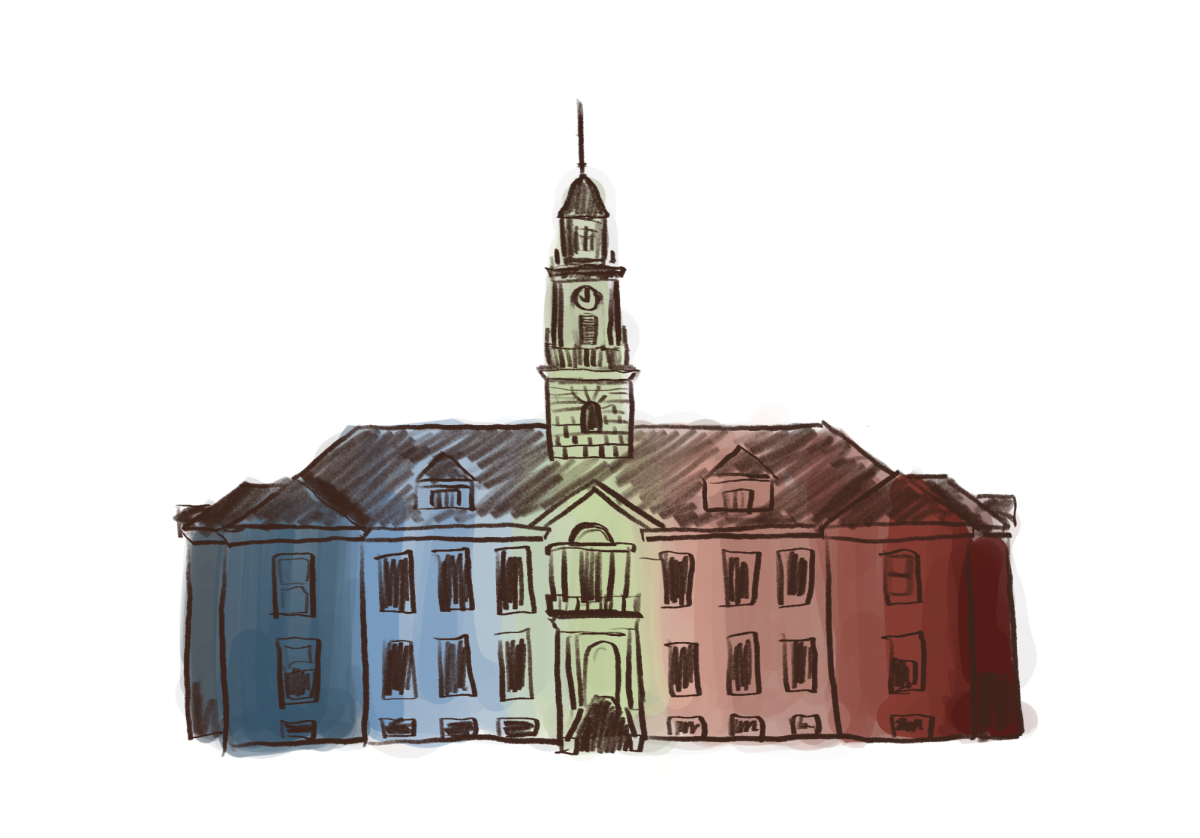
How Lakeside handles the United States’ intense current political climate is a frequent and pressing topic of conversation on campus. To understand how students believe the administration and faculty address political issues — as well as how students identify when it comes to politics — Tatler asked students from across all grade levels to gauge the school’s political climate. The data show a student body that is largely comfortable with Lakeside’s predominantly left-leaning identity but divided on whether it leaves room for anyone who doesn’t fit this demographic.
Most Lakeside students report being aligned with the Democratic Party when asked about their political affiliations, but the exact answers vary widely. Students used labels running from “moderate democrat” and “independent” to “socialist” and “Green Party.” “I’m liberal but I don’t love the Democrats — they’re too moderate,” one student wrote, highlighting one end of the progressive spectrum. Another described themselves as “socially liberal but fiscally conservative,” meaning they support the liberal side of many public issues (e.g. abortion, healthcare, or gun control) but want less government spending and market regulation. Meanwhile, conservative voices are definitely in the minority at Lakeside, with only a few students identifying as “right-centered,” “conservative,” or “libertarian.”
A recurring theme in students’ responses is the difficulty of sharing non-liberal views at Lakeside. Many students, both those who identified as liberal and conservative, noticed how the school’s culture makes it difficult for conservatives to speak up. “The entire institution is extremely liberal,” one student wrote. “It makes a lot of conservative students stay quiet … out of fear of being accused of being discriminatory.” Some described this feeling as “walking on eggshells.” One respondent said “there is one narrative that you should adhere to,” reflecting that any deviation from this narrative leads to judgement. Even students who want more debate feel like it’s impossible: “I genuinely do not believe that more centrist/right ideas would fly without being attacked,” one student observed.
This tension is not new. In 2005, then-Director of Diversity T.J. Vassar ’68 sent out an email to Lakeside staff about notes from a Parent Diversity Committee meeting where parents raised similar concerns. One parent reported that their child had been told by a teacher that there were only three reasons to vote for George W. Bush: “you are really rich, you are very religious, or you are stupid.” At the same meeting, parents observed that students quickly learn a “code for what is acceptable” rather than being encouraged to share differing opinions. History teacher Gray Pederson noted at the time that while the “overwhelming opinion of students is generally anti-Republican,” it often has an “unthinking, knee-jerk” quality to it, and he suggested that students only react this way because they have been conditioned by the people around them.
What passed as acceptable speech in a classroom was again brought up during the 2016 election. On the night of the election, then-Upper School Director Alixe Callen messaged faculty to acknowledge the impact that Donald Trump being elected president would have on marginalized students. While she reminded staff of their obligation to teach students “how to think, not what to think,” Lakeside administration’s public stance moved toward a more definitive position. By November 14, 2016, only a few days after the election, Head of School Bernie Noe sent an email to all staff stating that the election of Donald Trump — specifically his “disparaging, crude, and inaccurate” comments — challenged Lakeside to “more demonstrably live out the school’s values.”
During the 2020 election, Lakeside continued with this sentiment with the phrase “bipartisan but not neutral.” Bernie Noe urged the community to be respectful of all candidates while simultaneously “taking a stand on issues inimical to our mission as a school.” Lakeside attempts to respect the process of the two-party democracy and the right of individuals to support different parties, but it cannot remain neutral on specific moral or social issues that it believes violates Lakeside’s community expectations. While this policy aims to protect marginalized groups, many have felt that it creates a gray area for students. While Lakeside still supports students from any party, specific beliefs are not accepted if they fall on the wrong side of the “not neutral” boundary.
Today, students have mixed feelings about how teachers handle politics. Some praised the History department for the current events days, and appreciated when faculty members, like Upper School Director Ryan Boccuzzi, talked about real-world issues like ICE. However, others feel that teacher bias is too obvious. “History teachers are really good about it, but some English teachers feel more openly partisan,” one poll response claimed. Another student mentioned that “certain teachers make it very clear what their biases are and let it interfere with classes.” Gus L. ’28 thinks that the school should focus more on the facts. “Teachers should present the facts while the students discuss,” he said, saying this would help students form their own opinions instead of just listening to “their parents or some streamer.” Ruhamah T. ’28 agreed that Lakeside needs to do a better job of opening up discussions. “I think we haven’t quite figured out how to create an environment where different political opinions can be shared without judgment.”
Many students are also looking for more direct engagement with political issues by teachers and the administration. Several students noted that many of the adults on campus avoid talking about politics unless something “drastic” happens. One poll respondent pointed out that because many Lakeside students don’t hear about the news from their classes, they end up getting all their opinions from social media, which is often biased. “I don’t keep up with politics and news,” one student said, “and I think it would be helpful if the school helped us do that instead of leaving it entirely to social media.” Others suggested that instead of shying away from controversial topics, department heads should develop ways to better address the polarizing events happening in the country today.
Ultimately, any political friction at Lakeside may be less about specific administrative policies and more a reflection of its environment. “Lakeside’s politics will never change as long as Seattle stays as liberal as it is,” Gus asserted. As long as this remains true, Lakeside will likely continue to grapple with challenges surrounding its political stance. While this “not neutral” policy aims to protect Lakeside’s community values, the data shows that the student body is tired of tiptoeing around certain subjects due to fear of retaliation from teachers. If the school is inevitably a product of its surroundings, Lakeside’s challenge for the future is to ensure that the classroom remains a place for genuine intellectual thought, one where students are taught how to think critically about the world rather than just echoing what they see and hear around them.