
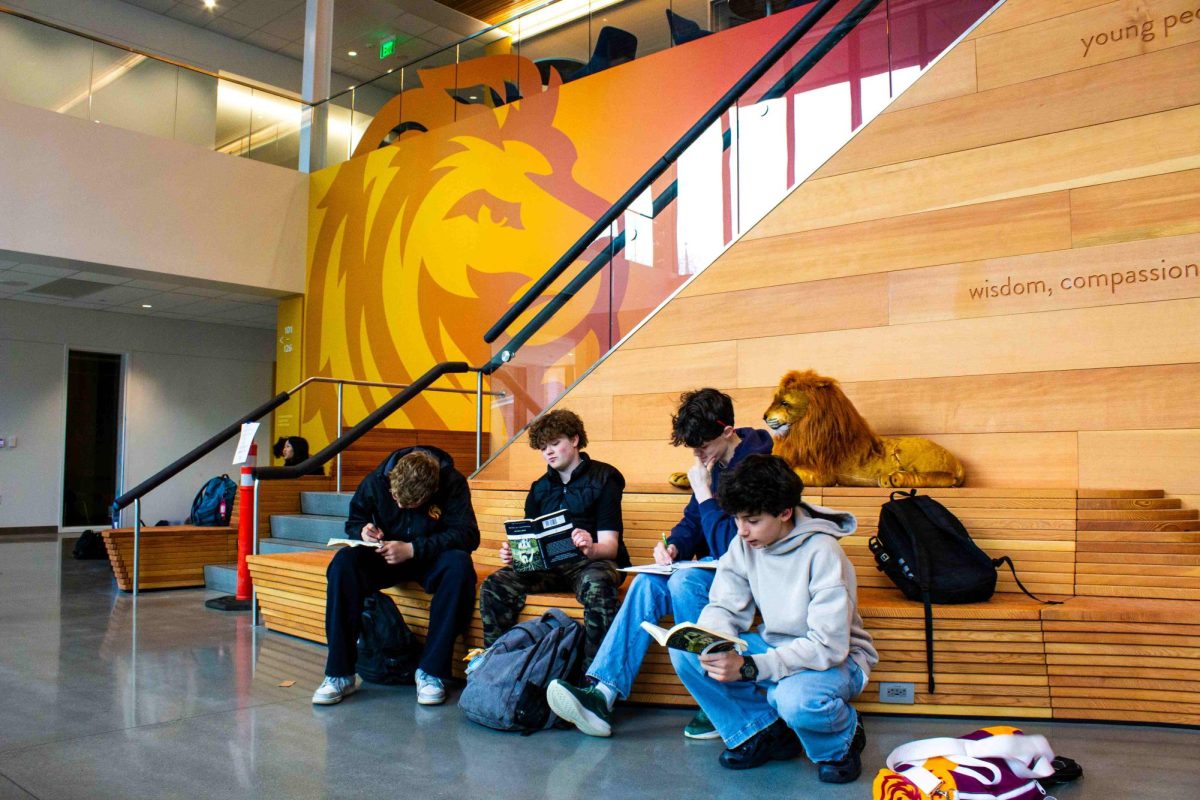
The T.J. Vassar ’‘68 Center for the Sciences and Humanities is only a few weeks away from its official opening. Classes have already begun moving in, and multiple advisories have toured the space, getting an early look at Lakeside’s first building in nearly four decades. The project marks a major milestone for the school — the first major campus construction since the redevelopment of the Paul G. Allen Athletics Center (AAC) in 2012.
Construction on the Vassar Center began in the fall of 2024, with the building expected to be fully operational after spring break. As final touches are put in place, anticipation continues to grow across campus. And for many, the question isn’t what the new building looks like, but rather how it will shape everyday life at Lakeside.
First impressions are already forming. These early reactions are part of the community’s process as it adjusts to a new building on campus. With even more classes scheduled to be held inside Vassar over the coming weeks, opinions will likely continue to evolve.
The building’s wide, open layout and abundance of windows allow natural light to flood the space, creating a bright and welcoming environment. In contrast to older campus buildings like Moore or Allen-Gates Hall, Vassar feels distinctly modern. Classrooms on the north side offer stunning views of Bliss Hall and an all-encompassing panoramic view of campus. Outside, the space is uniquely designed, with benches near a patch of turf that could easily become a popular hangout spot or even an impromptu spikeball game!
Yet, even as students praise these features, many continue to point out areas where the design falls short. Students and faculty alike have developed strong (and often mixed) opinions about the Vassar Center’s design and functionality. Some students have voiced concerns about the building’s gender-neutral bathrooms, while teachers have recently questioned the layout and practicality of its new office spaces.
When students first stepped into the Vassar Center during tours, many were captivated by the building’s most unique feature: Lakeside’s first-ever atrium. Walking through the double doors, they looked up at the towering lion mural stretching across the wall, taking in a grand space unlike anything else on campus.
But as they moved down one of the building’s parallel hallways, another feature quickly became a topic of conversation: the bathrooms.
The bathrooms aren’t completely open, of course. Individual stalls line one side, with sinks on the other. Notably, there are no main doors, and all bathroom entrances connect directly to hallways at either end. Combined with the fact that all bathrooms in the building are gender-neutral, the design has sparked debate among students.
Some reactions have been blunt, with ninth grader Lucas H. ’29 telling Tatler, “I might just walk to Allen-Gates [to use the restroom] instead.” Another student said they supported gender-neutral bathrooms in principle, but questioned the execution: “It’s totally fine to have gender-neutral options, but it’s kind of crazy that they made two large bathrooms for everyone when they could have created smaller, separate ones.” Others raised concerns about privacy and foot traffic flow. As one student put it, “People are going to start walking through the bathrooms to get to the other side of the building.”
Teachers, speaking anonymously, echoed some of these concerns. Several noted that the lack of doors could create practical issues, including noise and odor spreading into the adjacent hallways.
Despite expressing some criticism, students were equally quick to point out that the bathrooms themselves are well-designed. “They’re actually really nice,” one student said. “I just don’t see any reason why there can’t be doors.”
The bathrooms are not the only thing changing at Lakeside; so is the way teachers work day-to-day. In the science department, offices will no longer be in the “core” of Allen-Gates Hall, where the science faculty has worked for over three decades. And for the first time in many years, English teachers’ offices will not be located in the historic Moore Hall. Instead, faculty members will be located in several different rooms across the building, including in mixed-department offices. This leaves room for new collaboration, quieter office spaces, and more amenities for both faculty and students.
But not all teachers are in love with the new office setup. English teacher and alumnus Kevin Kimura told Tatler that he liked the design choices made by school leadership and was eager to teach in the Vassar Center, noting, “I am excited to share office space with brilliant colleagues with whom I can brainstorm ideas.” However, he went on to say, “If I am sharing my office, I will no longer have a relatively private office all to myself. That might impact my individual grading and planning speed … I might have to be intentional about finding quiet places to work alone.”
The English teacher went on to mention how the Vassar Center has a surplus of new student “hangout” spots, but argues that “it will be important for students to be mindful of how their behavior impacts the people around them.”
For students, the increase in indoor and outdoor space has been largely welcomed. But for Dr. Kimura, he will surely miss the outdoor view from his office in the 90-year-old Moore Hall, where he was once taught English as a Lakesider by his now-colleague Amy Kaz. “I will miss looking out my big windows at the quad and the springtime blooming trees as I sit at my desk. Again, this is a matter of tradeoffs, and I respect the thoughtful process that our leaders and design team used to make those decisions.”
The Vassar Center is more than just a new building. It represents a change in how Lakeside students and teachers learn, work, and spend their time on campus each day. Early reactions show both excitement and concern; nonetheless, this is part of adjusting to something new.
With the official opening set for April 23, the building is only just beginning to take shape in daily life. As more people move in, its role on campus will certainly become clearer.