As the end of the third quarter draws near, many students have been anxiously checking Canvas, hoping to bring their grades up before report cards hit their families. Thankfully, Tatler’s newly-bribed informants have revealed insider information from Lakeside’s departments that explains exactly how teachers grade assignments and how students can game the system for the rest of the year.
English
In English, Socratic seminars will be take-home, asynchronous assignments re-dubbed “Platonic seminars.” Students will submit a recording of themselves analyzing passages, asking questions, and nodding intently in silent agreement to an empty room. Extra credit is received for pauses over 30 seconds. “We wanted students to simulate the awkwardness of Socratic seminars from the peace of their own homes,” English teacher Kevin Kimura explained.
Additionally, students can happily wave goodbye to stressful in-class writes. No longer will classrooms be filled with writers anxiously clacking on their keyboards, trying to fit in as many uses of the word “juxtaposition” as they can. Instead, the English department has agreed to strictly assign “out-of-class writes,” assignments that students are only allowed to complete at home. Naturally, students will spend more time and effort on assignments if given unlimited time to complete them outside of school, exercising their creativity to the fullest.
History
With the rise of artificial intelligence, Lakeside’s history teachers have decided to emphasize creativity. “I mean, the thing with history is that it’s so boring. It’s like reading a novel with every spoiler already in front of you — we already know how it ends!” history teacher Katie Piper explained.
Instead, history assignments will center around what students think should have happened. Essays will be graded on vivid imagery, character development, and plot entertainment. After all, as Ms. Piper puts it, “Talking about real historical events is definitely something we can leave in the past.”
Math
Lakeside offers a variety of complex math courses. However, one recurring theme is that students have been making silly procedural mistakes. To address this, the math department has decided to revise their grading process so students have, as math teacher James Lajoie notes, “more opportunities to sharpen those arithmetic skills!”
Currently, of course, retake policies are logical and consistent across math courses — but leave it up to our beloved math teachers to add a sprinkle of pizazz. Effective immediately, grades for test retakes will be calculated by halving the student’s original score and adding the square root of their retake score multiplied by the date they took the test to the power of pi. Additionally, to combat grade inflation, teachers will randomly select five scores per class to be halved.
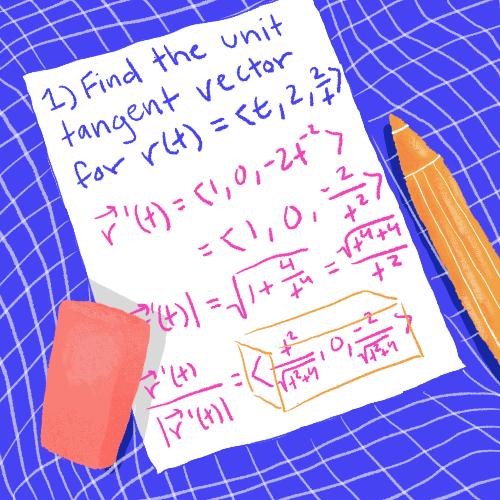
Boxing answers is required as a bare minimum, but students can earn extra credit for more creative presentations, such as star- or flower-shaped boxes. In Multivariable Calculus, students must indicate their answer using 3-D rectangular prisms.
Art
For years, teachers in the arts have complained about methods of evaluation for their department. “Our classes are the central hub of creativity at Lakeside, but we get stuck with the most boring grading metrics: credit/no credit,” music teacher Erica Johansen grumbles. Instead, art teachers will now be grading with a different scale.
Students who are frequently unprepared with class materials like sheet music or art supplies earn “credit” — constantly borrowing what they don’t have. “Debit” indicates steady practice and investment in their craft, while “Apple Pay” refers to students who practice infrequently or never. “Some students truly show up to class planning to just ‘tap and pay’ … or, as I like to say, ‘tap and pray,'” Ms. Johansen quips. “Those students need more than 20% in tips.”
Other departments, including science and language, don’t seem to have made any changes to their grading policies. But if current shifts are any indication, students can get excited for many surprises in their future.