Leaked internal emails, meeting notes, and documents appear to show the Lakeside administration’s varied proposals for the replacements of letter grades at the Middle School.
In their ongoing search for the perfect letter-grade replacement, the administration was shown to consider everything from inverting the traditional grading system to giving students feedback in the form of weather forecasts. Even more surprising, the documents suggest that the search has been going on for quite some time, with reports of anonymous focus groups of students trialing the different systems included in the leak.
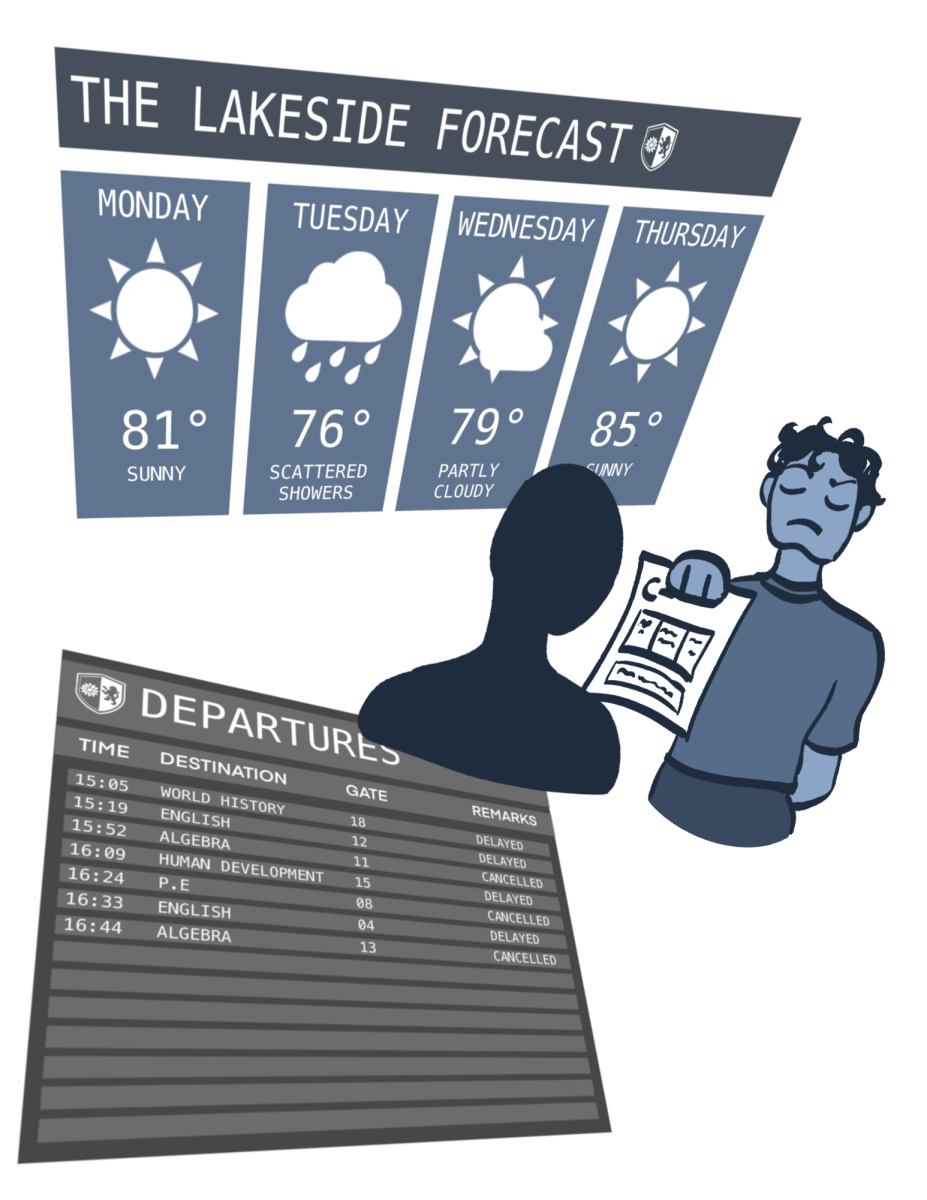
“We want our students to be as informed as possible about the state of their assignments,” wrote Assistant Head of School Jamie Asaka in one email about one of the grading experiments. In a transcript discussing this proposal, named the “Airport Status Model,” Ms. Asaka claimed that the model “combines the best part of the airport experience — dealing with airplane departures — with the best part of the schooling experience, which is waiting to get your grades back.” Teachers can inform their students that the assignment grade is “taxiing” or “experiencing delays due to bad weather conditions.”
In the meeting, Ms. Asaka admitted that the model did have some flaws. “We do know that, after a while, students will be thinking, ‘When will I get my grades back?’ Announcing a gate change will only work so many times.” She did add, though, that the school “believes this mimics the airport experience in surprising and revelatory ways. If we can distract students enough with departure warnings, perhaps they’ll forget the importance of letter grades altogether.”
Another idea, however, showed more promise. In a transcription of a Middle School administration meeting, Assistant Head of School and Middle School Director Reem Abu Rahmeh was seen suggesting a different proposal: students grading teachers.
According to the transcript, Ms. Abu Rahmeh described the grading model as “a bold and innovative reversal of student-teacher roles” offering students “a chance to show initiative and increase mutual respect in the classroom.”
The system involves the children creating their own sliding rubric, then filling out thoughtful reflections on teacher performance, which Ms. Abu Rahmeh suggests will “prepare our future citizens for roles in executive positions.”
Another administrator brought up concerns about the grading framework’s susceptibility to abuse, to which Ms. Abu Rahmeh repeated that the system will “prepare our future citizens for roles in executive positions.”
After the leak, Tatler received a tip explaining that the idea might have been suggested in response to parents’ furious censure over their children receiving bad grades, with the opportunity giving children a way to “enact revenge upon particularly adversarial teachers.” Tatler has been unable to confirm this.
Despite the concerns, student response to the newest grading model was markedly optimistic. Focus groups rated this grading model the highest, with a whopping 96.5% satisfaction rating. “It’s been a long time since [the teachers] have been in school, you know?” one anonymous 7th-grade student said. “We have to kind of remind them, like, what it’s like to be graded, evaluated, inspected — on every measure.” An 8th-grade student added, “I really feel like this is the fairest way. If teachers leave me comments about my class participation and collaborative performance, I should be able to grade them on passion for the subject and engagement level.”
Teacher response was less enthusiastic. “On a section of the rubric labeled ‘chillness level,’ I received a ‘not met,’” one teacher complained. “The worst thing is, rubric comments didn’t even elaborate on what I could do to improve my chillness!”
Chillness — or could it be wind chill? In one email dated March 27, Middle School Assistant Director Jesus Soler offered an inventive new approach: a weather forecasting-type system. Students in focus groups received ultramodern “science-based” forecasts on their assignments, with rubric-style attributes ranging from humidity, to air quality, to pressure.
While there have been multiple claims of AI usage powering these proprietary results, Tatler was unable to independently confirm the use of AI.
Reports from focus groups of students trialing this system show mixed results. “My score report on a lab report assignment showed a ‘feels like 45 degrees’ temperature, with 42 degrees cited as the actual temperature,” one anonymous student complained. “My grade should not be based on feelings!” Other students reported disappointment in the severity of grading. “I thought this weather forecast grading didn’t even mean anything, but I was graded ‘drought conditions’ in textual evidence and ‘low visibility’ of thesis claim,” one seventh grade student responded.
The report also found that many students found themselves unable to separate percentage points in “humidity” and “chance of rain” from their previous ratio-test percentages, while others found themselves scratching their heads over the significance of “moon phase: waning crescent” and “moon phase: waxing gibbous.” The system producing the forecasts has also been known to glitch, producing extraneous results like “pollen count” and “high flu risk in your area.”
But this confusion may have some benefits: in the email, Mr. Soler assured the administrator team of the model’s “incredible dynamism” and praised the “distancing language” the system produced. “Previously, a student receiving an 85%, or a ‘B’ grade, would almost certainly feel a strong sensation of disappointment. After trialing with our focus groups, we found that a student receiving “scattered showers with a 55% chance of rain” under our new grading model resulted in a 87% reduction in disappointment and a 32% reduction in complaints.”
“50% chance of rain,” Mr. Soler tagged at the bottom of the document, though Tatler is unsure what this note might mean. Tatler reached out to Mr. Soler, but he did not provide a comment.
For now, the administration’s final plans remain to be seen. Whether students’ future performance will be measured in scattered showers, airport delays, or their ability to grade their own teachers, the forecast remains the same: uncertainty, with a strong chance of confusion.