
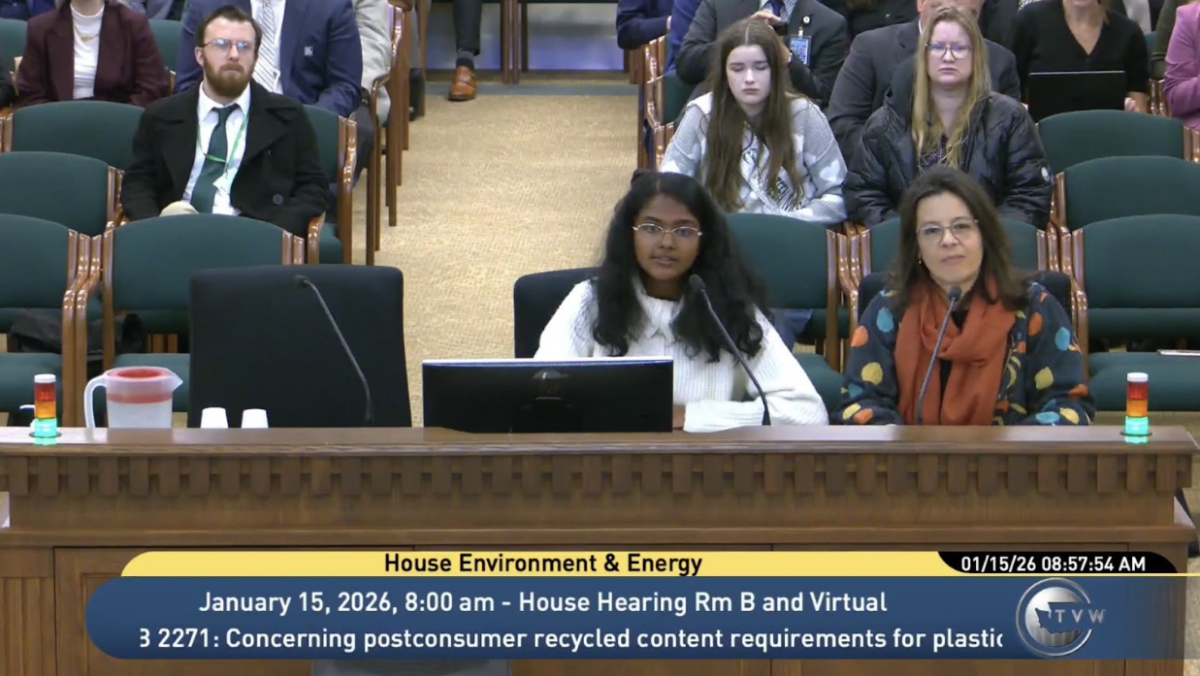
On Thursday, January 15, Annapoorani L. ’29 sat in front of the Washington State House Committee on Environment & Energy. She was there to testify for HB 2212, a bill that would mandate microfiber filters for commercial and industrial washing machines.
Annapoorani spoke with authority, sharing facts and figures with the lawmakers. Yet, she said, just months ago, she knew “very little” about microplastics. Her journey to Olympia began in Lakeside Middle School’s 8th-grade Physical and Earth Science class.
In May 2025, as part of a class project, Annapoorani collected tap water samples from her home. She carried them into her class and began testing. The results, she said, were shocking.
“I remember looking at that and exclaiming, ‘I cannot believe I’ve been drinking this every day!’ because there were just so many fibers in it.”
She tested a Lakeside Upper School water fountain this year and found that it also contained microplastics, including microfibers, though far fewer than her home’s tap water.
According to Rutgers University professor emerita Judith Weis, microfibers are the most common microplastics in the environment, and they mainly come from synthetic fabrics. Each time a garment is washed, it sheds tiny fibers made of plastic and, Annapoorani explained, “because they’re so small, the water filtration plants can’t actually catch [all of] them and they just end up right back in your drinking water, in the ocean, stuff like that.”
Weis also notes that even microfibers removed during water treatment “end up in sewage sludge,” which is sometimes treated and used as fertilizer, allowing microplastics to contaminate air, soil, and crops.
Research on microplastics is ongoing, but evidence suggests they are detrimental to human health. HB 2212 notes that microplastics have “already been linked to harm to reproductive, liver, digestive, and respiratory health.”
Annapoorani’s findings motivated her to publish an op-ed in the Seattle Times arguing that Washington state “should require microplastics filters on new washing machines.” Oregon lawmakers have proposed legislation that would mandate the filters, and a bill mandating microplastic filters on new residential washing machines was passed in 2023 by the California legislature but later vetoed by Governor Gavin Newsom, who cited concerns about increased costs for consumers and a need for more research.
Lakeside parent Jennifer Porter, who owns a school uniform manufacturing business called Satsuma Designs, reached out to Annapoorani after reading her article. The pair began emailing various stakeholders — including cruise lines who use a lot of washing machines and state legislators.
One of those legislators was Representative Gerry Pollet of Washington’s 46th District. In January, Pollet invited Annapoorani to attend his town hall to discuss microplastics further. Annapoorani said he asked her to write up a fact sheet about microplastics, and “that was what started the legislation,” which would later be sponsored by 22 representatives, including Pollet.
The resulting bill, HB 2212, would require new commercial and industrial machines to be equipped with a filter beginning in July 2028 and mandate that owners and operators of existing machines add a filter by July 2034. HB 2212 also opens the door for Washington’s Department of Ecology to “adopt a rule requiring new residential washing machines to be capable of filtering microfibers” in 2030 if certain conditions are met.
At the January 15 hearing, both Annapoorani and Porter testified to the importance of the bill.
“Our uniforms are made of 100% polyester fabric because families want clothing that is durable, affordable, and able to withstand frequent washing. I recognize that the synthetic fibers we use in our products shed microfibers when washed, and those microplastics enter our waterways,” Porter testified. “As a manufacturer, I am part of this problem, which is why I insist on being part of the solution.”
Porter shared her experience with the filters. “My husband and I installed our own microfiber filter on our washing machine in 15 minutes. No special tools, no professional help, and no arguing,” she said. “It works just like a dryer lint trap. We already require lint filters to protect our air. Applying the same common-sense approach to washing machines to protect our water supply is the logical next step.”
She also noted that the majority of clothing sold today contains synthetic fibers and said that “Reducing microplastics in our water is not something that families or small businesses like mine can realistically solve on our own.”
Lobbyists and representatives from environmental groups including Zero Waste Washington, Ocean Conservancy, and a researcher from the Seattle Aquarium testified in support of the bill, while representatives from the Association of Home Appliance Manufacturers, the Coin Laundry Association, and the Association of Washington Business testified in opposition. The bill’s critics expressed concerns about the feasibility of and safety of implementing the filters in laundromats, as well as increased costs to laundromat customers; about the fact that other jurisdictions had not yet implemented the filters; and more.
A representative from the Washington Department of Ecology’s Water Quality program testified under the more neutral label, “Other,” expressing concerns about the emerging nature of the technology, the cost to the state government, and more.
Addressing claims that the filters would drive up consumer costs, Annapoorani said requiring the filters would not significantly increase the price of residential washing machines. Notably, the bill includes a provision stating that the Department of Ecology can only mandate microfiber filtration on new residential machines if “the costs associated … will not result in an increase in the median retail price of new residential washing machines by more than 10 percent or will have a median cost of less than $70.”
Ultimately, Annapoorani said, on February 2, the committee decided not to take a vote on HB 2212, and HB 2212 “missed the legislative deadline to get [the bill] out of committee.” She said this session was short and thus had tighter deadlines (in odd-numbered years, the legislative session is 105 days; in even-numbered years like 2026, it’s just 60 days). She added that, according to Pollet, lobbyists representing opposed groups spoke to voting members “just before the session and confused them” about some details of the filters and bill.
Both Annapoorani and Porter plan to continue fighting for the passage of HB 2212.
“The hope is that, next year, when we have a longer session and we’re more prepared for what these lobbyists are going to say, we will be able to make more progress,” Annapoorani said. She invites any students interested in testifying to contact her, saying, “the more students we can get involved with this, the better.”
For now, speaking about what Lakesiders can do to help prevent microplastic pollution, Annapoorani said, “if there’s one thing they wanted to do about microplastics, it would be just try to wash your synthetic clothing less or buy less of that.”
“One day, we just want no microplastics in drinking water so that people can stay healthy and safe,” she said.

Leo | Mar 12, 2026 at 6:03 pm
I commend Annapoorani for her advocacy towards this important change. However, this change seems more like an environmental policy to decrease pollution rather than a climate policy to combat climate change.