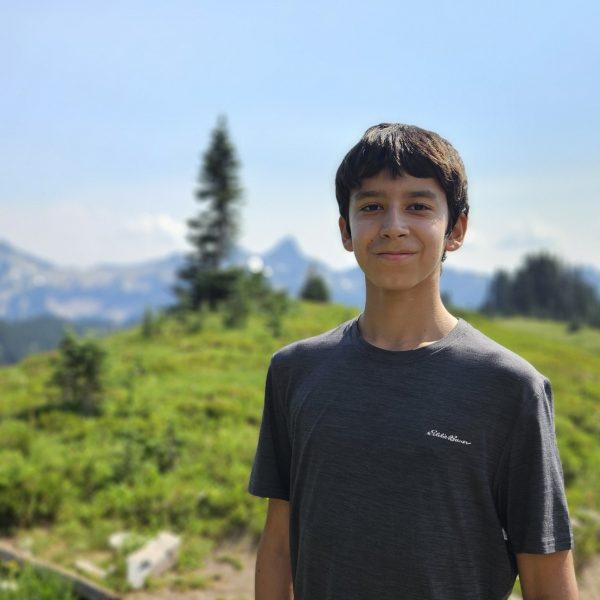
This January, Lakeside seniors Christina L. and Allie B. were named among the to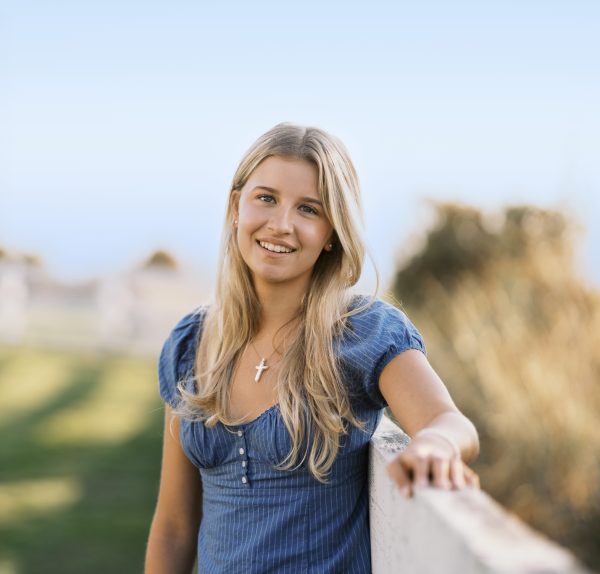 p 300 scholars in the Regeneron Science Talent Search, a nationwide competition for high school seniors organized by the nonprofit Society for Science. Regeneron proudly calls itself “the nation’s oldest and most prestigious science and math competition for high school seniors” and solicits novel research from over 2,000 students in various subjects. Several Lakeside students have been honored as Regeneron scholars, most recently Rohan D. ’25 and Aanika T. ’25.
Allie’s project, titled “Clinical Validation of a Novel $50 Multiple-Pinhole Optometer for Globalizing Vision Testing: Accommodation Bias Drives Dual-Target Innovation,” involved the design of an optometer, a device for measuring the refractive error in a person’s vision so that doctors can prescribe glasses. Optometers are used to correct astigmatism, a common condition where irregularities in the lens of the eye lead to blurry vision, and Allie sought to make a prototype that was inexpensive and simple to use. She initially based her creation on one patented by her grandfather, who was an inventor, explaining, “That sort of led me down the rabbit hole of beginning to understand what the patent was, but then also deciding that I wanted to work on it and build it myself.” Working with a patent that was intentionally vague enough to avoid infringement, Allie recalls, “I had to learn a lot about optics, and I also had to learn a lot about 3d printing and CAD [computer-aided design].” In the fall of her sophomore year, Allie investigated optics as part of her independent study with Dr. Dounas-Frazer and, with this knowledge, began building her device.
Her novel device made modifications to this patent. A standard eyeglass prescription includes components called the sphere, the amount of near- or farsightedness; cylinder, the amount of astigmatism correction needed; and axis, the angle of that correction. The original patent had the user focus on a blurry green dot, which would elongate into a line if they had astigmatism. While it included the sphere and cylinder components, it lacked a way of determining the angle of that line, which is the axis. Allie’s improvement involved multiple lines that can be rotated to connect to each other, with the angle of rotation being the axis.
To test her optometer on human subjects, mostly Lakeside teachers, Allie needed the ethical oversight of an institutional review board, or IRB, saying, “Every person that I was testing, I needed to inform them of the risks and how confidentiality would be maintained, and things like that. So, I had everybody sign this waiver, and the IRB had to approve that … For my device, there are basically no risks.” Interestingly, Allie found that results from test subjects over the age of 50 were more accurate to their prescriptions; as they age, people develop a condition called presbyopia, where the eye’s lens hardens and makes focusing on close-up objects more difficult. Young people’s more flexible lenses “would throw off the measurements that I was getting,” recalls Allie.
Although the single prototype cost Allie $170 to produce, she expects that mass-production could lower that figure to under $50. With this less expensive cost, Allie envisions her optometer being used by volunteers to further access to eye care in disadvantaged areas: “Not being able to go to the eye doctor and get glasses or get your vision fixed if you have eye conditions is the world’s largest unaddressed, largely unaddressed disability Allie reflects, “The thing that makes [my project] feel so much more fulfilling is just knowing the potential that has to help so many people.”
Christina L. ’26 has been conducting research that uses artificial intelligence to answer a very different question: “Can we as humans, or organic life as we know it, live on any other exoplanets?” She has worked on this project, titled “Applying Explainable AI To Understand How Stellar and Planetary Parameters Impact Exoplanet Habitability,” under a scientist at NASA’s prestigious Jet Propulsion Laboratory in California as part of “an exoplanet research group of peers, usually either undergrad students or grad students who … talk about the discoveries we made each week.”
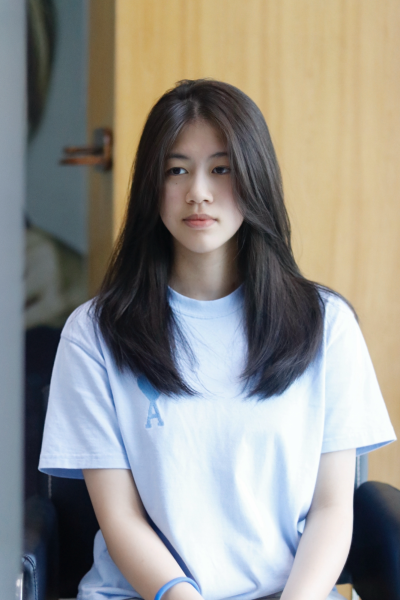 At the center of Christina’s project is the idea of Explainable AI. She describes how, “with a lot of traditional models right now … they’ll spit out a huge answer for you, and in this process, what we lose is a lot of the model reasoning,” while Explainable AI keeps this reasoning. Christina used a type of Explainable AI called Shapley Additive Explanations (SHAP). “The models that I’m making are based off of parameters,” says Christina, “and if you change these parameters, these weights, they’ll eventually start predicting things differently.” Given datasets associating values with features such as the radius or the orbit shape of the exoplanet, “what SHAP does is [that] it shows us how certain values of certain features will impact the habitability of an exoplanet.” Through SHAP, Christina found that the five features that generally determined an exoplanet’s habitability were stellar radius, the size of the star; stellar effective temperature, a measure of the star’s temperature; stellar mass; planet radius; and planet semi-major axis, the average distance of the planet from the star it orbits.
Having this knowledge of what influences an exoplanet’s habitability is also beneficial for understanding new discoveries, Christina says. “We know about 6,000 pretty well-documented [exoplanets], but with the launch of a new space telescope, which is the Roman Space Telescope, there will be around 105k.” AI models like Christina’s will make it considerably easier to sift through new discoveries; they can also shrink researchers’ search area “from the quadrillions into a certain few [to] point out which sections [of the search area] are next that we want to study in more detail.”
While searching for events where she could learn more, Christina found and applied to the AstroAI Workshop, a program of the Harvard-Smithsonian Center for Astrophysics. There, she presented and discussed her research in a poster session as the only high school student among many industry leaders. “A lot of people gave me really great advice,” she recalls.
For other students interested in participating in research, Christina recommends, “Especially when you’re starting out, you’re not always going to be amazing as soon as you enter.” She adds, “A pretty underrated portion of the research process is getting those first connections. … Don’t be discouraged!”