
By the time you graduate from Lakeside, you’ll have taken at least two years of an art and a language, four years of English, and three years of History, Science, and Math. Your transcript will also note that you completed requirements in Human Development, PE, Service Learning, and Outdoor Programs.
In addition to checking these boxes, you’ll also leave (hopefully) with a few competencies — Cognitive Flexibility, Introspection and Emotional Intelligence, Unstructured Problem-Solving, to name a few — and mindsets, whether Ethical, Service, or Growth and Learning.
Among these mindsets, described as who graduates are, is the Global Mindset. Along with learning a language or opting to participate in a GSL trip, in order to truly embody the global mindset, Lakesiders must “regularly explore current and historical global events, making relevant connections with course content and in their daily lives.”
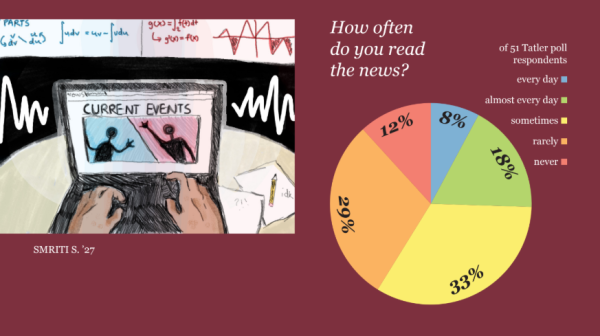
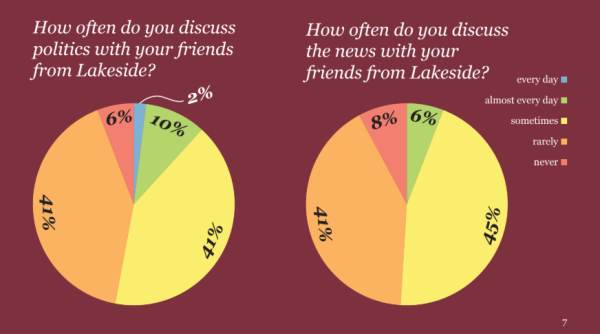
But how accurately does this statement apply to Lakesiders today? Tatler asked students to respond to a few questions in the poll—ranging from how often students consume or discuss the news, to where on campus they feel comfortable discussing current events—and has compiled their responses below.
How would you describe the culture at Lakeside towards discussing politics and current events in and outside of classes?
“Hot hot hot especially if you don’t have a mainstream ideology… people are pretty quick to judge.”
“People walk on eggshells talking about important subjects out of fear of getting in trouble”
“I feel like it’s 50/50 whether someone will want to talk about those things. Some people are weird about it but others are interested.”
“i feel like people are fine with it but i think everyone assumes everyone else is liberal (unless one or two people are assumed to not be, and they’re usually kind of cast aside). i wish we could do a better job of having different viewpoints feel comfortable sharing and represented in current event discussions, because sometimes it just feels like a bunch of people with the same views complaining together.”
“Some people discuss politics, but only among friends”
Do you wish current events played a larger role in classes and curriculum at Lakeside? Why or why not?
“YES. Current events are very important and I wish more people knew about and cared about what was happening. I hate when people say they don’t care to learn about what’s happening because it doesn’t affect them. Even if multiple sides of a conflict may be represented by the student body, can we please still learn about those things? Specifically around Israel and Palestine?”
“I do. I think they’re very important and it’s interesting to see how they connect to what we’re learning. Shoutout Mr. Souser for doing really well at this.”
“Yes, I feel that many teachers are afraid of protecting or not offending students so they don’t address extremely important and relevant issues (eg. Israel–Palestine, ICE raids)”
“Yes, I think talking about current events in class gives us a better idea of why what we are learning is relevant and important while informing us about what is happening in the world outside of Lakeside.”
“I wish they did, but I don’t think that’s something that can be built into the structure of the school. The reason Lakesiders don’t talk about current events is the same reason young people everywhere in the U.S. don’t talk about current events—our generation has been flooded with so much information (of which not a small part is misinformation) that we have adopted a very nihilistic stance towards events in the wider world. You can’t force students to care about current events just by asking them to read about them, and if it’s a voluntary thing (like the Israel–Gaza conversation sessions), the only people who’ll participate are those who are informed/passionate about current events anyway.”
“Yeah; it’s important to touch on what happens today. Gopopo does that pretty well.”
“no. because current events are always changing. you cant change curriculum every week. we go to school to learn the basics”
“no – it’s too chalant to bring up this stuff in class”