
“You won’t see the Once-ler.
…
He lurks in his Lerkim, cold under the roof,
where he makes his own clothes
out of miff-muffered moof.”
What is your immediate reaction upon reading this passage from The Lorax by Dr. Seuss? Absurd, nonsensical, and silly? Or funny, intriguing, and creative? This passage alone divides the world into two types of people: those who appreciate Dr. Seuss’s meaningful nonsense and playful profundity, and those who don’t.
Today, very few know that Dr. Seuss faced numerous rejections when he tried to publish his first manuscript And to Think That I Saw It on Mulberry Street. Guy McLain, who works at a museum in Dr. Seuss’s hometown, told NPR that Dr. Seuss altogether got 27 rejections before finally finding acceptance with the help of a friend in 1937. And the reason for all the rejections? The book was “too silly!”
Almost 90 years have passed since the debut of Dr. Seuss’s literature, and despite it being loved by millions of children, a divide remains. Some educators, psychologists, literary critics, and general adult readers including parents, continue to voice disapproval.
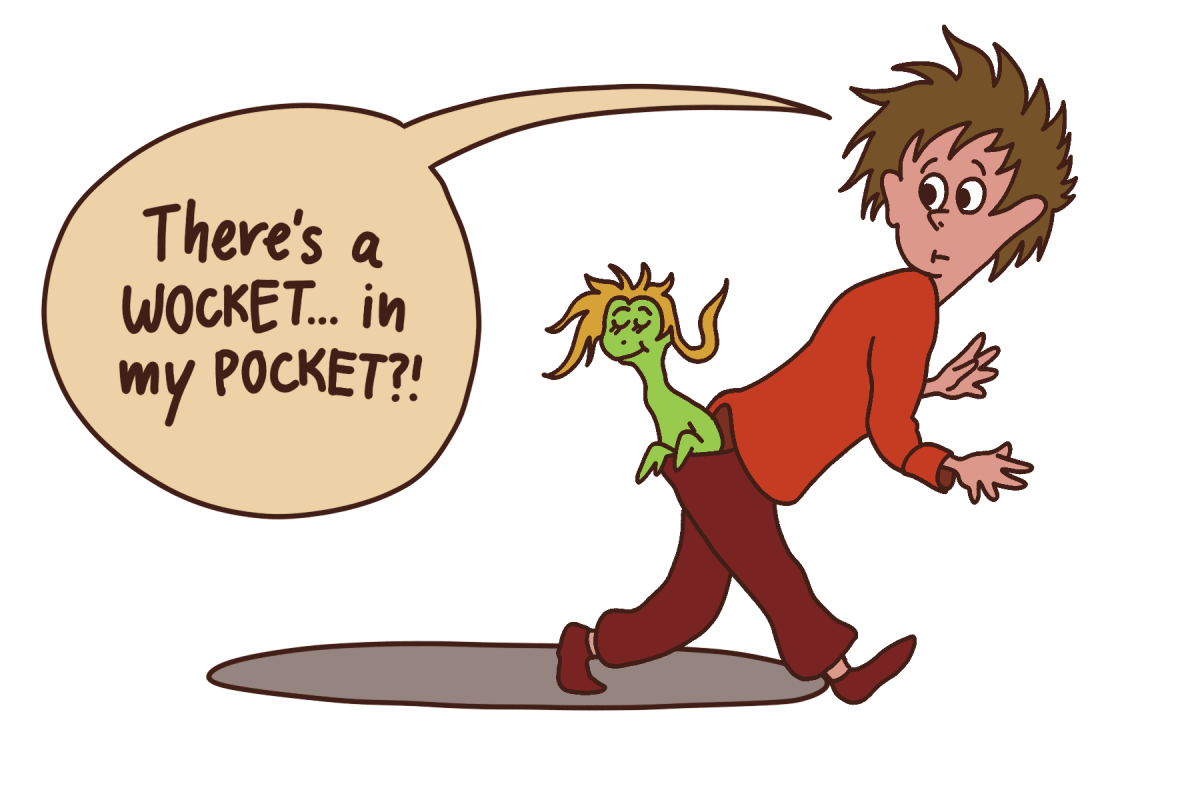
So why do some chuckle at the title There is a WOCKET in my POCKET! and lines like “But the NOOTH GRUSH on my TOOTH BRUSH…”? They enjoy the absurdity as a creative and fun adventure, while others frown at the broken logic and nonsense vocabulary so much that they react with questions such as “What is happening with the wocket? Why is it there? How come suddenly the nooth grush shows up on the tooth brush?” It turns out Dr. Seuss’s writings are an incredible stimulus set for testing the Need for Closure (NFC).
NFC is not a personality trait or a mental disorder; rather, it is a cognitive style that influences how people handle ambiguity and open-ended situations. Dr. Aerie W. Kruglanski, distinguished professor of psychology from the University of Maryland at College Park, defines NFC on his website as “the desire for certainty.” People with higher-NFC crave order, which means only toothpaste, not a nooth grush, is supposed to be on top of the toothbrush. And those with lower NFC tend to be more flexible and can entertain a made-up object like WOCKET sitting in the pocket. NFC also shapes how we perceive. People with higher-NFC see the world in clearer terms: there is right and wrong, there is friend and foe, and there is absolutely no such thing as “miff-muffered moof.” Meanwhile, those with lower-NFC are more comfortable to go with the flow, perhaps thinking, “OK, let me turn the pages and see what ‘miff-muffered moof’ is all about.”
Let’s look at what is behind the brain’s reasoning, threat, and reward systems when NFC rises. When a higher-NFC brain encounters Dr. Seuss’s phrase “You won’t see the Once-ler,” the prefrontal cortex, our reasoning system, enforces stronger and clearer cognitive rules. It reasons that in this wide world there is no such thing as a Once-ler, so the rule fails. The brain does not know how to interpret the Once-ler, so uncertainty builds up. Rapidly, the threat system, consisting of the amygdala and anterior insula, is engaged. The amygdala detects uncertainty and activates all alarm bells on “Once-ler.” The anterior insula lights up and people literally feel physical discomfort and have the urge to arrive at a quick resolution: “Once-ler” is totally nonsense and I shall dismiss it. This kicks the reward system in full gear with dopamine, making the higher-NFC brain feel instantly good because a decision is made and ambiguity is resolved.
But is banishing high-NFC brains an evolution mistake? No. High-NFC and low-NFC individuals are both indispensable to society, with the former protecting us from threats, enforcing stability, and managing crises, and the latter solving problems creatively, exploring new tools, and adapting to changes. More importantly, NFC is not fixed. It fluctuates based on the situation and the person’s state of mind. Our desire for quick answers increases when we are stressed and decreases when we feel calm and safe.
So next time you come across a quirky line or interesting situation, take a minute to think before letting your immediate reaction take over. And as Dr. Seuss wrote in Oh, the Places You’ll Go!,
“You’re off to Great Places!
Today is your day!
Your mountain is waiting.
So … get on your way!”