
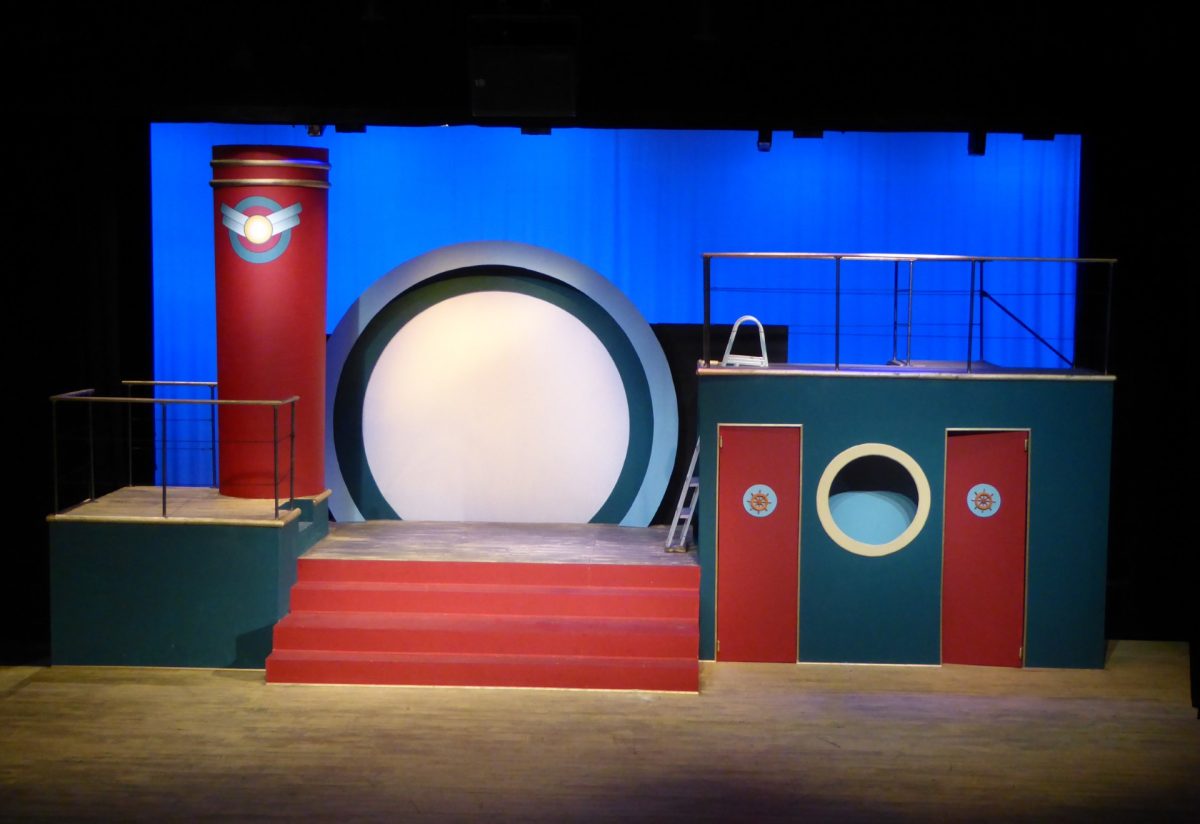
In the middle of the St. Nicholas Hall auditorium sits a giant imitation steamship. Originally covered by a curtain, over the course of two hours, the ship would be transformed into a private stateroom, an elegant dining hall and eventually even a brig. This is the experience of every audience member that witnessed Anything Goes at Lakeside, a classic Golden Age musical set on a luxury liner. But how are these extravagant sets built? Tatler sat down with director Michael Place, known to his students as Micky, and set designer Tommer Peterson to learn a little more about what was happening below the deck.
The process of building a set takes months. Both Micky and Mr. Peterson engage in a rigorous back-and-forth to ensure that the final vision was just right for both of their creative visions, as well as to stage all of the different parts of the play on with minimal disruptions.
“The way our process generally works is to share scripts,” Micky explains. After sending inspiration photos to Mr. Peterson, he’ll return to Micky with a design based off of what he was excited about as well as considering more of the practical needs of the set, such as entrances, exits and levels. The process repeats over the next few months, with general design happening before casting for the musical happens but with design being finalized in early December while rehearsals take place in the chapel. Even at this stage, elements are liable to change. With the future set taped out, both Micky and Mr. Peterson will test out sight lines and make sure that the stage is being built for the entire audience in mind.
“We test out what it feels like to stand in that part of the stage, and [for the distance to the audience] if this is too far away [from the audience], if this is too close, and how it affects the sight lines … We have time to try it out before we build it”.
Construction goes full swing at the theater when the team is back from winter break. The aim is to work as quickly as possible so that the actors can rehearse on the completed stage, especially significant when directing 50 actors. “We needed lots of room for lots of singers and dancers, so in some ways that drove the design,” said Mr. Peterson.
Finishing quickly comes with the added bonus of allowing the classes that normally use the space to resume. Micky credits the Lakeside music faculty, namely 5-12 Band Director Brianna Slone and Upper School Jazz Band Teacher Eric Patterson for their flexibility.
“We’re very fortunate that we get to build in the theater … and it also motivated me to get the set done as quickly as possible to make it safe, have railings, [and] be stable so that it can be multi-use and isn’t just for us. It’s for anybody who needs to use it, and they [used] it for a few concerts, and it’s kind of great!”
Undertaking any multi-month process with another person is a challenge, but Micky and Mr. Peterson both credit each other as being easy to work with. “I think of scenic design as providing a space to support the storytelling, which may not be literally what is described in the script, but creates a believable emotional atmosphere for the cast to work in. Micky and I are on the same page with this idea,” Mr. Peterson says.
The fact they share this opinion may have something to do with the fact that Mr. Peterson was Micky’s set designer all the way back when he was a high school student and Mr. Peterson was a teacher at Bishop Blanchet High School. While they lost touch after high school, they’d periodically reconnected at alumni events and were on good terms.
When Micky decided to start his own production company, Washington Theatre Ensemble, Mr. Peterson reached out and offered his services as a consultant and advisor. Eventually, he became the first board president of their organization. Over time, they collaborated on more and more projects together, with Mr. Peterson often being Micky’s go-to set designer, and Mr. Peterson in turn hiring Micky as an actor for his own separate arts organization. After Micky left his company and began doing less freelance work, Mr. Peterson toured the world with a company called 600 Highwaymen, and they lost touch as collaborators once more.
“And then this year, he offered to help design Anything Goes. When he offered that, he didn’t know that the show was Anything Goes. He just wanted to work with me again and work with the students. The irony is that [Mr. Peterson] designed Anything Goes when I did it in high school. I played Billy Crocker in high school, and [Mr. Peterson] did the set for that. … So that has been an incredibly full-circle moment.
For their second go of the show, it was important to both artists from the beginning that they wanted their production of Anything Goes to be unlike any other versions prior. “The social norms expressed in the script are dated, and we wanted to support that,” Mr. Peterson said. Micky said something similar. “Rather than doing Anything Goes in a way that is expected, we wanted our production to feel unique to our production.”
Instead of opting for a typical color scheme of an ocean liner, with light blues and reds and lots of white in perfect symmetry, the two derived inspiration from Art Deco wallpaper patterns and selected colors like dark teal, a deep crimson and an off-white cream. Micky also cites the asymmetry as a key difference — unlike past versions of the musical, Micky mentions something he learned from Mr. Peterson in high school, which is that a symmetrical set is only good for kings or gods. As an example, he mentions the Mean Girls set, in which antagonist Regina George rules the high school set “sort of like a goddess, like Aphrodite”.
For Anything Goes, however, that “divine context” isn’t as prevalent to the story. The asymmetry of the set — the assorted levels and dimensions on the stage — is meant to complement this difference. Micky likens it to interior architecture that’s highly compositionally focused and utilizes the rules of visual art: “It’s like the whole thing is one big canvas, [and there are] smaller canvases for the particular moments that we’re framing uniquely for the given narrative moment.”
Mr. Peterson is particularly proud of the hidden details of the piece. “While this set appears sleek and clean, it also has four hidden stairways and four stage-level entrances to get the cast of 40 on and off stage quickly. The upper level platforms have almost-invisible railings, built to OSHA [Occupational Safety and Health Administration] standards, for safety of the student actors.” When Mr. Peterson comes to the Friday show, he plans to take pictures of the final product of his labor, a monthslong creative endeavor that he’s undertaken with his former mentee.
“Then we’ll take it down on Sunday,” Micky laughs. It’s a process he finds cathartic, inviting the seniors of the production to come help him “so that they can have a little bit more closure with their final musical and not just show up on Monday and the stage is empty.” He doesn’t seem particularly sad about it. “It’s a temporal art form,” he says. “It’s not made to last.”