
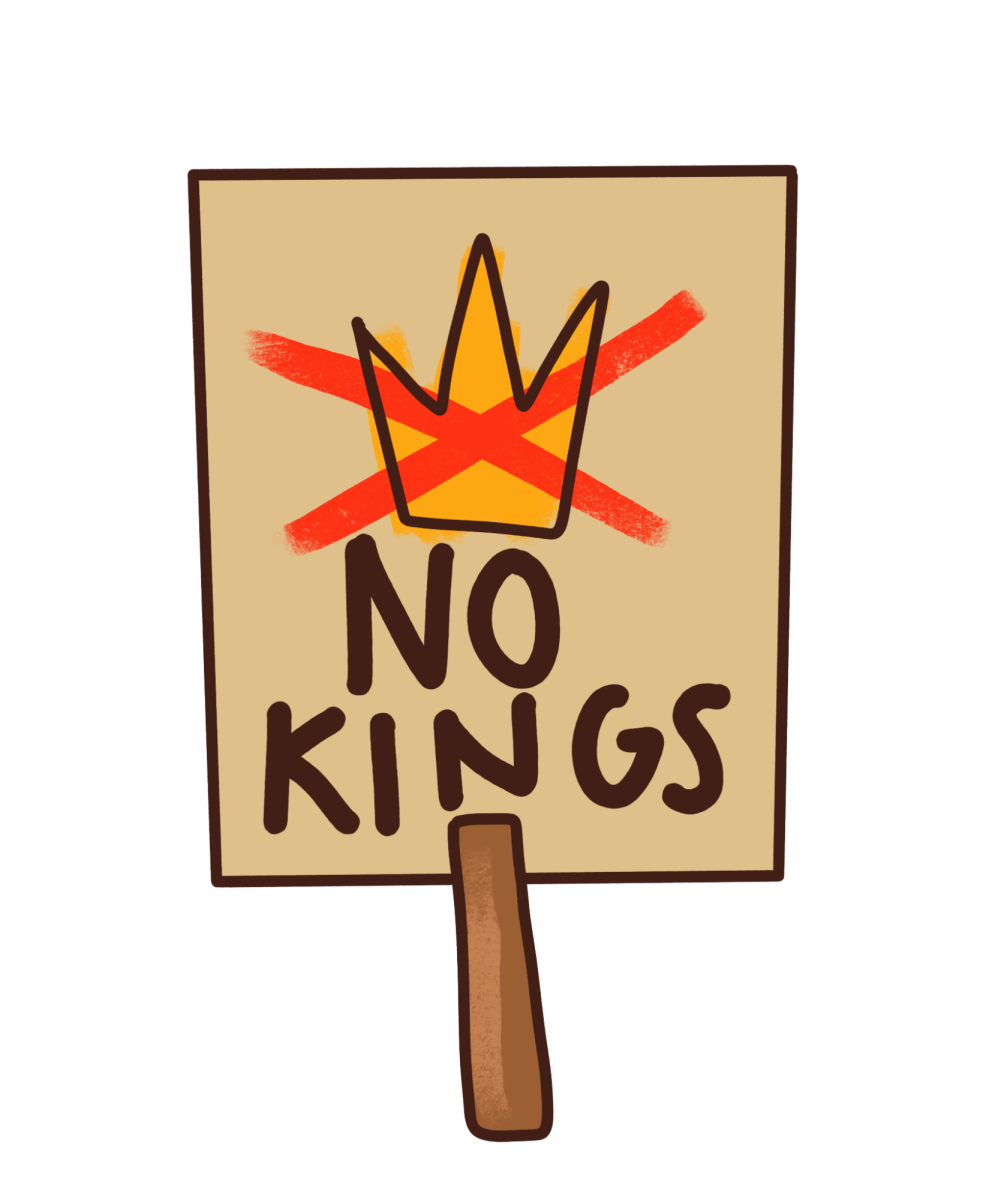
“We will defend ourselves and our communities against this administration’s unjust and cruel acts of violence.” This is the first thing you see when you open the No Kings website. “America does not belong to strongmen, greedy billionaires, or those who rule through fear. It belongs to us, the people.” But is that really true?
As No Kings protests continue to spread, so does the atmosphere of dissent that has grown since Trump’s election. However, a question remains: What impact do these protests actually have? So far, Trump has not backed down, and has even at times embraced his reputation on the left as a “king,” as in a Truth Social AI video of himself wearing a crown as he flies over a No Kings protest in a military plane that reads “King Trump.” Mike Johnson, a Republican and the speaker of the House of Representatives, has called protesters part of a “terror movement” in a recent press release. If Democrats really intend to have an impact, they need to change their approach.
Firstly, the No Kings movement has not made clear demands. In order for a protest to succeed, there needs to be some form of criteria that people want their government to fulfill. The demands of the “No Kings” movement are foggy at best. It is unreasonable to expect President Trump to step down or switch parties in an act of betrayal to his supporters. Impeachment cannot be achieved without due process from those in power, and with a Republican-majority House and Senate, it is again unlikely that this could happen any time soon. The only real influence left for the No Kings movement is policy change, but without any specified demands, it is impossible for legislative change to come in response.
None of this is to say nonviolent protest isn’t the right answer. According to studies by Erica Chenoweth at Harvard University, 3.5% serves as a “magic number” for peaceful protests. When this percentage of the population starts to speak out, change will follow. In the US, that equates to roughly 12 million people, a number which No Kings could probably hit. The No Kings movement with this oft-effective political strategy has high potential, and the current approach could represent powerful support and funding being used inefficiently, to less effect.
Furthermore, some current movements have had success. For instance, the recent student walk out drew the attention of Seattle’s mayor and several news outlets. I had an opportunity to be a part of this walk out and I was very impressed by the motivation of those around me. Everyone was there for the same reason, and though each sign said it in a different way, there was a sense of unity and a call to action. In this case, gathered with the goal of keeping ICE out of Seattle schools, the protest felt productive and meaningful.
However, a majority of protests remain ambiguous and “frivolous,” according to Current Affairs Magazine. Amazon Labor Union founder Chris Smalls has said, “No Kings Day is big […] Parades when are we going to withhold our labor for idk maybe Genocide??” Often, recent protests have been fun and light-hearted; and while this can be a good way for people to feel supported in their beliefs, it isn’t the most effective mindset for creating political change.
Recently, I ran into a Free Palestine protest in a public park in New Orleans. At first, I didn’t even realize the people there were protesting; there was music, a potluck, and people were reading books and chatting on the grass. Toddlers ran around playing tag as people in fantastical costumes danced and sang. It wasn’t until I noticed a few stray signs and began to listen to the lyrics of the song that I understood. It isn’t unreasonable that a fun and welcoming event like this one can create community and hope in divided times. However, if the goal of these events are to promote connection, why should they be political at all? Politicizing community gatherings doesn’t create a safe space — it furthers polarization and drives people apart. Is our country so divided that politics must be the basis of connection, that we can’t foster community with people of different beliefs? As long as this “us vs. them” mindset persists, it will be impossible to sway the opinion of those who have made up their mind. On the other hand, this event also isn’t effective as a form of protest. It seems unlikely that these sort of events have any impact, even on a hyperlocal scale. I doubt that a protest can change someone’s opinion unless it shows them something they weren’t already aware of, even simply through revealing the sheer number of people who hold a certain belief or directing the attention of news outlets and governments to the cause in question. This may have been a fun way to spend an afternoon, but there were surely enough people there to have held a march with higher chances of success.
Protest has worked in the past. Think of the women’s suffrage movement, which achieved the ratification of the 20th Amendment, or the Civil Rights Movement, which accomplished desegregation. True legislative change is possible, but it needs to be asked for before it will work. Imagine if the resources and energy poured into No Kings had been specifically directed at promoting diversity, equity, and inclusion, concrete policy change, or other defined goals. However unlikely, it’s worth a try.
In a time of polarization and disagreement, as more people take to the streets to share their opinions, it is important to be thoughtful about what exactly we are advocating for and how we hope to achieve it. Every day, the number of people who have participated in a protest against the current administration approaches Chenoweth’s 3.5%, but the question remains: what does success look like?