
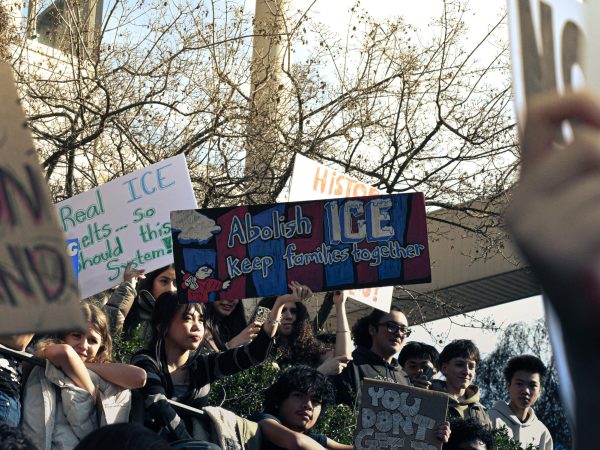
Last Thursday, over 150 Lakesiders walked out of school and joined over a thousand student protestors at the ICE Out Walkout in downtown Seattle, organized by six Lakeside seniors.
Crowded into the terraces outside City Hall, students arrived in droves by light rail and bus from more than 17 schools. Students carried signs condemning ICE and the Trump administration and passionately screamed chants towards the road. By noon, when the protest officially began, hundreds of students already packed shoulder-to-shoulder onto the stairs and three terraces of City Hall. More were standing across the street. When one student leading a chant would stop, another would pick it up. At every car that rolled by and honked its horns in support, the crowd erupted in vociferous cheers.
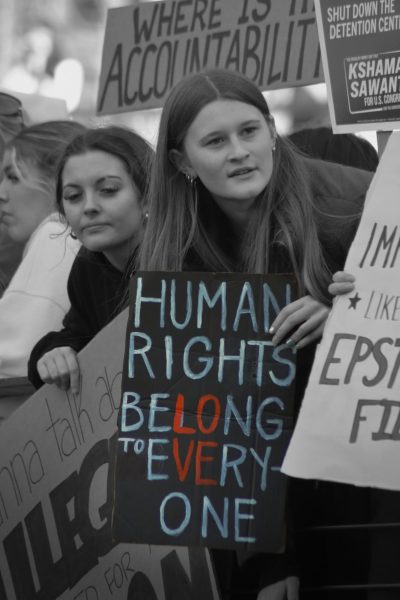
One senior from Rainier Beach, Socheta N. ’26, explained she was here because, “I was born to immigrant parents, and so I think this is a really good cause to spread awareness about what’s happening around the world. […] My parents came here to escape from oppression, from the Khmer Rouge, […] just to come to America and feel the same thing.”
She added, “I don’t think I’ve heard more than five teachers open their mouth about what’s happening, but I think everybody just needs to wake up and open their f*cking mouth, because too many people are being quiet, and that’s the problem.”
Sophomore Mia D. ’28 from the Northwest School explained she was in attendance because of the importance of showing up. She remembered one day when her best friend — “basically my little sister” — called her. “She was, like, ‘ICE is in my neighborhood and I’m so scared my dad’s going to get deported.’ And I remember just being on that call and just hearing the fear in her voice. And I don’t want her to have to feel like that,” she said.
Many Lakesiders were also at the protest, including Ada B. ’27. Ada said “the reason that I came to the protest is because I don’t think these days should feel normal to anyone. I don’t think anyone should sit in class and feel like it’s a normal day when there are children who are being incarcerated and families who are being taken out of their homes. So I want everyone here to feel like it’s not a normal day, and I want everyone at school who’s missing tens of classmates in all of their classes to wonder why that’s happening and feel like it’s not a normal day.”
Attendance wasn’t limited to high schoolers, either. Eighth grader Xavier RS. ’30 from Mercer International Middle School also walked out. “I think our school systems could definitely do a better job of educating especially middle schoolers,” he said. “We’ve gone into several shelter-in-places and lockdowns [because of ICE], and I think too many people are asking questions and not all of them are getting answered.”
Students weren’t the only ones present at the protest.
Seattle Mayor Katie Wilson made a brief appearance. A Tatler member who protested at the rally spoke to Wilson, who said, “This is really, really inspiring and it’s just a testament to the skills and passion of so many young people that such a crowd from throughout Seattle is gathered here today.
“As the mayor who’s trying to make sure that in Seattle we’re doing everything we can to protect our immigrant communities, this really helps to drive that work, knowing that this is what young people in our city want to see and that we’re united in wanting to protect our communities against ICE,” she said.
Wilson also mentioned that her favorite sign from the protest was Lakeside junior Ada’s sign, which said “Hot people melt ICE.”
In an interview with Tatler, Seattle City Councilmember Eddie Lin of District 2 said he was “generally aware” of a protest scheduled but was “super impressed” by the size. He mentioned that he felt “so inspired by the student activism. This is an incredible showing and it’s just really heartening to see students’ voices, to see people speaking up for their neighbors, standing up for our immigrant communities, and pushing back against the fascism, the authoritarianism. But most importantly, just seeing students involved and feeling empowered and speaking up. […] Couldn’t be anything more important right now.” Lin added that he is in support of abolishing ICE.
Several Lakeside teachers were also present. English teacher Rachel Maiorano explained, “I’m here because this is more important than what I do in the classroom. The reason we teach kids is so that they can act on what they learn, and they’re doing that here today.” She later said to a Tatler reporter, about the large showing of students, “this makes me feel like I can retire happy.” Ms. Maiorano said she had to head out of the protest around 30 minutes early to attend her final class at B5.
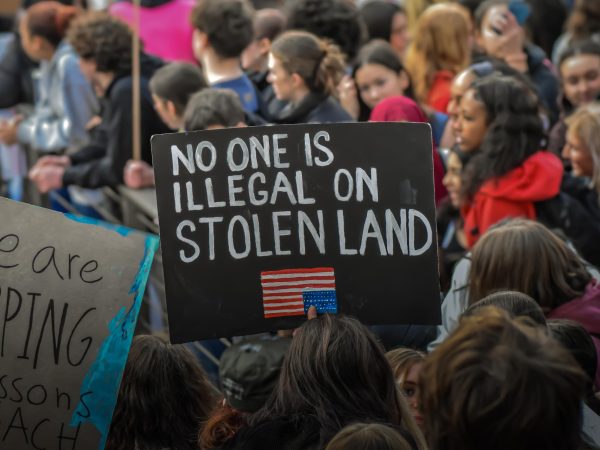
Abbey Sandusky, a sexual violence prevention and human development teacher who had supported the six Lakeside organizers in their planning, attended. Math teacher Lauren Wooley, who last week had worked with Abbey to distribute pink slips to students during lunch detailing their constitutional rights, was also at the protest.
Overall, around 9 Lakeside teachers attended the protest. According to Abbey, teachers who attended were told by administration that leaving school would constitute the usage of a “personal day,” which the administration has made clear teachers are allowed to use for protests.
At about 12:35 p.m., protestors flooded 4th Ave between James St. and Cherry St. after previously being confined to City Hall’s premises and the sidewalk across the street. Four minutes later, protestors poured across the intersection of 4th Ave. & James St., heading south along 4th Ave., despite organizers making calls to not march. Organizers urged students not to march, with one saying that students could be arrested if they marched in the streets.
The organizers emphasized that students did not have a permit to march. Marches that block traffic in Seattle require a permit 90 days in advance, according to the City of Seattle. “[We] didn’t have that time because this is such a relevant issue,” Koreb ’26, an organizer, explained. Rani ’26, also an organizer, added that “people walking in the streets were doing that of their own volition.”
Nevertheless, protestors strode through the middle of 4th Ave, stranding cars in a sea of signs, heading towards City Hall Park. Then, they took a right and marched north along 3rd Ave. Some were calling to march to the waterfront.
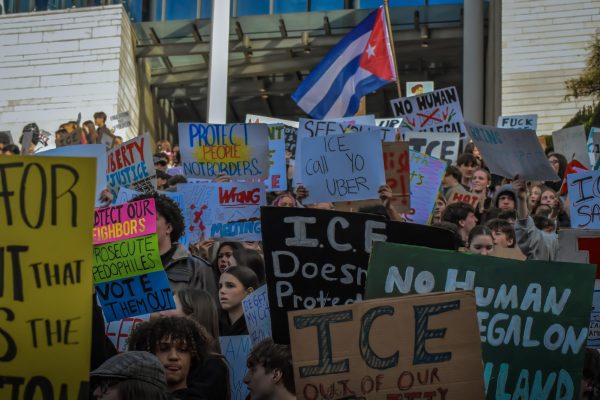
Soon, some of the protest organizers had begun calling for students to start heading back to city hall. “F*ck ICE! But go back to City Hall,” one announced over a megaphone. Although students had begun turning around, others were left confused. By Union Street, though, most of the students had started to head back.
As the time neared 2:00 p.m. and the protest neared its end, chants became less sustained, and students began giving speeches.
Khamille C. ’26 from Franklin High School, was one of those speakers. She was dressed in a Black Panther Party hoodie, and explained after her speech “I think that our government is hiding behind the Trump administration, and they’re using a white supremacist way to violently and injusticely arrest immigrants and not just immigrants themselves, but citizens as well, racially profiling us.”
The protest officially concluded at 2:00pm when organizer Amara A. ’26 gave the closing remarks, and thanked the crowd for attending. In just a few minutes, the terraces and staircases were almost back to their state just three hours ago, apart from the occasional Starbucks wrapper or can of chips .
Towards the end of the protest, Koreb reflected on the turnout as “genuinely insane.” Rani remembers walking from the light rail station to City Hall, and being pleasantly surprised by the amount of students who showed up. “I just had a smile on my face the entire time,” she said.
Anna ’26, another organizer, remembered feeling nervous about attendance at the beginning, “but seeing all of these people has really made me feel like it restored my faith in happiness and community. […] It feels like I can finally stand up for a community that I identify with.”
Rani also added that she was pleasantly surprised with Lakeside’s turnout. Koreb elaborated, noting “there’s obviously a big void at Lakeside in how we address current events […] you have to kind of push against the nonchalance, or maybe the apathy that exists within the community, […] and challenge your peers to understand why they might not want to do things like this.”
“I think that the reason why I wanted to help with this is because you can’t really wait for things to happen,” she said.
On school responses
Several Lakeside students at the protests also shared their opinions on Lakeside’s response to ICE’s actions. Isabel S. ’28 who sent an email to administrators Tuesday night mentioned she was frustrated at Lakeside’s administration for “the lack of support and labeling of our current situation.”
With regards to the administration’s response, Harper C. ’28 said ,“There’s been a good baseline addressing like the walkout and stuff. I think I could do with a little bit more, but I’ve also really appreciated the history department’s current events staff.”
Emmy T. ’26 said, “It’s not perfect and it doesn’t have to be, but I think, we’re starting, right, and that’s all that matters.” She also explained that “Lakeside is really good at encouraging students to initiate things like this and protests […] even though it seems like a small step into making impact, if we’re all here in solidarity and all using our voices, then I think we could really make an impact, even if it’s just a small one.”
But as at Lakeside, some students are still frustrated with the school and community response. Tatum H. ’27 felt that “Roosevelt is doing a very bad job of handling this. All the students that have to organize, we kind of feel like we’re doing some kind of underground thing because we’re not being supported at all.”
She said, “I want to know what my school’s going to do for people who are feeling in danger. Because I feel like there’s not a lot of resources that are being given, […] And not a lot of people showed up, and I feel like that says a lot about our school and about our faculty.”
Behind the organizing and plans moving forward
With their first protests under their belt, the six Lakeside seniors hope to use their platform to continue “amplifying student voices and supporting those who are taking the initiative to make a positive difference,” organizer Demri ’26 wrote. For the former, helping publicize walkouts from smaller organizations and, for the latter, providing resources in walkout planning.
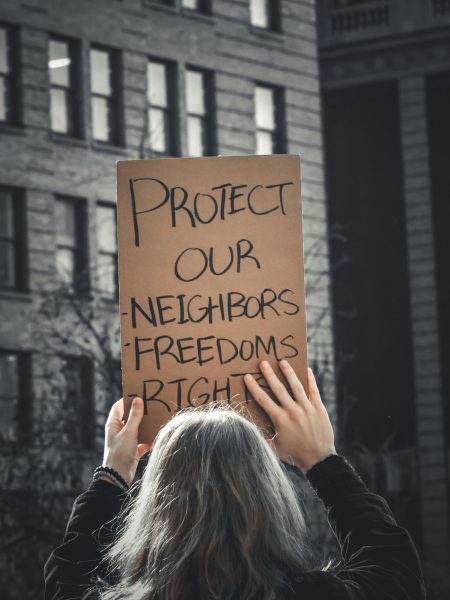
In the early stages of planning, Amara recalled an “internal moment of panic” a few hours after making the organizers’ group chat. At around 700 followers on their Instagram, she realized “people were actually interested. And then I was like, ‘Oh, my God, I can’t be the face of this.’” To make things worse, when she arrived home to share the exciting news to her mom, who has experience in protest organizing, she was hit with the legal ramifications. First, a “super intense” permitting process, which entailed waste management and insurance, among other requirements.
Additionally, organizing a protest was no easy feat. The team split up their jobs. For example, Koreb worked on transportation plans; Rani talked to an immigration lawyer; Amara contacted city officials. Anna also assisted with organizing the protest. Demri remembers staying up until 4 a.m. that Friday evening researching protest safety. She contacted many childhood friends to promote the protest.
“I’m a pretty introverted person usually, and for me […] I was messaging people from just everyone I knew. Some of these people I hadn’t talked to since middle school.”
Kameirah ’26, the sixth Lakeside organizer, was on outreach duty, utilizing her connections across schools to find student speakers and students willing to promote the event. Two days before the protest, Kameirah also took about 50 posters and hung them around Seattle Prep, Bush, and Roosevelt.
From learning to write a press statement to organizing student speakers to running the social media, Demri summed up the experience for the group, writing, “Organizing this was a huge learning experience for all of us, and we’d like to share that with others who are in a similar space.”
Other future plans include community events such as “picnics, arts & crafts days, partnering with local youth organizations, and other activities to nurture connections between kids,” she adds.
So far, there hasn’t been any major legislative action in response, but Demri stated she was glad the protest caught the attention of councilmembers and Katie Wilson, who she hopes will “listen to our voices and further work to protect Seattle against ICE attacks and occupation and urge the Washington governor and other state legislators to do the same.”
Demri added, “Besides its political impact, the walkout brought the city together.”
“We’ve received so much positivity from both adults and kids regarding the walkout, and I hope it inspires others to keep fighting for our immigrant neighbors and for the protection of human rights.”
Additional reporting contributed by Elina L. ’29 and Zavier F. ’27.