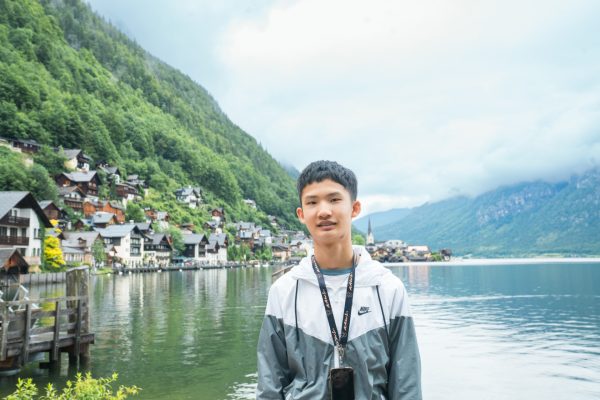
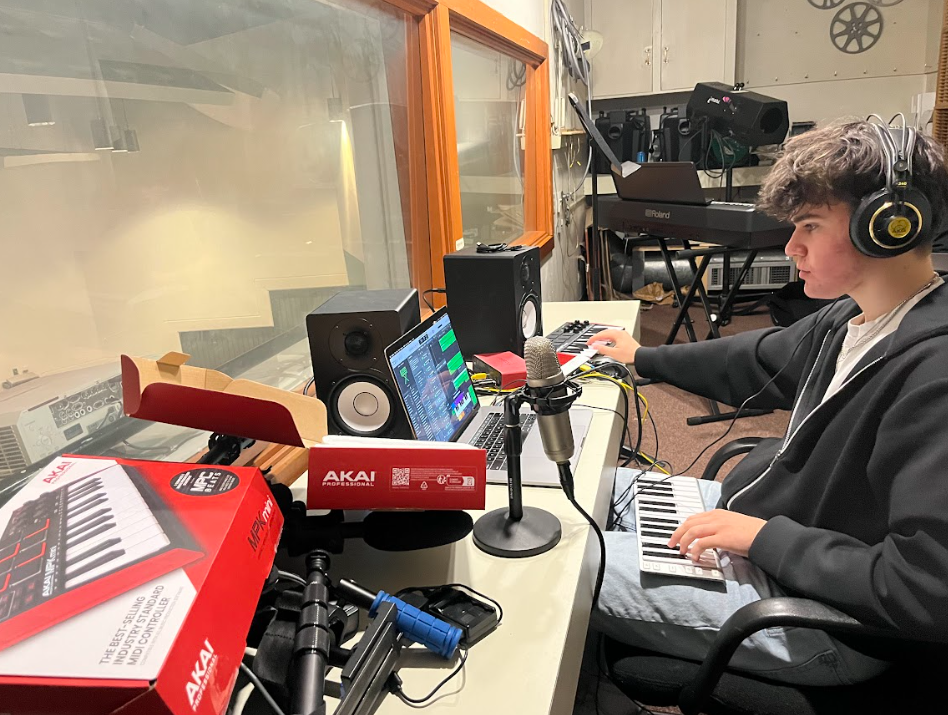
After having an idea for an orchestral arrangement of a tune he came up with while sitting in orchestra class in 6th grade, violinist and producer Sebastian B. ’28 started researching ways to bring the ideas in his mind to fruition. He started off using a music notation software called Noteflight, an online platform that allowed him compose music scores for various instruments. Sebastian’s new passion for music-making caught the attention of his father, who offered to install Logic Pro, a Digital Audio Workspace (DAW), on Sebastian’s computer — and, of course, he said yes. The rest is history.
To learn more about Sebastian as a musician, Tatler asked about his experiences, process, goals, and advice for other aspiring producers.
This interview has been edited for clarity and concision.
Q: Do you remember the first beat you ever made? What was it like?
A: Yeah, it was really bad. It was a hip hop beat, but I generated the drums with an AI, and I remember at the time I thought it was really good, but looking back now, it was pretty bad.
Q: How would you describe your sound in 3 words?
A: Diverse, sample-based, modern.
Q: What’s your starting point when making a beat — drums, melody, sample, or something else?
A: That often depends. A lot of times my dad plays me a lot of music that I’ve never listened to because he used to be a professional musician. I might hear it and be like, “Ooh, I want to sample that,” and then build based on that. Or some other times, I start with the drums, and then I try adding the melody and the baseline and the chords and all that on top. I’d say overall, the thing I do the most is I start with a sample and then I build the song. I try sampling it first, making something new, and then I add drums, and then other elements of the song.
Q: How long does it usually take you to finish a beat?
A: That depends on how complex I want it to be, but I’d say 30 minutes to two hours. You can always add more and take away stuff. For me, a song wouldn’t be totally complete until I have an established intro, a chorus, a verse, and then another chorus and then a bridge, because I’m making these for people to rap on, so I want to have an established songwriting structure laid out.
Q: What’s your favorite part of producing?
A: For me, it’s the satisfaction of having an idea in your head, and seeing that come to fruition. If you do a good job, then it’s like, “Wow, I had an idea in my head,” and there was nothing I could listen to that sounds exactly like what I had in my mind, and then you make the whole thing.
Q: What’s the hardest part of producing for you right now?
A: For me, it’s audio, because with beatmaking, it sounds different. Let’s say you’re listening to it with headphones on, right? That’s going to sound different than when you’re listening to it on a speaker, or a whole sound system. Audio engineering — you need to make sure that your bass isn’t overpowering everything else, or that your drums have the right articulation. For me, that’s the hardest part right now, because you might have the right instruments, the right melody, the right chords, everything, but the whole dynamic of every individual part could be off.
Q: Do you ever get beat-block? What do you do when you’re stuck?
A: I actually get beat-block a lot. Sometimes I go weeks without making a new beat, and then sometimes I make 3 new beats every day. It’s interesting. I’m actually going through beat-block right now. But what I tend to do when I go through beat-block is I try and just make anything. Even if it’s really getting me back into the practice of beatmaking, that will help me persevere through it. Besides that, another thing I like to do when I’m going through beat-block is to just listen to lots of different kinds of music. A lot of times, listening to different kinds of music that you haven’t listened to in the past will open your eyes to new ideas. Oftentimes, if you’re listening to the same kind of music, you get stuck in a soundscape, and you can’t really try anything new.
Q: Do you use samples? If so, what makes a sample “good” to you?
A: Oftentimes, samples are not immediately obvious. You might hear something and be like, “oh, that’s nice, but I don’t think I want to sample it.” And then weeks later, you might hear it again and have an idea. With sampling, it’s very creatively random. There’s so many different ways to sample the same song or sound. One thing that makes a good sample is it’s not too complex. Usually, I like to sample things where there’s something missing. When there’s drums missing or something, I know the sample isn’t complete and I can do my own thing with a sample, because usually it’s easier to sample songs and sounds that aren’t completely full. It really comes down to what you’re looking for. If you want a soul sample or a chipmunk sample, then you’re looking for an old soul song or a Motown song. If you want to make something more futuristic, then you’re looking for a synth sample. It really comes down to what you want to make, and what kind of sound you want.
Q: Do you make your own melodies or prefer chopping samples?
A: I like doing both. I do a lot of ’90s East Coast hip-hop soul samples, but then I also do a lot of modern trap beats. In the modern trap beats, I mainly make my own melody with them, whereas with the ’90s East Coast hip-hop samples, I chop up the sample, add drums, add bass. Sometimes, I might add my own melody, but in the ’90s samples, often you should let them go on on their own.
Q: Does beatmaking have a larger impact on your life?
A: Yeah, it certainly does. It’s kind of similar to anything that anyone does that they love. If you do anything that you love, it will relieve stress, and for me, making music is one of the things I love, so not only does it relieve stress, but it also elevates my mood — it makes me happier. I feel like a better person when I make music, because I love it. It’s a big part of my life for sure.
Q: What’s the biggest thing you’ve learned about music so far?
A: I’ve learned a lot more about the music industry side of things. I always knew it was difficult to make it, but now I know just how difficult it is. There’re countless other producers that do the exact same thing as me. That’s kind of something one has to admit to oneself — the oversaturation of the industry. That’s something that I want to navigate past. I would like to develop my own kind of sound with my music; there’s so many producers that maybe technically are better than me, but they’ve been making the same kind of beats for years and years and years, and there’s no variation in it. I strive to make something unique.
Q: What kinds of emotions do you try to build into your beats?
A: I would say ethereality. A lot of times, if we’re looking at my more modern beats, it’s very synth heavy and fast paced. It gives a feeling of freedom. Some of my other music has a very melancholy undertone. That might just be because of the sounds that I use, or because many of my beats are in a minor key. My reggaeton beats — sometimes I sample salsa — those kinds of music are based on joyfulness and celebration, salsa especially.
Q: What would you tell a student who wants to start producing but feels intimidated?
A: Just start. There’s so many helpful communities online that, and even if you don’t feel good about the ideas that you make, every producer, every beatmaker, has been in the same situation that that student is in. I was there for a while, when I was on like Noteflight, for example, which was before I was on Logic. I had ideas, but I didn’t want to create beats or songs out of them, because I thought they were bad. My main piece of advice is just to start — it’s like when you dive in the deep end and rip the Band-Aid off.
Q: What do you think people misunderstand about producing?
A: That you need to have expensive gear, or innate musical talent. You don’t need that. You can make really good beats or songs using a very minimal amount of gear. Even if you just have a laptop and a DAW [digital audio workstation], you can make something great.