One chilly morning, just before the sun begins to peek over Capitol Hill, as the rest of Seattle slumbers in the late winter morning, five Lakesiders stand shivering, knowing they were about to run in possibly one of their most memorable experiences of their life. Some are shuddering in shorts and a T-shirt, and one is wearing chicken leg stockings.
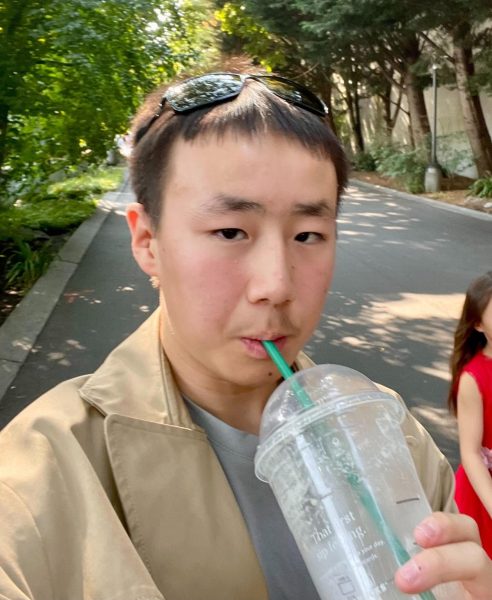
The story of the Seattle Marathon and Half Marathon from the eyes of Lakesiders is a story about uncertainty, friendship, and triumph in the face of challenge. The story begins with a 4:30 a.m. wakeup, a meal of pancakes and bananas, and a daunting nervousness. That’s what Kaiden P. ’26 gets for signing up for the full 26.2-mile race on a whim. A “completely different challenge” from the Seattle Half he’s ran the past two years, he notes, but one he decided he would take because it’s his final year at Lakeside and might miss out on “certain core memories.”
A nervous energy prevails within Elizabeth W. ’27 as she stands packed shoulder to shoulder with other runners at the starting line near MOPOP. Minutes before 7 a.m., when the race begins, the energy in the air is infectious.
But the story isn’t only about uncertainty. It’s also a story about friendship: even if Kaiden first felt a little intimidated in a plain Nike shirt besides runners decked out in singlets and collegiate wear with “multiple marathons under their belts,” he and these same runners in the 7:30 a.m. full marathon flight were introducing themselves and forming an impromptu community under the low Seattle sun.
Suddenly, tension snaps through the air as the speakers crackle a countdown from five. The crowd chants in unison, but by zero, people are still standing around, nothing happening.
“It’s a little anticlimactic,” describes Sophia C. ’26. The large crowds mean both races start in waves, so Sophia and her friend Sonia P. ’26, who are running together like they did last year for the 2024 half-marathon, just stand there while the waves ahead begin.
But runners do eventually cross the line. Kaiden strides into his first few miles feeling relaxed and confident. After an easy downhill for the first mile and an inclined second mile up to I-5 “I just kind of turned my brain off and just started running,” he remembers. With no phone and no earbuds, he just listened to the cheers of the crowds.
Once again, the story of the Seattle Half Marathon is a story of friendship. Sonia and Sophia ran together for the full 13.1 miles. Similarly, Elizabeth ran it with her best friend Katie, crossing off another element on their best-friend bucket list.
For the actual race, Elizabeth and her friend decided that their pacing plan would be “vibes,” targeting “somewhere in a two-hour-ish range.” Unsurprisingly, going off vibes “kind of screwed us over a little bit” when they ended up tagging along a group twenty minutes slower. On the bright side, the slower pace gave them a chance to talk for the first few miles.
Given that the whole race was quite lengthy, Sonia and Sophia also jogged and chatted, but about flag football and college. However, the conversation only lasted for about three miles.
Nevertheless, when they’re not connected by speech, they’re still connected by their music taste. While running, the duo is sharing an AirPod. Singular. Sonia recalls they dropped it several times during the race.
Halfway through her race, running beside the marigold shimmering water lit by a rising sun, was Jillian M. ’26’s favorite part. The interesting scenery made the time fly by, she adds. Bounding by Ballard, she dances the line between accomplishment from being halfway done, and utter exhaustion.
Halfway through his race, Kaiden has just hit the UW campus, having conquered the first 13 miles calmly, paced from his gut, shoulders down and relaxed. But this story is also a story of uncertainty, and right now, he was feeling anxious. Prior to the race, Kaiden had heard horror stories about hitting “the wall” halfway through the race.
In retrospect, Kaiden advises “don’t worry too much about what other people say. Obviously, you shouldn’t … do something that you’re not capable of, but you should trust yourself rather than trust others who don’t know what your capabilities are.”
But boosted by cheering from spectators and seeing his parents, in reality he was feeling confident. As this story is one of friendship, racing around a hairpin turn at the UW fountain, he was cheered on by crowds of spectators with motivational signs; he too cheered on his newfound friends and fellow runners coming from the opposite side — including Luke Li ’23, a Lakeside alum also racing the Seattle Marathon.
Elizabeth, as she nears the end, has stopped talking with Katie. After making up some time from starting behind, she’s starting to feel tired. But she knows she’s not alone. “I’m doing this for me and Katie. I’m doing this for me and Katie,” she chants in her head.
Then, 4 miles in, she sees her mom’s Conrad and Jeremiah signs — yes, giant cardboard cutouts of the two conflicting male love interests from hit Netflix show The Summer I Turned Pretty.
In fact, a spectacle for the runners are the myriad motivational signs on the sidelines made by families and friends of athletes. Sonia, in retrospect, describes the half-marathon in two words: “adrenaline,” and “satisfying.” The former due to all the huge crowds and constant support, both verbally and artistically. Yes, artistically. The course was full of creative signs made by spectators, ranging from Mario-themed power-ups to signs like “toenails are overrated.”
Sophia has also cleared her mind and shut her mouth. “After we stopped talking, I just wasn’t thinking.” Sonia finishes her sentence, “When you run, you don’t think about anything … you’re just trying to not think about the pain.” In retrospect, Sophia describes her half-marathon experience in two words: the wait, and the “realization.” The former, the “slow pace” they were running at. The latter, when her dad passed her (he had been training a lot recently due to recently acquiring a new Garmin) and she realized “wow, I should have trained for this.”
Jillian, meanwhile, is pulling herself along, motivated by the knowledge that slowing down means a disproportionally challenging effort to get back up to speed. “Before the race I was like ‘I’m not going to slow down. I’m not going to slow down’ … that almost-promise to myself that I’d made made me keep going.”
Up until now, things have been fine for Kaiden. But the story of the Seattle Marathon is a story of triumph in the face of challenge, and challenge is inevitable. The second half was a battle, Kaiden explains. “But it wasn’t a battle that you’d expect.”
Half-marathons differ from full marathons in the sense that half-marathons tax your lungs — “the break-even point where your lungs still [take] up the majority of the energy that you need,” Kaiden explains. That’s why Sonia remembers the elderly and children running the half-marathon, since as long as you really wanted to and had some basic training, you could run it. Full marathons, though, rob you of your legs.
“It was a different type of pain,” Kaiden recalls. “The sheer mileage, 26 miles, is a huge feat. That’s when you want to try to preserve your legs.” Instead of fighting for air, he was fighting for strength.
Then, the dreaded wall. Around mile 20, Kaiden is expecting something. Legs numb and burning, he tried pushing, but they weren’t moving as fast as he’d like them to. He states, “a lot of people say, in a marathon, the last six miles is when you actually start your race. I think that’s inherently true. Because the first 20 miles, you’re just trying to preserve yourself until that last kicking moment.”
21 miles in, he runs past a man with trembling legs walking up a hill. 22 miles in, he’s running along a wharf with no runners in near view. He starts talking to himself. “There’s only four more miles. You’ve already done five times this amount,” he reassures himself. Stopping at this point would lock up his legs and be the end of his race, he recalls.
Miles 24 and 25 are the hardest. “I think that’s the point when my legs started giving out almost,” he remembers. “It started feeling like everything was almost cramping.” His pace fell from his target of 6 minutes 40 seconds to 7:00. The enervation was a completely different feeling; “my legs just didn’t have any energy output,” he remembers. “The last 14 minutes probably felt like 30 or 40.” But the end is near.
Elizabeth, meanwhile, is nearing the end of the race too. She’s in the final mile, looping a small hill through the Olympic Sculpture Park right by Elliot Bay.
Though in a lot of pain, she shares a special moment in the sculpture park. Recalling her childhood where she grew up a few blocks away, she describes how the park was where she took her first steps. “It feels very full-circle in a way,” she reminisces.
—
The story of the Seattle Marathon and Half Marathon is a story of triumph in the face of challenge. The biggest challenges, the scariest walls, and the longest cruises have already been surmounted, and the distance left was only one of triumph. Eight hundred meters to the end, Kaiden tells the story of his highlight from the race.
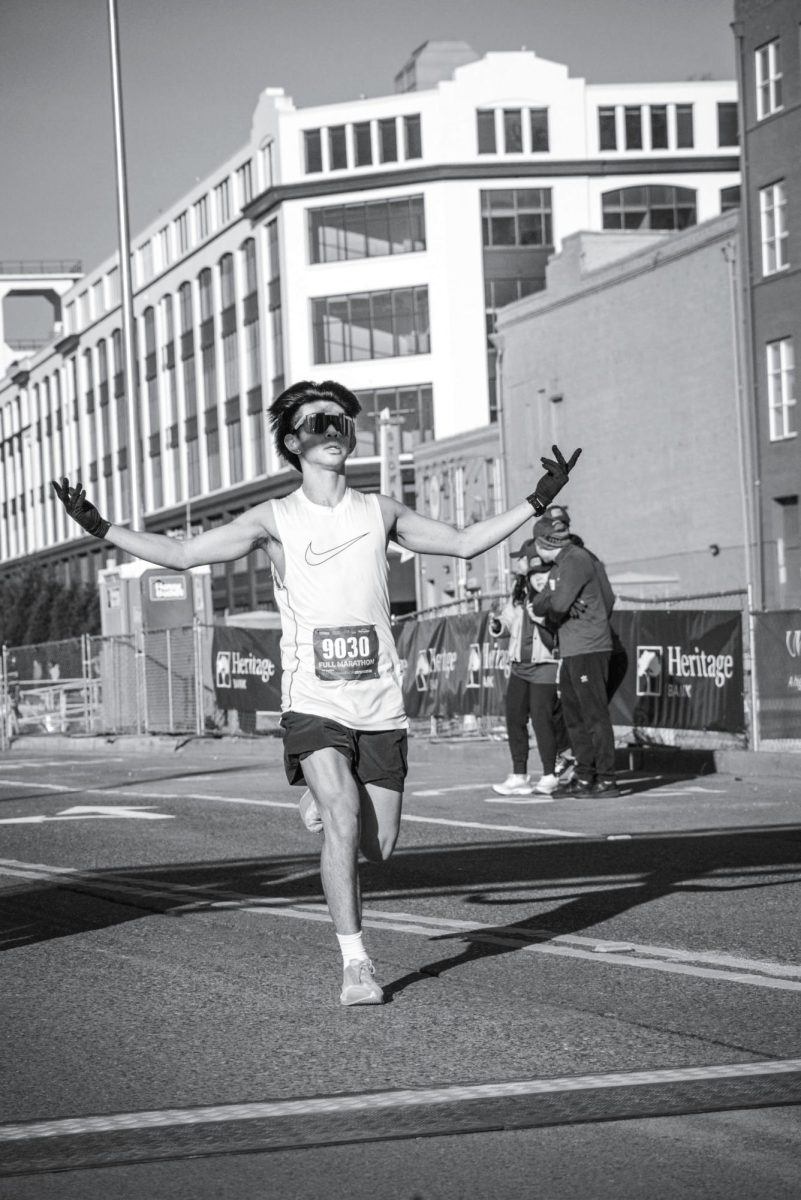
“I remember there was this one pacer I was running with at the end … He was telling me to go forward when he couldn’t because he was fighting some issues of his own with his body. So I took that to heart and just did it for him. So, the last 800 meters, I was just kicking it in. When I was getting closer, I saw the huge finish next to the pier. And I saw the sea of people, and I was like, ‘I can hold this for a couple more minutes.’ So I just kicked it in towards the finish.
“I think that was one of the coolest moments of my life. Crossing a cross-country finish line, it’s fun and everything because you’re done. But a marathon is a whole different thing. It’s a celebration of just how far you’ve come to get there. Everyone’s cheering. It’s completely surreal. It’s completely different. And I think that’s also why I want to do it again.”
Kaiden crossed the finish line with a time of 2:55:25 as the fastest runner under 18, and fourth in the Men’s 15-19 age category. “I was insanely surprised,” he describes. “I mean, 2:55 was crazy. I was not expecting anything like that.”
“Three years ago, I wouldn’t even be in the top thousand,” he explains. The results, if anything, were a reflection of his commitment, and the payoff felt rewarding. “I feel like I’m not the most naturally talented athlete in terms of cross-country. But seeing that just showed me that even if I’m working towards a goal, I can most definitely achieve it, even if I don’t believe that I’m built for it, necessarily.”
When asked about his competitors, Kaiden remarks “I didn’t have any competition. I was just looking to see people I was running with, not against.”
The story of the Seattle Marathon and Half Marathon is a story about friendship, and on that day the community could not have been stronger. Kaiden describes the running community as “amazing. There’s no competition or teams or people hating each other. It’s all people just trying to push themselves while pushing others forward.”
Elizabeth crosses the finish line too. “It’s so nice. I was so ready to be done at that point,” she remembers. “I saw my mom in the crowd, and that was just super special. She’s my No. 1 fan … she’s been to all my cross-country races. She drives out always to come up … and she’s just always there for me.”
For Elizabeth, Seattle’s always felt like a very disconnected city. On Nov. 30, though, the crowds of spectators there were supporting everybody no matter if they knew them; “it made a city that’s pretty big feel like a tight-knit community, which I thought was pretty special.”
“That’s one of the best things about the marathon,” says Kaiden. “It’s just a bunch of these random people coming together to cheer on random total strangers, which is nothing you see in everyday life. I feel like we need more of that.”
Jillian, Sonia, and Sophia also cross the finish line. Sophia notes that although she felt super sore, the effort was worth it. “I’m happy with it, but I feel like it just kind of makes me want to do it again,” she says. Sonia agrees, and adds that she wants to keep running half-marathons every winter “just to prove to myself that I can run 13 miles and I’m not getting worse.”
She also points out another fun benefit to running a half-marathon: all your non-running friends regaling you for running 13 miles.
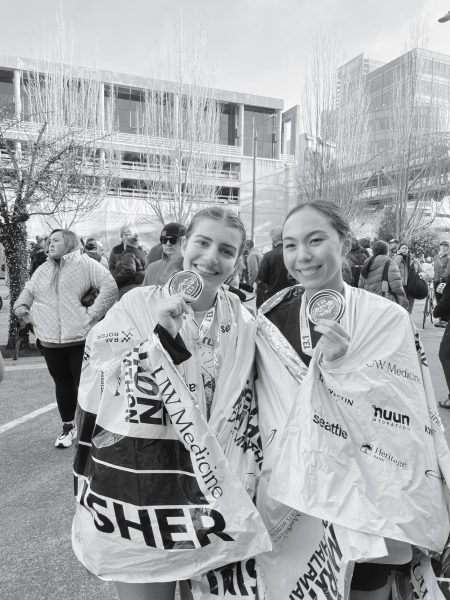
Right after the finish line, runners first receive a heat blanket, then a medal, and then have access to a snack buffet. Aside from the organization-provided instant noodles and energy bars, athletic brands offer free samples of drink powders, juices, and natural gummies. The blood orange juice, for example, was a post-race highlight for Sophia … although, she does note that she didn’t like the finish this year because of how tightly packed the Pier 66 ferry terminal was in comparison to last year’s much more open Memorial Stadium.
After the race, the runners split paths. Kaiden, whose legs locked up right after he finished, was feeling nauseous and “very much constrained to my room” for the rest of the day. He ate sushi, updated his strava, and took a huge nap. The aftermath was tolling though. Until Thursday, he waddled and hobbled around school with his legs that were “pretty much destroyed.”
Elizabeth went home and ate pad thai noodles. Due to her hip pain, she had to use her dad’s crutches to move around for the rest of the day. Jillian watched Wicked: For Good. The next day, she woke up with a fever. Sophia came to school the next day with three blisters on her foot.
After running the Seattle Marathon and walking away with the fastest 18 & under time, Kaiden plans to train for the Boston Marathon. But he’s glad the Seattle Marathon introduced him to the world of marathon running, something he hopes to continue in the future as a hobby.
“Training for something always keeps me going,” Kaiden explains. “Whenever I have a goal, I feel more motivated, and in turn, I just feel more satisfied at that.” Plus, long-distance running is a social thing for him — the reason why he joined cross country in freshman year.
His advice for all the non runners? First, do everything “within the realm of rationality.” Obviously, don’t go into a half-marathon without any training whatsoever. Second, find your why: “a reason to push through the practice days or when it’s hard. And you’ll understand why you did it at the end, no matter how bad it looks.”
For Kaiden, his reason was his promise to himself and his friends. “I can’t let others down, even if they’re not depending on it [.. If I’m going to say something, I’m going to do it. And I just had to follow through. And it definitely paid off because now it’s probably one of the best experiences I had in a long time.”