
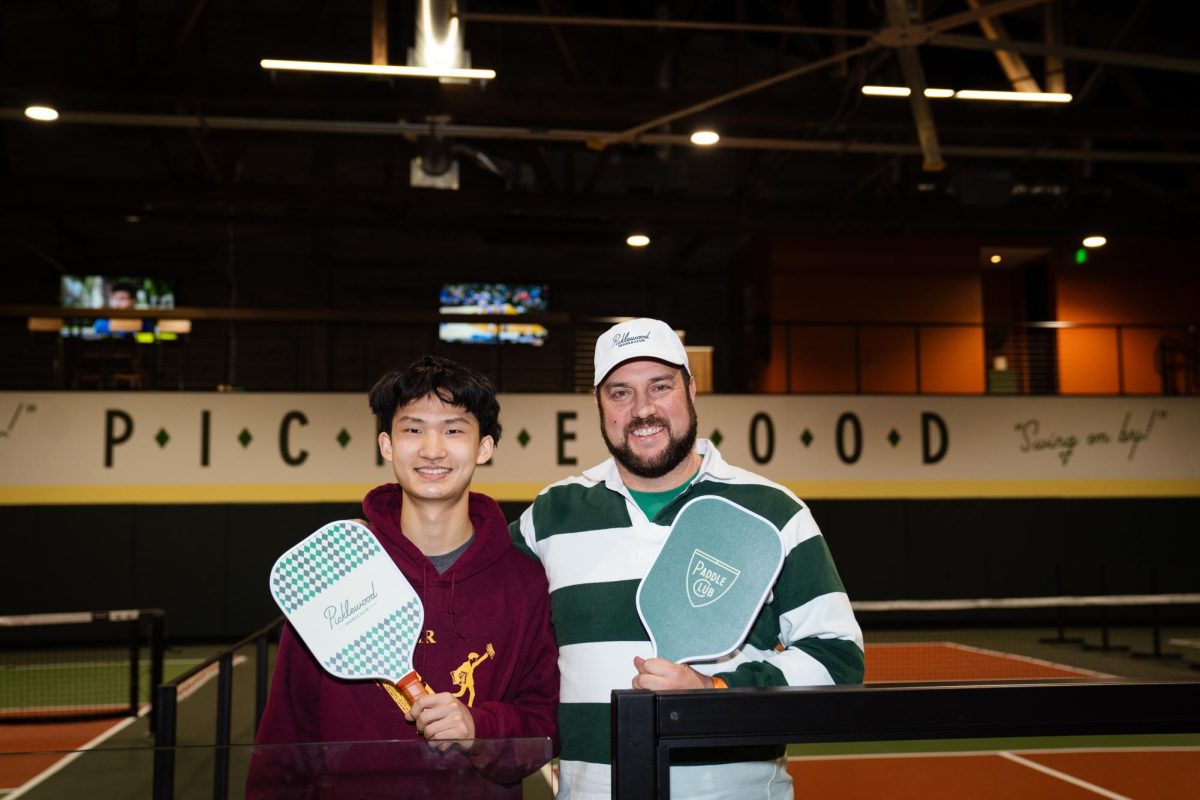
Pops of paddles and sounds of laughter echoed across a warmly lit warehouse as guests raced across courts to play some friendly games of pickleball. Just a few meters away separated by a glass enclosure, others feast on a warm meal of club sandwiches and wings. At Picklewood, dinner and pickleball aren’t two separate activities, they complement each other in a one-of-a-kind experience.
Opened in early November of 2025, Picklewood is a hybrid restaurant and pickleball facility, the brainchild of Lakeside alum Nathan Talbot ’02. The concept combines 7 indoor courts and 4 outdoor courts, all full sized, with a fine-dining-style restaurant and bar as well as a merchandise store. It’s aimed for people of all ages and skill levels, and it’s one of the first of its kind in the Seattle area, and reflects Talbot’s mission to build community post-Covid through pickleball and food.
Nathan Talbot, a tri-sport athlete and passionate photography student, attended Lakeside for four years of high school, before heading off to Emory University, where he received a B.A. in Spanish and English. Professionally, Talbot started off his career as an investment banker at Goldman Sachs, and several middle-market companies that were selling their businesses, before deciding to embark on a different career path, a decision he came to when he was working as a 40 year old with 3 kids at the Bank of Montreal and seeking ownership. “You can really create a lot of value when you own something,” Talbot explained. “Building your own company and owning it is a high-risk, high-reward proposition, so I wanted to be more entrepreneurial.” “I wanted to do something that I liked,” he said. “I loved playing pickleball, and I love eating good food, and [Picklewood] kind of combines those things.”
“Eatertainment,” Talbot explained, is the idea of combining sports with food and beverage. It’s not a new concept—popular eatertainment businesses today include Topgolf and Chicken and Pickle: offering golf with food & drinks, and pickleball with a chicken-driven menu, respectively. In fact, bowling, and most sports games, e.g. the Seahawks and Mariners, are a form of eatertainment, as there is often courtside catering, or stadium food available for purchase.
Hence, the Picklewood origin story begins here, with a gap in the market being recognized. “Top Golf is golf and food, Chicken and Pickle is pickleball and food, but it’s mostly in the Midwest… there’s been no high end food and beverage option with pickleball in the Seattle area,” Talbot explained.
He then partnered with renowned chef and successful restaurateur Ethan Stowell, who owns and operates several restaurants including “The Goldfinch Tavern,” and “How to Cook a Wolf,” to realize his dream of having top tier food and beverage combined with pickleball. “Of all businesses, the restaurant industry is probably one of the hardest businesses to be in,” Talbot stated. “I don’t pretend that I know a whole lot about it, so I wanted to partner with someone that knows the industry in and out.”
Of course, it’s hard to miss the distinctive name. Turns out, it was inspired by the movie Caddyshack—a comedy starring Bill Murray from 1980—and specifically the name of the country club where protagonist Danny Noonan works as a caddy to raise money for his college education: “Bushwood.”
“It’s meant to be a silly play on a vintage 1970s country club, but non-exclusive and open to all,” Talbot explained. He believes that a core aspect of Picklewood should be a high standard of customer service, something he realized pondering how he wanted to be treated at a club. The quality care is inspired by customer service from companies such as Disney, Ethan Stowell’s restaurants, and also Bellevue Club, an athletic and social club, who all offer excellent customer service.
In the process of building Picklewood, Talbot also explained that he exercised a lot of due diligence , including several trips to Phoenix, Arizona, home to dozens of pickleball facilities already operating, and attendance of three pickleball conferences in Chicago, Phoenix, and Fort Lauderdale, Florida. After talking to everyone in the pickleball industry—from facility managers, to manufacturers, and even specialists in pickleball insurance—Talbot settled on his business model, seeing that it was unproven and unique.
“Most of our competitors don’t have the entertainment concept as part of their business. It’s either just pickleball or the pickleball products,” he said. “We wanted to really combine [pickleball, with] the food and beverage to be eatertainment.”
The True Purpose of Picklewood
“It’s really all about creating community, especially after COVID,” Talbot explains, “to have a third space or a place where you can go and meet people and make friends and do things with family.” Pickleball is a very community driven sport by nature, because of the four player requirement, and pick-up games occur with players of various skill levels and ages, making the sport also very diverse. With more media exposure and marketing events, Picklewood seeks to create a vibrant hub for community and recreation.
Along with inclusivity and community, Picklewood also champions customer service, as well as great food. Speaking to the former, Talbot introduced a concept called KYC — know your customer. “It’s going the extra mile,” he said. “We really want to know who our customer is and create an experience that they’ll enjoy.” A “hardcore, advanced, professional pickleball player,” might not be one of their core customers, he notes; rather, he’s targeting anybody: they might just be a beginner, or a family who’s looking to have a good time and enjoy some good food.
On the latter, Talbot commends the work of chef Ethan Stowell, who curated a country club-inspired menu for the restaurant and courtside catering, and ensured the usage of fresh ingredients and low food costs for customers — instead of very expensive menu items, “we wanted it to be accessible,” Talbot recalled. At a glance, the menu seems to be priced somewhat reasonably, accounting for additional costs and their high commitment to their employees, with their chicken wings priced at $15, their deluxe cheeseburger at $21, and their caesar salad at $14.
Challenges and Future Growth
Every entrepreneur faces setbacks and obstacles, and it was no different for Talbot. The first obstacle was real estate — finding a home for Picklewood. At first, “commercial real estate professionals scoffed at the idea of pickleball as a use for a large 25,000-square-foot warehouse,” said Talbot, “so we had to be very persistent in talking to landlords.” Talbot noted that Stowell’s partnership aided in this process, as his reputation as an established chef bolstered the project’s legitimacy, and aided in achieving the business vision.
Fundraising was a major obstacle in the project, and Talbot explains that the process of raising money is one that takes a lot of persistence and disappointment. “You talk to hundreds of people; very few of those people will write a check for your entrepreneurial concept,” he said. In every encounter too, he adds, “you have to treat every investor like they’re the one that’s gonna write the big check.”
Picklewood is still in its early days of business — a soft opening period — but it’s undoubtedly on the come-up, and has experienced some early success and engagement from the community.
“Some of our customers are coming in posting TikToks that have gotten 30,000 views,” Talbot told me. Their opening event in early December sold out 300 ticketed spots in just two days. But success isn’t just measured in views or tickets, as Talbot explained; they measure success in the people’s enjoyment, which can be difficult to quantify, and also in pursuing what one enjoys doing the most.
“It’s really empowering and fun to follow a passion project, and we think that we’ve fully realized our vision of what this facility can be,” he said. On the topic of expansion and further growth, Talbot explained that they wouldn’t have started the project initially if they didn’t believe that Picklewood could be expanded to multiple facilities in multiple different markets. He plans to expand to the Eastside next — but for now, Talbot is focused on the task at hand. “We can’t expand unless we make this facility work,” he remarked.
Ties to Lakeside
When asked to reflect on his time at Lakeside, the first thing that Talbot thought of was his teachers and coaches, who influenced him significantly. He singled out the English department, whom he credits with providing him with a crucial skill set of writing and communication, which has served him well in the business world.
Having played three sports as a student — baseball, basketball, and football —Talbot also remembered his coaches as some of the most inspirational people to him during his time at the school. “For me,” he remarked, “a lot of my sports coaches were just as important as my teachers.”
Lastly, Talbot fondly remembers his time spent in the photography studio as one of the most important courses he took, and how the course allowed him to develop the artistic side of his mind, and exposed him to a different type of workflow that he would encounter later on in his professional career. For example, the assignments in photography would allow students two months to do the project, he recalled. “That’s how a lot of projects in work really are, you could spend as little or as much time as you want, trying to get the vision perfect.”
As the players and families started to trickle out of the warehouse and the lights slowly died down, I asked Talbot about his advice for the future generation of aspiring entrepreneurs. “Have fun in college,” he said. He told me that students shouldn’t spend college worrying about our career, but rather that we should focus on learning what we want, and taking advantage of the flexibility to learn about the world. “The career thing will figure itself out,” he acknowledged.
And on the topic of entrepreneurship, he smiled as he mentioned that “a misconception would be that you actually know what you’re doing.” But there might not be experts if you’re venturing and innovating into uncharted territory, as with running a pickleball facility business. He notes that Lakeside students are often trained to become doctors, lawyers, or tech workers, and that there is space to take a risk and become an entrepreneur, and create something valuable for the community. So, his final words to students? Take risks, and “just do it.”
“Even if people say it’s a crazy idea … sometimes you can’t listen to other people, and you must do what you think is right,” he said.
Jeffrey Murray | Feb 12, 2026 at 10:56 am
Jeffrey Murray here, almost class of 1972. I made the first 50 pickleball paddles for Joel Pritchard, my neighbor. Played with him and his kids on Bainbridge.
Nathan Talbot | Jan 21, 2026 at 3:21 am
Oliver, what well-written and comprehensive article. I wish you worked for the Seattle (or New York) Times. Thanks for spending time at Picklewood and thanks for your mother for giving you a ride on a school night and for the beautiful photography!