
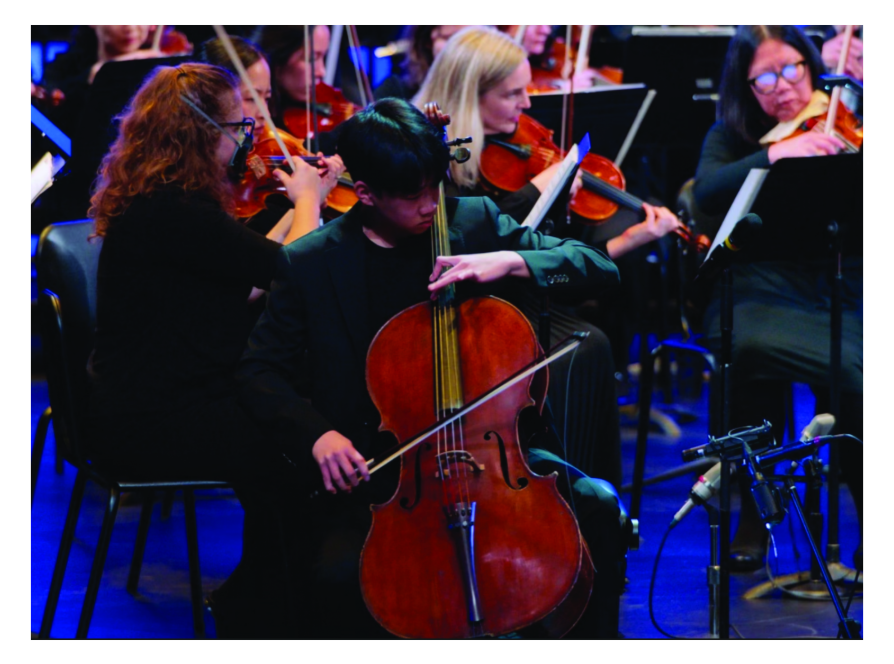
In 1981, the National Foundation for Advancement in the Arts was established in Miami, Florida. What emerged as the product of Lin and Ted Arison’s aspirations to support young artists has now blossomed into the nation’s premier youth art competition, accepting over 7,000 applicants each year across visual, literary, and performing arts. Among these applicants, a select cohort of incredibly accomplished winners — known as YoungArts Winners with Distinction — is chosen to attend National YoungArts Week in Miami, an intense week of workshops, public performances, and opportunities for further recognition and professional development. Winners connect with renowned artists, mentors, and YoungArts alumni, and are also considered for the prestigious title of U.S. Presidential Scholar in the Arts.
Joining the list of 2026 YoungArts Winners with Distinction is none other than Lakeside student Charlie L. ’26. A two-time YoungArts Winner in 2024 and 2025, participant in the Chamber Music Northwest Summer Festival, and student of the Perlman Music Program, Charlie is a remarkable cellist who has received both national and international recognition for his artistry and skill. In addition to leading the cello section of Lakeside’s orchestra, Charlie has been a longtime member of the Seattle Chamber Music Society, sweeping through radio performances and national chamber music competitions with his piano trio. Yet beyond his musical accolades, Charlie’s deep dedication to his craft and passion for classical music have inspired countless members of the Lakeside community, and we’re so excited to see Charlie continue growing his artistry and impact on YoungArts’s stage.
To learn more about the personal significance of this award, Tatler asked Charlie about his experiences, words of advice, and goals as a musician.
Q: What instrument(s) do you play? How long have you been playing?
A: I’ve been playing the cello (best instrument, no debate) for roughly 12-13 years.
Q: Are you a part of any musical ensembles (in school, outside of school, etc.)?
A: Things have been super busy lately, so I’m not in very many groups at the moment. If it counts, I’m part of the Lakeside orchestra, and I’m part of a smaller ensemble (string quartet) where we’re exploring the Arensky String Quartet No. 2!
Q: What is your favorite memory related to your instruments/classical music?
A: Last year, I went to a couple of competitions (Coltman and Fischoff) with a piano trio I had put together! It was a one-of-a-kind experience, and I had so much fun with my chambermates.
Q: What was the process preparing for YoungArts like for you, and what does this award mean to you?
A: The process that went into preparing for YoungArts required a lot of reflection. This was my third year applying for YoungArts (I was a winner, but not with distinction in the other 2 years), and, in all honesty, even after my third year of preparing for YoungArts, I’m still not sure what it is that they are looking for in their applicants. They weren’t just looking for technical perfection; they were looking for something “special,” and a lot of my time was spent thinking about how I could embed this into my music.
I’m overjoyed and absolutely honored to have received this award, but, in all honesty, there isn’t much past that. Instead, the journey of preparing for YoungArts and refining my music has undoubtedly been the most rewarding part of it all, and I suppose the award serves as an indication that I have grown as a musician.
Q: What role does music play in your life? (doesn’t have to be limited to classical music)
A: Music gives so much character to our lives. Just imagine there was no music in movies, there was no music in videos, and music wasn’t playing in any store or anywhere you went. At least in my opinion, music is so important in the well-being of our lives, but we don’t really think about it. For me, it does the same thing!
Q: What is a moment, experience, or word of advice that most deeply impacted your musical experience?
A: While at PMP [the Perlman Music Program], I vividly remember the first studio class I played in. For context, I was learning online from a teacher through Zoom, I had never been a part of a studio class, and it had been a while since I last performed as a soloist. Even in the weeks leading up to the studio class at PMP, I was so nervous. I would find any time to practice because I was surrounded by so many top musicians—cellists who won national competitions and were recognized for their music.
However, when it came time to actually play, it was just about the worst performance I had ever given. My fingers felt frozen solid; there were so many intonation mistakes and memory slips, and the quality of playing in general was really poor. I ended up crying from both embarrassment and frustration for the rest of the studio class. When it came time for comments, however, everyone kept telling me that, despite the mistakes, the performance and interpretation were touching. They didn’t skip over the mistakes, of course, and they gave feedback on how to address those things, but it felt like the things I had focused on were not so important to them.
I think this moment was so important for two reasons. First, I felt like I had a community that could really bring the best out of me. The other reason is that it expanded my perspective on the purpose of music. At a certain point, we, as musicians, need to shift our focus away from perfection and think more about how we can move others with our music. How can we create a more human sound? How can we get the audience to feel something? I feel like this experience really led me down a rabbit hole and a long line of questioning about my purpose as a musician.
Q: What do you hope to share with others through your music?
A: At face value, what I guess I’m sharing is my interpretation of the music. Because of our differences in life experience, background, etc., everyone comes to interpret the music a little differently since the music holds [a] different value. Likewise, I’m just sharing my take on a piece of music. However, I do this with the hope of moving others — to evoke some kind of emotion in the audience. What this emotion may be differs for everyone, since, once again, everyone has different experiences. Maybe my interpretation of a piece caused one person to reminisce about a loved one but reminded another person of their childhood. Regardless of what this memory or emotion may be, I think the sign of a successful musician is the ability to create music that moves. In reality, however, no one really knows what moves people — it’s a difficult question with a lot of possible answers––so I’m continuously searching for that and trying to embed that into my music.
Q: Is there anything you wish more people knew about you as a musician/artist or about music itself?
A: Given my answers to the previous questions, I really urge people to reconsider what music is capable of conveying and its purpose in our lives. It’s so wonderful, so we should take the time to appreciate it!
Q: Do you have any words of wisdom or advice for other musicians or members of the Lakeside community?
A: Try your best! If you try your best and you still don’t get the results you want, then you shouldn’t have any reason to be frustrated or stressed. The what-ifs and the worries all come from when you know you could have done more, but you chose not to.
Q: Do you see yourself pursuing your studies/a career in music? If so, in what way?
A: Absolutely! I want to become a musician (hopefully, a soloist), but what studying music is actually going to look like is still a bit unclear to me.
Q: What are your dream pieces of repertoire?
A: I have too many, and I’ve actually started keeping a list. I really want to play Dvořák Cello Concerto, Herbert Cello Concerto No. 2, Schumann fantasy pieces, Schumann Adagio and Allegro, Rachmaninoff Sonata, both the Brahms Sonatas, Brahms double concerto, Schubert Arpeggione, Shostakovich Sonata, Mendelssohn Sonata, more Beethoven Sonatas, and I want to finish the rest of Schumann Cello Concerto. I also want to play a lot of chamber music, like the Brahms piano trios, Smetana piano trio, and the list goes on.
Q: What are your current favorite composers/pieces of repertoire that you’ve played?
A: I love Schumann, Brahms, Dvořák, and Schubert!
Paul Mackay | Dec 27, 2025 at 12:00 pm
Go Charlie!!!