
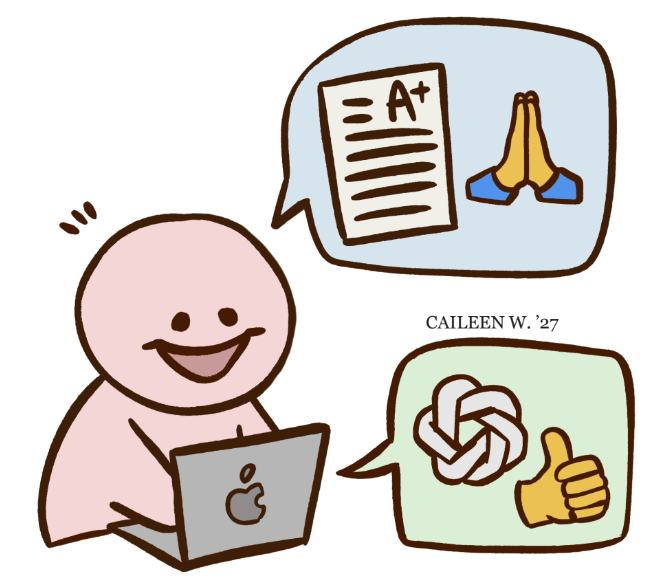
What defines Lakeside better than academic rigor? 100% of graduates attend college year after year, and the pressure to succeed couldn’t be higher. Maybe it’s our collective competitiveness, the talk of grade inflation, or the tuition families expect a return on that sets this school apart. But for many, with the rise of artificial intelligence and persistence of traditional methods of cheating, perfectionism comes at a price.
Of those polled, 42.2% of 46 students report having cheated at least once. This number is surprisingly high considering it only includes students who willingly, although anonymously, reported academic dishonesty on the Tatler December poll. Methods of cheating can be as simple as copying a friend’s answers on a homework assignment or more risky, like using AI to write an essay.
“One of the things that is really tricky about AI is that it is so easy to make a bad choice in a split second,” Upper School Assistant Director and Judicial Committee head Whitney Suttell explained. Making cheating even a little bit more difficult allows students to pause long enough to think through what they’re doing and what the other options are. For this reason, the school has applied several proactive methods to combat the instinct to cheat. “Prevention is the best possible solution,” Whitney said. She compared the problem to a game of Whac-A-Mole: once cheating happens, it is very difficult to catch every student.
Lakeside has implemented many tools to help prevent cheating. Some teachers have recently applied lock-down browsers during tests, preventing students from accessing other tabs. Other teachers aim to find essays written by computers through differences from the student’s normal writing style. Most teachers also use a browser extension to check document history that shows them how long a student spent writing, whether they made large copy-pastes, how much they revised, and other parts of their process which could indicate something out of the ordinary.
Ultimately, catching and punishing academic dishonesty is a difficult process that often fails. One student mentioned they knew several seniors who had admitted to cheating but still got accepted at prestigious schools. Whether one mistake could send a student down a path to suspension, taking a toll on their reputation and appearance, or several such mistakes could go unnoticed is largely luck. “I’ve never cheated on anything that I care about,” the student said, explaining that they only cheated on subjects that they didn’t want to continue after high school. For them, like many students at Lakeside, outside of a few areas of passion, other subjects can feel purely obligatory and the motivation to act honestly quickly loses strength.
With the frequency of academic dishonesty, another question arises. What does it even mean to cheat? For instance, only one out of 44 students thought that asking a friend how difficult a test was before taking it would be considered cheating. However, in the Lakeside handbook it mentions that any discussion whatsoever of a test between students who have taken it and others who haven’t is fundamentally not allowed. Still, JC members and Whitney agreed that everyone who cheats does it intentionally, and if an honest mistake were to happen, though rare, it would be treated differently from actual “cheating.”
Lakeside’s Judicial Committee is unique in its empathy toward students. The vast majority of students who are caught cheating admit it immediately, according to Whitney. She expanded that disciplinary responses have to strike a careful balance between supporting the student’s growth and holding them accountable for their actions. Whitney emphasized that this is an element which Lakeside handles extremely well. To better understand the functions of the JC, I spoke with Rani J. ’26 and Omji K. ’26, the committee’s senior members. The JC’s response to academic dishonesty is mostly uniform, with changes based on what support the student needs. However, the people who go to the JC aren’t always the people who cheat the most or do so in the most significant way. Rani emphasized that cheating doesn’t only impact the person who does it, but the broader community, especially those who did the work honestly. Often, it comes as a consequence of a culture that prioritizes grades over learning. Omji added that Lakeside’s culture doesn’t place enough focus on character — limiting students’ readiness for the world outside of academics. They both suggested solutions like giving students more choice to learn about areas of interest, technology-free discussions that force students to use only hand-written notes and become more familiar with the material, and the implementation of seminars for values like honesty and respect.
Ultimately, as AI improves, it doesn’t seem like instances of academic dishonesty are going away any time soon. However, we might still have time to implement changes that can stop the ongoing cheating trend. While some people might unknowingly break subtle or unenforced rules, full-fledged cheating happens willingly and on purpose. It’s not a secret that there are flaws in the system, and a committed student will always be able to find short-cuts. As a result, focusing on harsher regulations and more methods to prohibit cheating are minimally effective. If the administration wants to make real change, it starts with the everyday elements that make Lakeside’s culture so competitive: friends sharing grades, rumors about which classes or tests are especially hard, and the dogmatic obsession with well-known schools like Harvard and MIT. In the real world, the consequences for cheating are much worse than they are at Lakeside. Students need to find space to accept failure here, before things get serious. “This is not a problem that adults can fix,” says Whitney, “Ultimately, the solution lies with students.” Until there is a good reason to do things the hard way, even if it means worse performance and higher effort, someone will always find a way to break the system.